


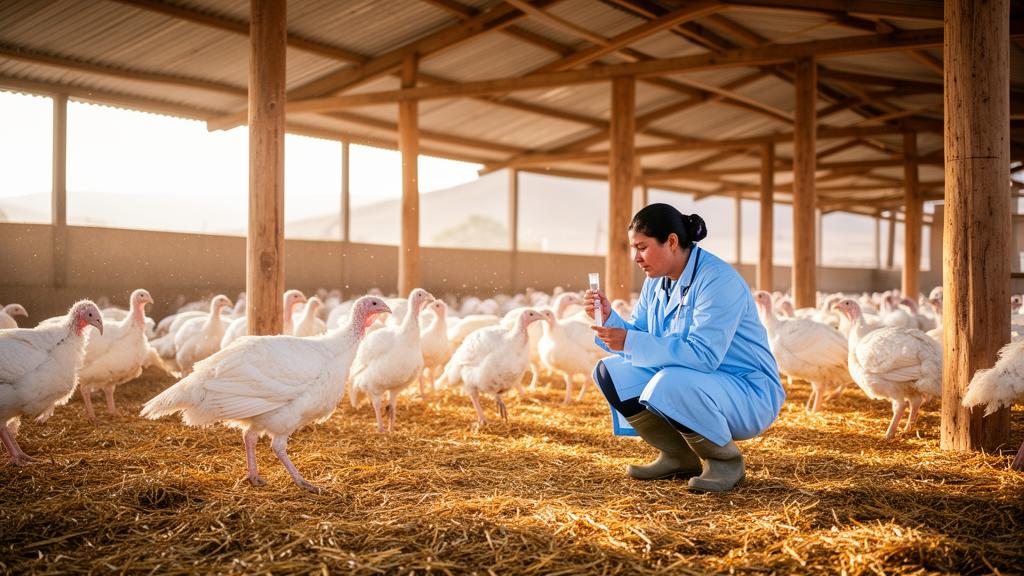
On a small turkey farm on the outskirts of Lima, Peru, researchers collected swabs from birds and samples from the litter beneath them and found something sobering: every single bacterium they recovered was resistant to multiple classes of antibiotics. A new study published in Frontiers in Veterinary Science reports that all 50 Enterobacterales isolates from turkeys and their production environment met the criteria for multidrug resistance, and a subset showed resistance to as many as 18 antimicrobials, including carbapenems, the last-line drugs reserved for the most severe human infections.
The research team, led by scientists at Universidad Peruana de Ciencias Aplicadas and Universidad Privada del Norte, focused on a semi-technified small-scale turkey production system housing 8,000 birds raised for meat under routine commercial practices. The farm, located in a mixed agricultural-livestock area where pigs, cattle, and other poultry were also raised, used azithromycin as a growth promoter. During a single cross-sectional visit in April 2026, the researchers collected 19 cloacal swabs from individual turkeys and six environmental litter samples from poultry houses, ultimately recovering 50 bacterial isolates: 38 from birds and 12 from the environment.
Most of the recovered bacteria were Escherichia coli, accounting for 39 of the 50 isolates, followed by Klebsiella species with 7 and Citrobacter species with 4. Using the Kirby-Bauer disk diffusion method on Mueller-Hinton agar, the team tested each isolate against a panel of 27 antimicrobials spanning clinically relevant classes, including cephalosporins, carbapenems, aminoglycosides, quinolones, tetracyclines, and macrolides. Resistance to aminoglycosides and tetracyclines was nearly universal, with every isolate resistant to kanamycin, 48 resistant to tetracycline, and 42 resistant to neomycin. The most frequently observed resistance profile combined kanamycin, tetracycline, neomycin, cefuroxime, and amoxicillin-clavulanic acid.
The resistance burden varied considerably across bacterial species. Among E. coli isolates, every one was resistant to tetracycline, nearly 90 percent to neomycin, and about 72 percent to cefuroxime. Klebsiella isolates showed complete resistance to cefuroxime and high resistance to tetracycline and amoxicillin-clavulanic acid. All Citrobacter isolates were resistant to amoxicillin-clavulanic acid and cephalothin. Notably, 24 percent of all isolates were resistant to 10 or more antimicrobials, including six E. coli, three Klebsiella, and three Citrobacter isolates. The broadest resistance profile belonged to an E. coli recovered from a cloacal swab, which was resistant to 18 antimicrobials spanning aminopenicillins, beta-lactam/beta-lactamase inhibitor combinations, and multiple cephalosporins.
Perhaps the most striking finding involved a Citrobacter species isolate recovered from an environmental litter sample, which showed resistance to 17 antimicrobials, including imipenem, a carbapenem. Carbapenems are not authorized for veterinary use under current international recommendations and are considered critically important for human medicine by the World Health Organization. The detection of phenotypic carbapenem resistance in a food-producing animal environment is noteworthy precisely because these drugs are not routinely used in veterinary medicine. The authors caution that the resistance observed here is strictly a phenotypic finding based on disk diffusion, and that confirmatory assays for carbapenemase production, such as molecular detection of carbapenemase genes, were not performed. They suggest that environmental contamination through wastewater and other anthropogenic sources, contaminated water, feed, or wild birds could represent plausible pathways for the introduction and circulation of carbapenem-resistant Enterobacterales in agricultural environments, though none of these can be established from the present findings.
To move beyond conventional surveillance approaches that focus on resistance to individual antimicrobials, the researchers applied multiple correspondence analysis, a dimensionality reduction technique suitable for categorical data, combined with k-means clustering. This multivariate approach revealed that resistance phenotypes were not randomly distributed but organized into distinct clusters with different resistance spectra. The first two dimensions of the MCA accounted for 45.3 percent of the total inertia, and three clusters were identified containing 22, 20, and 8 isolates respectively. Cluster 1 was characterized by high resistance to tetracyclines, aminoglycosides, and beta-lactams, with no resistance to macrolides, sulfonamides, quinolones, or carbapenems. Cluster 2 showed a similar profile but also included moderate resistance to quinolones and macrolides. Cluster 3 displayed the broadest resistance spectrum, with universal resistance to beta-lactams and aminoglycosides, accompanied by resistance to macrolides, tetracyclines, carbapenems, quinolones, sulfonamides, and phenicols. Notably, this was the only cluster in which carbapenem resistance was identified.
The three-cluster solution achieved an average silhouette width of 0.68 and was validated through bootstrap resampling with 100 iterations, achieving a higher average Jaccard similarity coefficient of 0.72 compared to 0.66 for a four-cluster alternative, which contained a highly unstable cluster with a Jaccard value of 0.32. Cluster 1 was dominated by a single resistance profile, indicating a high degree of internal homogeneity, while Clusters 2 and 3 each comprised seven distinct phenotypic profiles, with Cluster 3 showing greater dispersion and increased phenotypic heterogeneity. The authors suggest that antimicrobial resistance within the production system is composed of multiple phenotypic profiles rather than a single homogeneous multidrug-resistant population, and that the identification of these resistance structures highlights the value of exploratory multivariate approaches for understanding resistance patterns in animal production systems.
The researchers also explored phenotypic resistance combinations that may be indicative of distinct resistance mechanisms. Within the quinolone class, the most frequent combination was resistance to both nalidixic acid and ciprofloxacin, observed in 16 percent of isolates, a pattern that may suggest plasmid-mediated quinolone resistance determinants. Within the aminoglycoside class, the most prevalent phenotype was a combination of resistance to gentamicin, amikacin, tobramycin, kanamycin, and neomycin, present in 72 percent of isolates, with E. coli as the primary carrier. These profiles may be indicative of aminoglycoside-modifying enzymes, though molecular confirmation was not performed in the present study. None of the isolates exhibited a phenotypic ESBL-positive result using the double-disk synergy test.
From a One Health perspective, the identification of multidrug-resistant Enterobacterales in both cloacal and environmental samples is epidemiologically relevant, as resistant bacteria may circulate across animal, human, and environmental compartments. The findings align with growing recognition of small-scale poultry production systems as an overlooked driver of antimicrobial resistance emergence and spillover into the community. In Peru, where national turkey production reached 51.9 thousand tons in 2025 with an estimated per capita consumption of 1.45 kilograms, antimicrobial-resistant E. coli has been reported in poultry, together with mcr-1-harboring E. coli from chicken and pig farms in Lima. The present study contributes data from a comparatively understudied poultry production setting and supports the inclusion of diverse poultry systems in integrated antimicrobial resistance surveillance, consistent with Peru’s National Multisectoral Action Plan on Antimicrobial Resistance.
The authors acknowledge several limitations, including the non-probabilistic sampling strategy, the relatively small number of isolates, and the inclusion of a single production system, which limit the generalizability of the findings. Subgroup sizes were particularly small for Citrobacter species and environmental isolates, and the cross-sectional design did not allow assessment of temporal changes in resistance. Detailed information on antimicrobial use was unavailable beyond the reported use of azithromycin as a growth promoter. Bacterial identification relied on conventional phenotypic and biochemical methods, limiting species-level discrimination for some Enterobacterales. The authors emphasize that the clusters represent phenotypic resistance patterns that tend to co-occur, and that isolates assigned to the same cluster should not be assumed to share antimicrobial resistance genes or mobile genetic elements. Larger and longitudinal studies incorporating molecular characterization are needed to validate the observed resistance patterns and characterize the mechanisms underlying the carbapenem resistance detected in this study.
Subject of Research: Phenotypic antimicrobial resistance structure among Enterobacterales from turkeys and their farm environment in Lima, Peru
Article Title: Phenotypic antimicrobial resistance structure among Enterobacterales circulating at the turkey–environment interface in a small-scale poultry production system
Article References: Yauyo, A., Castro, A., Ayzanoa, B., Cardenas, M., & Salvatierra, G. (2026). Phenotypic antimicrobial resistance structure among Enterobacterales circulating at the turkey–environment interface in a small-scale poultry production system. Frontiers in Veterinary Science, 13, Article 1935777. https://doi.org/10.3389/fvets.2026.1935777
Image Credits: AI Generated
DOI: 10.3389/fvets.2026.1935777
Keywords: antimicrobial resistance, Enterobacterales, Escherichia coli, Klebsiella, Citrobacter, carbapenem resistance, multidrug resistance, One Health, poultry production, turkeys, multiple correspondence analysis, Peru
Cite Scienmag News
Kristina Jarvis. (October 17, 2026). Turkey Farms in Peru Harbor Bacteria Resistant to 18 Antibiotics, Study Finds. Scienmag. https://scienmag.com/turkey-farms-in-peru-harbor-bacteria-resistant-to-18-antibiotics-study-finds/
Kristina Jarvis. "Turkey Farms in Peru Harbor Bacteria Resistant to 18 Antibiotics, Study Finds." Scienmag, 17 October 2026, https://scienmag.com/turkey-farms-in-peru-harbor-bacteria-resistant-to-18-antibiotics-study-finds/. Accessed 17 October 2026.
Kristina Jarvis. "Turkey Farms in Peru Harbor Bacteria Resistant to 18 Antibiotics, Study Finds." Scienmag. October 17, 2026. https://scienmag.com/turkey-farms-in-peru-harbor-bacteria-resistant-to-18-antibiotics-study-finds/


