


When the Shanghai Cooperation Organisation convened in Astana in July 2024, regional commentary focused overwhelmingly on Xi Jinping, whose state visit accompanied the summit, while Vladimir Putin’s presence was treated as a secondary storyline. Editorial choices are not evidence in themselves, but they point to one of the most intriguing puzzles in contemporary Eurasian politics: why has a visible shift in the relative standing of China and Russia in Central Asia not translated into visible conflict? A new study published in Frontiers in Political Science argues that the answer lies not in the absence of rivalry, but in its form. The two powers, the research suggests, are locked in what the authors call a structured rivalry, a contest of incompatible long-term positional interests pursued through low-visibility mechanisms rather than open confrontation.
For more than two decades, analysts have asked whether China’s growing economic weight in the five post-Soviet Central Asian states, Kazakhstan, Uzbekistan, Kyrgyzstan, Tajikistan and Turkmenistan, would eventually collide with Russia’s claim to a privileged position in the region. The most careful answers have not predicted collision. Marcin Kaczmarski has shown that the surprising absence of rivalry rests on mutual accommodation: Russia’s adaptation to China’s economic pre-eminence, China’s self-restraint in the security sphere and its tacit acceptance of Russia’s status claims, and the co-existence of divergent visions of regionalism. Related work has described a functional division of labour in which Russia remains the principal security actor and China the principal economic partner. The period since Russia’s full-scale invasion of Ukraine in February 2022, however, has placed these explanations under new strain.
The war and the resulting sanctions regime have increased Moscow’s dependence on Chinese markets, technology and financial channels, while China has institutionalised a China–Central Asia summit format without Russian participation and accelerated connectivity projects that bypass Russian territory. At the same time, Russia has demonstrated that its security role remains consequential. In January 2022 it led a Collective Security Treaty Organization deployment of roughly 2,000 to 2,500 personnel, overwhelmingly Russian, that helped the Kazakhstani leadership restore control during the most serious domestic crisis in the country’s independent history, while China remained largely passive, offering rhetorical support but no material role. Any account of the post-2022 period must therefore explain both the deepening of asymmetry in China’s favour and the persistence of Russian centrality in key domains.
The research team, based at L.N. Gumilyov Eurasian National University and partner institutions in Kazakhstan, frames the question as a puzzle for Power Transition Theory. That theory holds that international systems are hierarchically organised, and that the most dangerous periods occur when a dissatisfied challenger approaches parity with the dominant power. Central Asia after 2022 appears to satisfy several of these conditions: China has overtaken Russia on most economic indicators in most of the region, while Russia, the incumbent, has shown clear dissatisfaction with its diminishing status. Yet no friction is visible in official diplomacy. To resolve this, the authors turn to Relational Power Analysis, which locates power not in aggregate capabilities but in patterns of network position, asymmetric dependency and institutional design, allowing the transition to be observed sector by sector and relationship by relationship.
Through this relational lens, the study advances a central claim: the transition under way in Central Asia is sectoral rather than systemic. China’s relational gains are concentrated in connectivity, trade, finance and new institution-building, while Russia retains central positions in regime security, labour migration, parts of the energy-transit network and the information space. There is no single regional hegemon, and the transition is not a hegemonic succession. The framework identifies three mechanisms through which power operates: network centrality, the ability to monitor, delay or deny flows that must pass through a given node; asymmetric dependency, unequal exit costs measured through sensitivity and vulnerability, as seen in remittance flows, debt and single-buyer energy relationships; and institutional design power, the capacity to create institutions and define the normative vocabulary of regional cooperation.
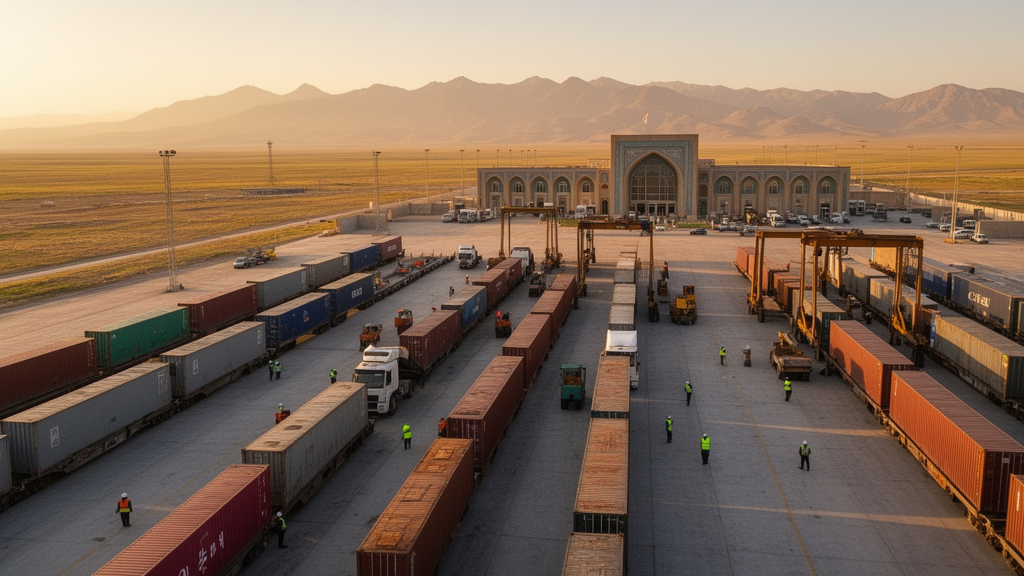
The comparative evidence is drawn from a structured, focused comparison of all five Central Asian states for 2022 to 2026, combined with congruence analysis that weighs the structured rivalry argument against power-transition, alignment and accommodation explanations. Kazakhstan emerges as the case that most clearly demonstrates the continuing weight of Russian assets. Beyond the January 2022 CSTO deployment, Russia retains network centrality in oil exports through the Caspian Pipeline Consortium, which carries the large majority of Kazakhstan’s crude to the Russian port of Novorossiysk. This capacity was demonstrated in July 2022, when a Russian court ordered a temporary suspension of CPC operations shortly after President Tokayev’s public refusal to recognise the self-proclaimed republics in eastern Ukraine. China’s gains, meanwhile, are concentrated in trade and transit: China became Kazakhstan’s largest trading partner in 2023, and Kazakhstan has invested heavily in the Trans-Caspian International Transport Route, which links China to Europe while bypassing Russia.
Kazakhstan’s government has actively allocated domains between the two powers. The most telling example is civil nuclear energy: in June 2025 Kazakhstan selected Rosatom to lead the consortium for its first nuclear power plant and designated China National Nuclear Corporation for the second, giving each power a stake in a strategic sector while preventing either from obtaining exclusivity. Uzbekistan provides the strongest evidence for China’s institutional design power. The China–Central Asia format, upgraded to summit level at Xi’an in May 2023 and equipped with a permanent secretariat, is China’s first region-specific multilateral mechanism in Central Asia without Russian participation, and at the second summit in Astana in June 2025 the six states signed a treaty on permanent good-neighbourliness. In Uzbekistan’s foreign trade, the shares of China and Russia were almost equal in 2024, at 18.9 and 17.6 percent respectively, a condition that Power Transition Theory associates with heightened friction, yet which has been reached without visible conflict.
The remaining cases reveal the mechanisms and their limits. Kyrgyzstan operates under dual vulnerability, to Russia through remittances that amounted to between roughly one-fifth and one-third of GDP, and to China through debt and imports, which limits its room for manoeuvre but also means neither power can exercise exclusive leverage. Tajikistan hosts Russia’s largest military installation abroad, the 201st military base, and its remittances have approached half of GDP, yet China has established a limited security-adjacent presence near the Afghan border, focused on border management and counter-terrorism rather than regime security guarantees. Turkmenistan identifies a boundary case: its quasi-monopsony gas dependency on China, which receives more than 30 billion cubic metres annually, is the most extreme in the region, but highly institutionalised neutrality and a closed domestic political system have insulated foreign policy from economic dependency, suggesting that domestic institutions mediate the conversion of relational power into political influence.
Why, then, has the transition not produced confrontation? The study identifies three interdependent conditions. The first is reversed dependency: Russia’s post-2022 reliance on China for market access, dual-use goods and financial intermediation raises the cost of confronting China in Central Asia, turning Russian adaptation from a strategic choice into a structural constraint. The second is Chinese restraint: Beijing continues to avoid responsibility for regime security and collective defence, confining its security presence to security-adjacent functions, which preserves the Russian status niche that accommodation requires. The third is regional agency: Central Asian governments allocate strategic projects across both powers, engage selectively with competing institutions, resolve security problems themselves, as in the March 2025 Kyrgyz–Tajik border treaty, and use neutrality to insulate foreign policy. Together, these conditions fragment the hierarchy in which a transition would otherwise take place, dispersing the contest across issue areas and preventing the emergence of a single zero-sum arena.
The resulting pattern, the authors argue, is structured rivalry: incompatible long-term positional interests expressed through competing infrastructure, parallel institutions and discursive repositioning rather than open diplomatic or military contestation. Visible friction is low everywhere, but it is not absent. It takes indirect forms: the CPC suspension order, Xi’s sovereignty statement in Astana, Tajik President Rahmon’s public demand that Russia show respect to the smaller states of the region, and the parallel summit formats of China–Central Asia versus Russia–Central Asia. The concept is deliberately distinguished from strategic partnership, which does not require incompatible regional interests, from strategic rivalry, which requires mutual threat perception, and from a shared regional order, which would require co-design of rules. The evidence shows few joint China–Russia projects in the region, and connectivity initiatives such as the Trans-Caspian route and the China–Kyrgyzstan–Uzbekistan railway are designed to bypass Russia entirely.
The findings carry implications beyond Central Asia. They refine the accommodation thesis for the post-2022 period, specifying that accommodation persists but its foundations have shifted from consent towards necessity. They also integrate the agency of regional states as an explanatory variable rather than a background assumption, identifying four distinct strategies: brokerage in Kazakhstan, selective institutional engagement in Uzbekistan, constrained hedging in Kyrgyzstan and Tajikistan, and insulated neutrality in Turkmenistan. These strategies do not stop the transition, but they shape its pace and form, explaining why China’s relational gains remain dispersed rather than consolidated and why friction takes indirect forms. For policy, the message is stark: stability in Central Asia depends less on the intentions of either great power than on the maintenance of the conditions that keep their rivalry structured. Erosion of any of these conditions, whether Chinese restraint in regime security, Russian constraints on escalation, or the ability of Central Asian states to preserve a diversified set of partners, would make open rivalry more likely.
Subject of Research: Between overlap and encroachment: power transition without confrontation and China–Russia structured rivalry in Central Asia
Article Title: Between overlap and encroachment: power transition without confrontation and China–Russia structured rivalry in Central Asia
Article References: Supyaldiyarov, I., Aliyeva, S., Kakenova, G., Ibragimova, G., & Supyaldiyarova, D. (2026). Between overlap and encroachment: power transition without confrontation and China–Russia structured rivalry in Central Asia. Frontiers in Political Science, 8, Article 1889886. https://doi.org/10.3389/fpos.2026.1889886
Image Credits: AI Generated
DOI: 10.3389/fpos.2026.1889886
Keywords: Between, overlap, encroachment, power, transition, without, confrontation, China, Russia, structured, rivalry, Central
Cite Scienmag News
Gavin Prescott. (October 17, 2026). China Gains, Russia Holds: Central Asia Power Shift Without Open Rivalry. Scienmag. https://scienmag.com/china-gains-russia-holds-central-asia-power-shift-without-open-rivalry/
Gavin Prescott. "China Gains, Russia Holds: Central Asia Power Shift Without Open Rivalry." Scienmag, 17 October 2026, https://scienmag.com/china-gains-russia-holds-central-asia-power-shift-without-open-rivalry/. Accessed 17 October 2026.
Gavin Prescott. "China Gains, Russia Holds: Central Asia Power Shift Without Open Rivalry." Scienmag. October 17, 2026. https://scienmag.com/china-gains-russia-holds-central-asia-power-shift-without-open-rivalry/


