


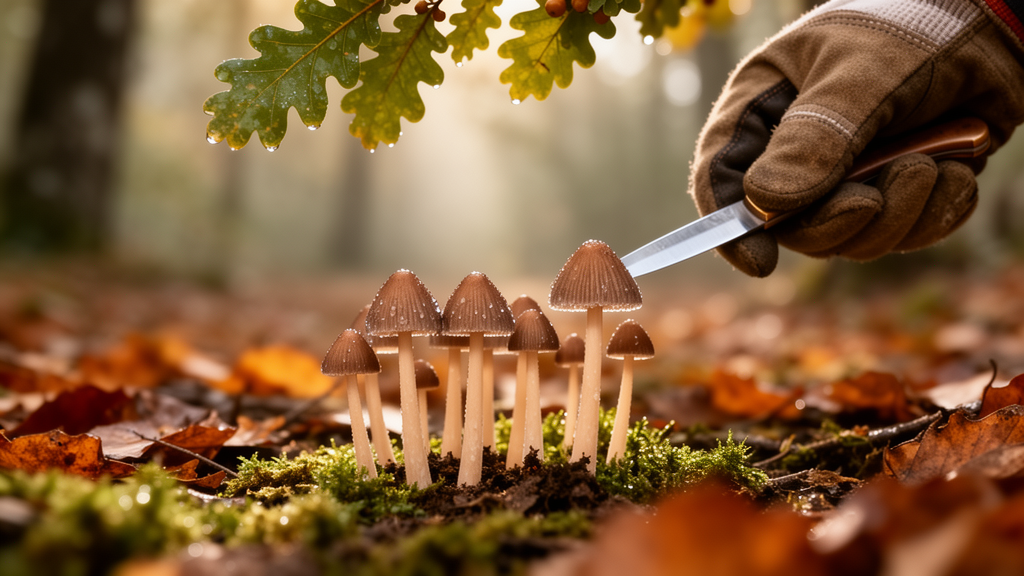
Italy has never taken a systematic look at its psychedelic mushrooms—until now. A new study published in Italian Botanist has compiled the first comprehensive account of the genus Psilocybe in the country, revealing that nine taxa currently grow on Italian soil, from the alpine conifer forests of Trentino-Alto Adige/Südtirol to the mountain woodlands of Calabria. The work, led by researchers affiliated with the University of Palermo and conducted within the Network for the Study of Mycological Diversity sponsored by the Italian Institute for Environmental Protection and Research (ISPRA), combines classical taxonomy, herbarium detective work, and modern DNA barcoding to bring order to a genus that has long been shrouded in confusion—and in chemistry that is now at the center of a global psychedelic renaissance.
The genus Psilocybe contains the famous hallucinogenic mushrooms that produce psilocybin, a naturally occurring tryptamine alkaloid chemically described as 4-phosphoryloxy-N,N-dimethyltryptamine. When eaten, psilocybin is rapidly dephosphorylated in the acidic environment of the stomach into psilocin, and any remaining psilocybin is converted in the gut, blood, and kidneys through alkaline phosphatase into psilocin, the active, lipophilic form responsible for the drug’s psychoactive effects. Humans have depicted these mushrooms since the Stone Age, in African and European rock art and in pre-Columbian sculptures throughout the Americas, and interest in their medical applications is now booming worldwide as clinical trials test psilocybin against depression and other conditions.
Taxonomically, the genus has undergone a dramatic overhaul. Originally described by Fries as a group within the Pratella series of his vast genus Agaricus, Psilocybe was elevated to generic rank by Kummer in 1871, but for decades it served as a dumping ground for small brown mushrooms of every description. Recent elucidation of the psilocybin biosynthetic gene cluster, together with molecular systematics and ecological studies, has overcome the traditional separation of species into psilocybin-active and psilocybin-inactive groups. Today, Psilocybe sensu strictu includes more than 150 species distributed worldwide, with the type species being Psilocybe semilanceata, the liberty cap familiar to foragers across Europe. The greatest species diversity lies in the neotropics: Mexico alone possesses 53 taxa, while Europe has recorded only 16 to date.
Because Italy lacked specific studies on the genus, the researchers turned first to the Checklist of Italian Fungi (Basidiomycetes), published in 2005, which had listed dozens of names under Psilocybe. Using Index Fungorum as of November 2025, they performed a sweeping nomenclatural update that drastically reduced the count. Ten taxa were transferred to Stropharia, nine to Hypholoma, seven to Deconica, two each to Protostropharia and Leratiomyces, and one to Bogbodia, while Psilocybe ericacea proved to be a nomen nudum, probably confused with P. semilanceata or P. cubensis. In the end, only seven scientific binomials from the old checklist were confirmed as genuine Psilocybe: P. aurantiaca, P. cyanescens, P. semilanceata, P. semistriata, P. subcoprophila, P. subviscida, and P. turficola.
Two more species were added thanks to fresh fieldwork in 2024. Psilocybe medullosa, previously reported in a conifer forest of northern Italy, was newly collected in the Paneveggio Pale di S. Martino Regional Park in the province of Trento, while Psilocybe serbica, a bluing European species, was gathered in the conifer forests of the Sila National Park in the province of Cosenza, Calabria. Both collections were made within the NDM network activities, wrapped in aluminum foil in the field, and transferred to the mycology laboratory of the Department of Agricultural, Food, and Forest Sciences at the University of Palermo for detailed examination. Dried specimens prepared in a universal dryer are now deposited in the herbarium SAF of the University of Palermo.
The morphological characterization relied on both macroscopic and microscopic features. For each taxon, the team analyzed the pileus, flesh, lamellae, and stipe, along with habit—solitary, grouped, clustered, or cespitose—and spore color, then examined microscopic characters such as spores, basidia, cystidia, and elements of the stipe surface, using analytical keys for the genus. Colors were standardized with the RAL matching system. The species share a recognizable profile: small fruiting bodies, often growing on fertilized soil, dung, or mosses; caps ranging from hemispherical to conical-bell-shaped, sometimes viscous; slender stems longer than the cap diameter; smooth basidiospores with an evident germinative pore; and spore deposits in shades of brown-purple or blackish purple. Several species instantly develop an intense blue color when scratched, a reaction historically used to define one of the genus’s two main lineages before molecular reclassification.
Microscopy reveals telling differences among the Italian taxa. P. aurantiaca bears bright red to orange caps of 3–5 centimeters and elliptical spores of 10–13.5 × 6–8.5 micrometers, with fusoid-ventricose pleurocystidia. P. cyanescens, the wavy cap, has caramel-colored, slimy cuticles and a strong mealy smell, with a distinct surface layer of ixocutis visible even at low magnifications. P. medullosa shows an orangish-brown conical cap of only 1–2 centimeters, a faint horseradish smell, and numerous lageniform cheilocystidia of 25–40 micrometers, while pleurocystidia are absent. P. semilanceata, the type species, displays its signature pronounced central protuberance and a 100–130 micrometer thick ixocutis immersed in a hyaline gel. P. serbica bruises blue when rubbed, has a radish-like but never farinaceous smell, and thick-walled ellipsoid spores of 10–13 × 6–7.5 micrometers. P. subcoprophila, found only on dung, has unusually large spores of 16–21 × 9.6–12 micrometers, and P. subviscida, growing on mosses, has tiny mitre-shaped spores of 6.5–7.5 × 4.0–4.5 micrometers.
The molecular analysis confirmed the morphological conclusions. DNA was extracted from dried samples with the Extract-N-Amp kit, purity and concentration measured on a NanoDrop spectrophotometer, and the internal transcribed spacer region of rDNA amplified by PCR with ITS1/ITS4 primers in a 20 microliter reaction volume. After purification and sequencing at BMR Genomics in Padova, sequences were compared with GenBank entries through BLASTn, aligned with ClustalW, and analyzed with the Maximum Likelihood method and the Tamura-Nei model in MEGA12, with branch confidence assessed by 1,000-replicate bootstrap tests. The resulting tree encompasses all psilocybin-active taxa growing in Italian territory and confirms that P. semilanceata is the representative type species within the genus. The analysis also resolved nomenclatural tangles: GenBank names such as P. fuscofulva, Leratiomyces ceres, and Deconica semistriata correspond to the binomials P. turficola, P. aurantiaca, and P. semistriata as reported in Index Fungorum.
Ecologically, the nine taxa fall into four categories: saprotrophs on dung, on mosses, terricolous saprotrophs, and saprotrophs on wood. Distribution remains patchy, shaped by limited exploration of certain territories and the small number of experienced mycologists working in Italy. Five species are currently restricted to a single administrative region—P. medullosa and P. semistriata in Trentino-Alto Adige/Südtirol, P. serbica in Calabria, P. subviscida in Emilia-Romagna, and P. turficola in Veneto—while P. subcoprophila is recorded for Emilia-Romagna and Trentino-Alto Adige/Südtirol, and P. semilanceata is distributed in central and northern regions. Only P. aurantiaca and P. cyanescens reach the islands of Sardegna and Sicilia. Most species prefer meadows and pastures rich in organic matter of mainly animal origin, though P. cyanescens grows on decaying woody material such as chips, bark, and mulch, and P. medullosa and P. subviscida grow on mosses. The authors also note that Mediterranean fungi often show smaller basidioma parts and microscopic features than their northern relatives, an adaptation to long drought periods.
The chemistry makes the survey more than an academic exercise. According to literature data, psilocybin content is high in P. cyanescens, at 2.5 percent by dry weight of psilocybin and 1.2 percent of psilocin, in P. semilanceata, at 0.33–1.57 percent psilocybin and 0.1–0.38 percent psilocin, and in P. serbica, at 0.15–1 percent psilocybin and 0.004–0.249 percent psilocin, while P. turficola contains only minimal levels. In Italy, cultivation and trade of hallucinogenic mushrooms remain illegal, and psilocybin is listed as a narcotic substance by the Italian Ministry of Health, even though it is not addictive and has low toxicity. Yet momentum is building: in 2025, the Italian Drug Agency AIFA authorized the first clinical trial in Italy, at a hospital in Chieti in Abruzzo, involving 68 patients suffering from depression. The authors hope that Italy will soon legalize psychedelic mushrooms in clinical therapies, following the examples of the United States, the United Kingdom, Switzerland, and Australia, and allow free scientific investigation into applications ranging from psychedelic-assisted psychotherapy and end-of-life care to neurodegenerative diseases such as ALS and chronic neurological conditions with limited treatment options. With Psilocybe mushrooms widespread in Italian forests, meadows, and pastures, the groundwork for that research is already growing underfoot.
Subject of Research: The genus Psilocybe in Italy
Article Title: The genus Psilocybe in Italy
Article References: Venturella, G., Rollini, M., Mirabile, G., Favia, N., & Gargano, M. L. (2025). The genus Psilocybe in Italy. Italian Botanist, 20, 167-181. https://doi.org/10.3897/italianbotanist.20.181001
Image Credits: AI Generated
DOI: 10.3897/italianbotanist.20.181001
Keywords: Psilocybe, mycology, taxonomy, psilocybin, Italy, fungi, molecular analysis, biodiversity, genus, scientific research
Cite Scienmag News
Roger Howard. (October 17, 2026). Italy Counts Its Psychedelic Mushrooms: Nine Psilocybe Species Revealed. Scienmag. https://scienmag.com/italy-counts-its-psychedelic-mushrooms-nine-psilocybe-species-revealed/
Roger Howard. "Italy Counts Its Psychedelic Mushrooms: Nine Psilocybe Species Revealed." Scienmag, 17 October 2026, https://scienmag.com/italy-counts-its-psychedelic-mushrooms-nine-psilocybe-species-revealed/. Accessed 17 October 2026.
Roger Howard. "Italy Counts Its Psychedelic Mushrooms: Nine Psilocybe Species Revealed." Scienmag. October 17, 2026. https://scienmag.com/italy-counts-its-psychedelic-mushrooms-nine-psilocybe-species-revealed/


