


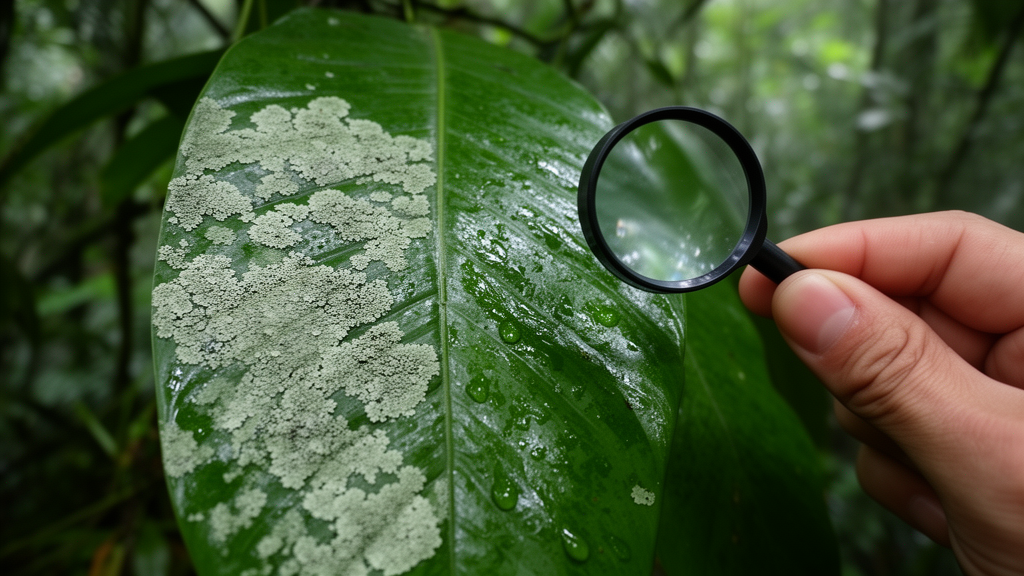
Deep in the humid understories of tropical China, an unassuming genus of leaf-dwelling lichens has been quietly hiding an extraordinary secret. A new study published in IMA Fungus has revealed sixteen species of the lichen-forming fungal genus Mazosia that are entirely new to science, uncovered through the first comprehensive DNA-based family tree of the group. The finding boosts the number of recognized lineages in the genus by roughly fifty percent and underscores how much biodiversity still evades detection even in organisms that live, quite literally, under our noses on the surfaces of rainforest leaves.
Mazosia belongs to the family Roccellaceae within the order Arthoniales and was first circumscribed by the Italian botanist Abramo Massalongo in 1854. Its species are among the most commonly encountered foliicolous lichens, meaning they grow on the surfaces of intact living leaves rather than on bark or rock. Across the lowland tropical forests of the world, Mazosia forms thin, crust-like thalli that paint leaf surfaces in shades of yellow-green and grey, often coexisting with several other species on a single leaf. Up to seven Mazosia species have been recorded sharing one leaf, and three to five species per leaf are not considered rare.
Until now, scientists had accepted only 23 foliicolous species in the genus, many presumed to have vast pantropical distributions. Identification relied almost entirely on visible traits: the texture of the thallus, the shape of the spore-producing structures called apothecia, and the number of divisions, or septa, in the ascospores. But such features can be deceptively similar across unrelated lineages, a phenomenon known as morphological convergence, and it appears to have masked an enormous amount of hidden diversity.
To pierce through that camouflage, an international team led by researchers including S.H. Jiang, Z.T. Yao, J.C. Wei and Robert Lücking examined 358 specimens collected from China and Brazil, preserved in herbaria in Beijing, Liaocheng, Berlin and Itabaiana. They generated DNA sequence data for three genetic markers: the nuclear ribosomal internal transcribed spacer region (ITS), the nuclear large subunit (nuLSU), and the mitochondrial small subunit (mtSSU). In total, the dataset included 115 newly generated ITS sequences, 148 nuLSU sequences and 177 mtSSU sequences, forming one of the most densely sampled phylogenetic datasets ever assembled for a foliicolous lichen genus.
The laboratory workflow combined classic lichenology with modern molecular systematics. DNA was extracted using a modified CTAB method and amplified by polymerase chain reaction, including two newly designed primers for the nuLSU region. The sequences were aligned with the software MAFFT, tested for combinability across markers, and then analyzed with both maximum likelihood methods using IQ-TREE and Bayesian inference using MrBayes. The best-fit model of sequence evolution for the combined 2,438-base-pair alignment was TIMe+I+G4, and the resulting tree was rooted with the related genus Dichosporidium as an outgroup.
The phylogeny revealed a startling picture. Instead of the roughly 15 foliicolous taxa that the traditional phenotype-based taxonomy would recognize among the sampled material, the molecular data distinguished 45 distinct foliicolous lineages, plus three corticolous, or bark-dwelling, ones, for a total of 48 lineages. That represents a threefold increase in the number of species implied by morphology alone, and in certain lineages the diversity rose by as much as 200 percent. Some well-defined species, such as M. tumidula, formed clean, coherent clades, but others turned out to be polyphyletic, meaning their members were scattered across unrelated branches of the tree, often separated by vast geographic distances.
Species complexes proved especially rich. Mazosia melanophthalma and M. tenuissima, both traditionally treated as widespread single species, each contained multiple geographically separated subclades correlated with subtle physical differences such as ascospore size or the presence of a gelatinous halo around the spores. On the basis of this combined molecular and phenotypic evidence, the team formally described sixteen new species, including Mazosia centrica, named for the concentric circles of wart-like verrucae on its thallus; M. gelatinospora, distinguished by ascospores wrapped in a gelatinous sheath never before observed in the genus; M. dimorphoverrucosa, with two differently colored types of verrucae; and M. straminea, which produces the lichen substance psoromic acid, a chemical rarity in the group.
Perhaps the most striking pattern emerged from Hainan Island, a tropical island separated from the Chinese mainland by the Qiongzhou Strait. The phylogeny revealed an extraordinary cryptic radiation of Mazosia on Hainan, suggesting the island functions as an independent evolutionary refugium where prolonged geographic isolation drove in-situ diversification distinct from continental relatives across Indochina and Malesia. Hainan’s year-round moist microclimate, stable temperatures and abundant evergreen leaf substrates create ideal conditions for fine-scale ecological differentiation among sympatric lineages, through differences in photobiont choice, spore morphology and thallus texture. Most of the new species partner with the green algal photobiont Phycopeltis, whose rectangular cells form radiate plates within the lichen thallus.
The discovery echoes similar findings in other foliicolous lichens. The genus Strigula, for example, has recently been shown to harbor even higher levels of hidden diversity, with the supposedly pantropical species S. smaragdula encompassing numerous unrelated species within a single region of subtropical Asia. Together, these studies suggest that tropical leaf surfaces may represent one of the least explored evolutionary frontiers in fungal biology, where tiny, morphologically cryptic organisms diversify in isolation across forest fragments and island archipelagos.
To help future researchers navigate this expanded diversity, the authors compiled a new worldwide identification key to all known species of Mazosia, addressing the taxonomic ambiguity caused by rampant morphological convergence. The team predicts that further surveys of the lesser-explored montane rainforest fragments of Hainan will uncover additional unrecognized lineages, and they emphasize the urgent need to conserve the island’s intact understory habitats, where the delicate leaf substrates these lichens depend on remain intact. For a genus that has been studied since 1854, Mazosia has just demonstrated that the smallest inhabitants of the rainforest canopy may hold some of its biggest surprises.
Subject of Research: Hidden species diversity and multilocus phylogenetics of the foliicolous lichen genus Mazosia in tropical China
Article Title: Sixteen new species of Mazosia ( Ascomycota , Roccellaceae ) from China revealed by molecular and morphological evidence
Article References: Jiang, S.-H., Yao, Z.-T., Xue, X.-D., Cáceres, M. E. S., Aptroot, A., Wei, J.-C., Jia, Z.-F., & Lücking, R. (2026). Sixteen new species of Mazosia (Ascomycota, Roccellaceae) from China revealed by molecular and morphological evidence. IMA Fungus, 17, Article e200357. https://doi.org/10.3897/imafungus.17.200357
Image Credits: AI Generated
DOI: 10.3897/imafungus.17.200357
Keywords: Mazosia, lichenized fungi, foliicolous lichens, phylogenetics, new species, Hainan Island, Roccellaceae, Arthoniales, cryptic diversity, tropical rainforest, ITS, taxonomy
Cite Scienmag News
Drew Townsend. (October 17, 2026). Sixteen Hidden Lichen Species Discovered on Rainforest Leaves in China. Scienmag. https://scienmag.com/sixteen-hidden-lichen-species-discovered-on-rainforest-leaves-in-china/
Drew Townsend. "Sixteen Hidden Lichen Species Discovered on Rainforest Leaves in China." Scienmag, 17 October 2026, https://scienmag.com/sixteen-hidden-lichen-species-discovered-on-rainforest-leaves-in-china/. Accessed 17 October 2026.
Drew Townsend. "Sixteen Hidden Lichen Species Discovered on Rainforest Leaves in China." Scienmag. October 17, 2026. https://scienmag.com/sixteen-hidden-lichen-species-discovered-on-rainforest-leaves-in-china/


