


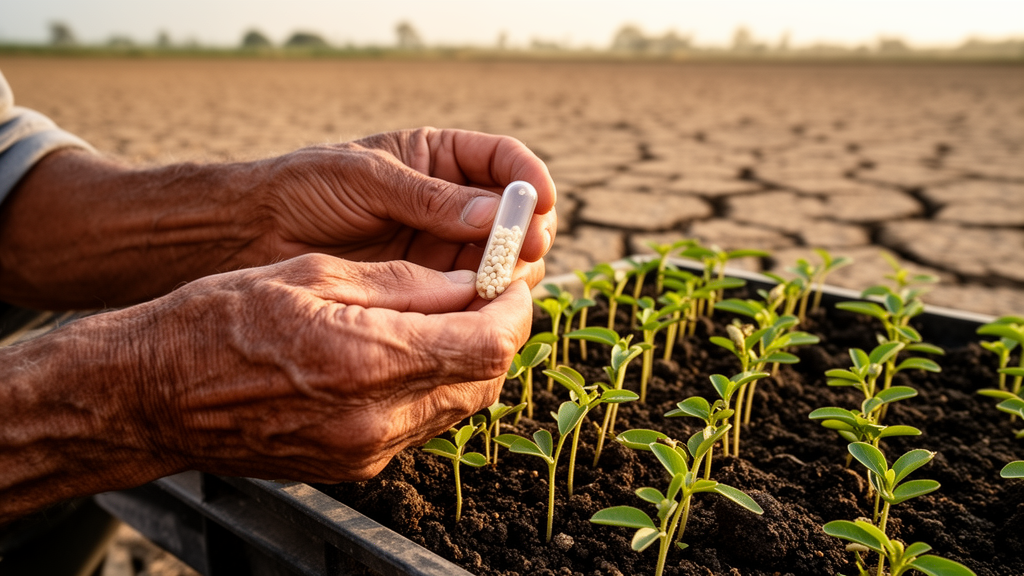
Drought is one of the most punishing constraints in agriculture, and few crops feel its bite as sharply as groundnut (Arachis hypogaea L.), a protein- and oil-rich legume that loses an estimated 6 million tons of annual production and up to 85 percent of pod yield when water runs short. A new study from researchers at Periyar University in Tamil Nadu, India, published in Frontiers in Industrial Microbiology, offers a strikingly detailed molecular account of how an encapsulated microbial biostimulant helps groundnut endure that deficit. By combining two drought-tolerant rhizobacterial strains with a biopolymer delivery system and then tracing the resulting metabolic fingerprints in the plant’s seeds, the work moves the field beyond simple growth promotion and into the realm of engineered metabolic reprogramming.
The research team, led by Sakthi Uma Devi Eswaran and Lalitha Sundaram, began with two bacterial strains originally isolated from groundnut rhizospheric soil: Acinetobacter calcoaceticus AC12 and Bacillus amyloliquefaciens BA13. Both were genotypically identified by 16S rRNA gene sequencing and deposited in NCBI under accession numbers ON495939 and ON495964. In laboratory assays, the strains tolerated polyethylene glycol concentrations of up to 30 percent PEG-6000, a standard osmotic challenge that simulates drought by lowering water potential to roughly -1.03 megapascals. That tolerance was not merely survival; both strains produced a battery of plant-growth-promoting compounds under stress, including indole acetic acid, gibberellic acid, exopolysaccharides, and catecholate-type siderophores, and both solubilized insoluble phosphate from calcium phosphate sources.
AC12 emerged as the stronger performer across most traits. It produced 122.02 micrograms per milliliter of indole acetic acid compared with 97.30 for BA13, achieved a phosphate solubilization index of 9.9 against 7.5, and generated 88.87 percent siderophore units versus 79.16. Both strains produced exopolysaccharides, with AC12 again ahead at 2.10 milligrams per milliliter. The team then probed the strains’ osmolyte production, a critical mechanism for drought endurance, by measuring five compatible solutes under osmotic stress: glycine betaine, trehalose, salicylic acid, alginate, and ectoine. Under 30 percent PEG, AC12 produced 83.33 percent more glycine betaine than BA13, and its trehalose output rose 86 percent above unstressed levels. Salicylic acid production increased by 64.08 percent in AC12 and 51.91 percent in BA13 relative to unstressed controls, while ectoine content surged by 248 percent and 175 percent respectively. Alginate, a hygroscopic polymer that keeps bacterial cells hydrated, rose by 26.8 percent in AC12 under stress.
With the consortium’s credentials established, the researchers turned to encapsulation technology, a strategy designed to protect the bacteria from fluctuating climatic conditions and preserve their viability during transport, storage, and field deployment. The team suspended the AC12 and BA13 consortium in a 2 percent sodium alginate solution containing 2 percent starch as a filler, then extruded the mixture drop-wise through a 0.2-millimeter needle into sterile 0.1 molar calcium chloride. Ionic gelation cross-linked the alginate with calcium ions, forming spherical microcapsules roughly 1 to 1.5 millimeters in diameter. A 0.4 percent chitosan solution, acidified with glacial acetic acid and adjusted to pH 6.0, was then applied as a coating. Chitosan, a polyvalent cation, undergoes instant electrostatic cross-linking with sodium alginate, reducing the porosity of the matrix and increasing surface hardness and internal stability.
Scanning electron microscopy confirmed successful entrapment of the bacterial consortium within the biopolymeric matrix, with freeze-dried microcapsules showing slight wrinkling from lyophilization. Fourier transform infrared spectroscopy verified the chemical composition of the capsules: characteristic peaks appeared at 3,298 reciprocal centimeters for the hydroxyl bending vibration of sodium alginate, 1,598 for the N-H deformation of chitosan, 1,415 for the asymmetric carboxylate stretching of alginate, 1,148 for the C-O-C stretching of starch, and 1,077 and 1,014 for the C-N and C-O-H vibrations of chitosan and starch respectively. Critically, no new peaks emerged, confirming that no chemical reaction occurred between the three polymers. The microcapsules achieved a moisture content of 5.20 percent, a swelling rate of 82.05 percent, and an encapsulation efficiency of 99.5 percent, indicating nearly complete entrapment of the rhizobacterial consortium.
Release kinetics and shelf-life data underscored the practical value of the formulation. Live bacterial counts within the microcapsules rose significantly in the first four days, reaching 10^6 colony-forming units per gram, then continued a slow release up to 10 days before saturating after 20 days. Viable cell counts remained at 10^7 colony-forming units per gram for up to 30 days of storage, and the team tracked survival across a full 90-day period. These figures align with prior work on Enterobacter ludwigii microcapsules, which maintained 10^7 viable cells under 90 days of storage, and suggest that the chitosan-coated alginate matrix provides the stability, efficiency, and extended shelf-life that commercial biostimulant development demands.
The field trial, conducted on a farmer’s farmland at Poosaripatty in Salem district, Tamil Nadu, tested the encapsulated biostimulant against a non-encapsulated liquid formulation and an uninoculated control across three irrigation regimes: full field capacity, 60 percent field capacity representing mild drought, and 40 percent field capacity representing severe drought. The groundnut cultivar TMV 7 was sown in a completely randomized block design with three replicate blocks, and no agrochemicals were applied throughout the growth phase apart from the biostimulants. After 90 days, the plants were uprooted for physiological, biochemical, and yield analysis.
The results were statistically significant across multiple parameters. Relative water content, a key indicator of plant water status, fell by 17.64 percent under mild drought and 64.70 percent under severe drought in uninoculated plants. The encapsulated biostimulant restored relative water content by 10 percent under mild drought and by 22.21 percent under severe drought, outperforming the non-encapsulated formulation, which achieved only 2.85 percent and a smaller increment respectively. Lipid peroxidation, measured as malondialdehyde accumulation, surged by 112.56 percent under mild drought and 196.22 percent under severe drought in uninoculated plants, reflecting overproduction of reactive oxygen species. The encapsulated biostimulant reduced malondialdehyde by 23.11 percent under mild drought and 24.03 percent under severe drought, compared with reductions of 8.6 percent and 4.4 percent for the non-encapsulated version. Total soluble sugars rose dramatically under drought, by 113.17 percent and 142.41 percent in uninoculated plants, and the encapsulated biostimulant further enhanced sugar concentration by 10.18 percent under mild drought. Leaf protein content increased by 29 percent under mild drought and 25 percent under severe drought with the encapsulated formulation, against 8.6 percent and 2.1 percent for the non-encapsulated version.
Yield parameters told a similar story. Pod number per plant rose by 37.97 percent under mild drought and 32.44 percent under severe drought with the encapsulated biostimulant, compared with 10.34 percent and 18.98 percent for the non-encapsulated version. The 100-seed weight increased by 2.73 percent under mild drought with the encapsulated formulation relative to the non-encapsulated one, and per-hectare yield improved by 17.98 percent under mild drought, against 8.07 percent for the non-encapsulated version. Under severe drought, both formulations produced substantial yield improvements over the uninoculated control, though the difference between them was not statistically significant.
The most revealing layer of the study came from untargeted metabolomic profiling of groundnut seeds using gas chromatography-mass spectrometry. Seed samples were lyophilized, extracted with precooled methanol, derivatized with methoxyamine hydrochloride and MSTFA, and analyzed on an Elite-5MS column with helium carrier gas. The profiling identified 52 altered metabolites spanning sugars, amino acids, fatty acids, esters, ketones, organic acids, and aromatic compounds. Hierarchical clustering and heat map analysis revealed clear separation between metabolite profiles under well-watered conditions and drought stress with and without biostimulant inoculation. Plants treated with the encapsulated biostimulant expressed the maximum number of differential metabolites, 21 in total under mild drought, with significantly higher concentrations of glycerin, D-glucose, homoserine, allantoic acid, cystathionine, glycine, L-mannose, asparagine, pyruvic acid, hexadecanoic acid, and L-arabinose, among others. Under severe drought, the encapsulated treatment enriched dibutoxybutane, isopropylphosphonic acid, benzisoxazole, propanediamine, 2-propanone, homoserine lactone, aminobutyric acid, linoleic acid, and heptanoic acid. Partial least squares discriminant analysis, validated through permutation testing and cross-validated ANOVA, confirmed that the metabolomes across treatments were clearly distinguishable, with variable importance in projection scores identifying distinct stress-specific metabolites.
Pathway enrichment analysis using the Kyoto Encyclopedia of Genes and Genomes database mapped the 52 matched metabolites to 25 significantly upregulated and enriched metabolic pathways under water deficit. The top ten most influenced pathways, ranked by statistical significance, included alanine, aspartate, and glutamate metabolism; glycine, serine, and threonine metabolism; butanoate metabolism; propanoate metabolism; cysteine and methionine metabolism; glyoxylate and dicarboxylate metabolism; beta-alanine metabolism; valine, leucine, and isoleucine biosynthesis; galactose metabolism; and linoleic acid metabolism. Alanine, aspartate, and glutamate metabolism, glycine, serine, and threonine metabolism, and cysteine and methionine metabolism each acquired four metabolite hits, the maximum recorded. Linoleic acid metabolism, though enriched with only one metabolite, carried the highest pathway impact value of 1.0, exceeding all other metabolisms.
The biological significance of these pathway shifts is substantial. Amino acids play essential roles in stress resilience, osmoprotection, stomatal governance, photorespiration, and antioxidant defense. The aspartate family, particularly asparagine, accumulates in plants primed with endophytic PGPR and improves metabolism during water deficit. Glutamate, a precursor for ornithine, arginine, and proline, facilitates protein synthesis and stress recovery. Glycine, serine, and threonine metabolism contributes to osmoprotection and antioxidant defense, while cysteine and methionine metabolism is highly susceptible to reactive oxygen species, highlighting its antioxidant properties. Branched-chain amino acids such as valine, leucine, and isoleucine lower osmotic pressure and sustain cell turgor pressure and integrity. Butanoate metabolism, with accumulated 4-aminobutyric acid, succinic acid, malic acid, and maleic acid, maintains ATP production and metabolic regulation under stress. Galactose metabolism supplies glucose as an energy substrate for the tricarboxylic acid cycle, supports membrane stability, and preserves osmotic equilibrium. In fatty acid metabolism, the encapsulated biostimulant induced differential expression of unsaturated fats including dodecanoic acid, linolenic acid, methyl linolelaidate, heptanoic acid, and octadecadienoic acid, reflecting the plant’s strategy of modulating cell membrane lipids during dehydration to preserve integrity.
The study’s authors frame these findings as a foundation for developing new biostimulant products with encapsulation technology to enhance global food production and nutrition. By deciphering the precise metabolic action of an encapsulated microbial consortium, the work addresses a persistent knowledge gap in the tripartite interaction between biostimulant, plant, and abiotic stress, a gap that has hampered both the rational formulation of new products and their integration into agronomic practice. The team notes that further attention and in-depth functional study through integrated multi-omics approaches will be needed to fully exploit the molecular knowledge base these metabolomic signatures provide. For now, the study stands as a compelling demonstration that a carefully engineered bacterial delivery system can do more than help a crop survive drought; it can fundamentally rewire the crop’s seed metabolism to endure it.
Subject of Research: Encapsulated PGPR biostimulant triggers metabolomic drought adaptation in groundnut
Article Title: Deciphering metabolomic signatures of drought adaptation in groundnut triggered by encapsulated microbial biostimulant
Article References: Eswaran, S. U. D., & Sundaram, L. (2026). Deciphering metabolomic signatures of drought adaptation in groundnut triggered by encapsulated microbial biostimulant. Frontiers in Industrial Microbiology, 4, Article 1741397. https://doi.org/10.3389/finmi.2026.1741397
Image Credits: AI Generated
DOI: 10.3389/finmi.2026.1741397
Keywords: groundnut, PGPR, encapsulation, metabolomics, drought, biostimulant, alginate, chitosan, osmolytes, Frontiers in Industrial Microbiology, Deciphering, metabolomic
Cite Scienmag News
Alan Morgan. (October 17, 2026). Encapsulated Bacterial Biostimulant Rewires Groundnut Seed Metabolism to Beat Drought. Scienmag. https://scienmag.com/encapsulated-bacterial-biostimulant-rewires-groundnut-seed-metabolism-to-beat-drought/
Alan Morgan. "Encapsulated Bacterial Biostimulant Rewires Groundnut Seed Metabolism to Beat Drought." Scienmag, 17 October 2026, https://scienmag.com/encapsulated-bacterial-biostimulant-rewires-groundnut-seed-metabolism-to-beat-drought/. Accessed 17 October 2026.
Alan Morgan. "Encapsulated Bacterial Biostimulant Rewires Groundnut Seed Metabolism to Beat Drought." Scienmag. October 17, 2026. https://scienmag.com/encapsulated-bacterial-biostimulant-rewires-groundnut-seed-metabolism-to-beat-drought/


