


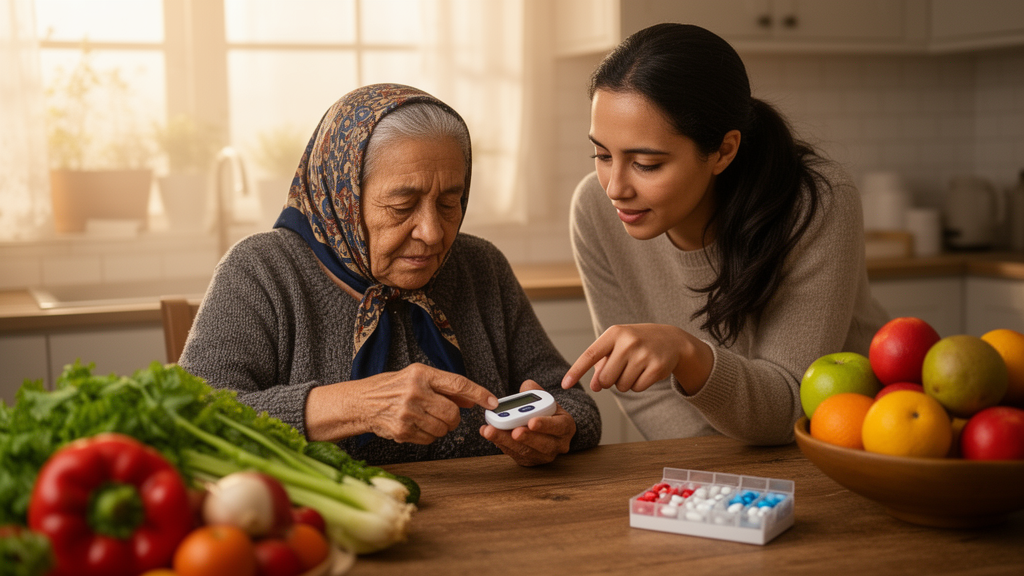
For the roughly 304 million people living outside their country of birth, managing diabetes is not simply a matter of willpower. A new scoping review from the University of Tsukuba, published in Frontiers in Clinical Diabetes and Healthcare, maps how the social circumstances of immigrant life—money, language, family, neighborhood and food—quietly dictate whether someone eats well, exercises, checks blood glucose, takes medication or shows up at the clinic. The findings suggest that diabetes self-care among immigrants is shaped less by individual choice than by a complex interplay of structural and environmental forces.
Researchers Rie Kudoh and Taiga Shibayama searched PubMed and Web of Science for peer-reviewed empirical studies published in English between 2020 and 2024, following the PRISMA-ScR framework for scoping reviews. From 286 initial records, 25 studies met all inclusion criteria. The team mapped each study’s findings onto the six domains of the Hill-Briggs social determinants of health framework: Economic Stability, Education Access and Quality, Community and Social Context, Neighborhood and Physical Environment, Health and Healthcare System, and Food Environment. Self-care was operationalized across five measurable behaviors: diet, physical activity, glucose monitoring, medication adherence and regular medical visits.
The geographic picture is strikingly lopsided. Seventeen of the 25 studies came from North America and the Caribbean, mostly the United States, examining communities as diverse as Haitian, Chinese, Korean, South Asian, Latino, Mexican, Nepali-speaking Bhutanese and Arab immigrants. Europe contributed three studies, Australia two, and Saudi Arabia one. Not a single study was identified from South-East Asia or Africa, despite Asia hosting roughly 86 million international migrants and Africa accounting for 9 percent of the global migrant stock. The authors call this absence a critical gap that limits how far current findings can travel.
Across all five self-care behaviors, one domain proved the most pervasive: Community and Social Context. Family and spousal support repeatedly emerged as the strongest facilitator of successful lifestyle change. Spouses prepared diabetes-tailored meals, reminded patients to take medications, served as exercise partners and even monitored cardiovascular health remotely across transnational family ties. Among Arab Americans, family encouragement was strongly associated with discussing care with a clinician. Yet the same social fabric could cut the other way. Social gatherings pressured people to eat non-recommended foods, and among Middle Eastern immigrants, 90 percent reported that dietary changes caused stress in relationships with family and friends, particularly around meal-centered events.
Economic Stability, Health and Healthcare System, and Education Access and Quality were each linked to multiple behaviors, with financial constraints and language barriers acting as recurring cross-cutting barriers. Among older Haitian immigrants in the United States, financial difficulties directly led to medication discontinuation, with participants reporting inability to afford insulin for months at a time. In a Saudi Arabian study of Arabic-speaking immigrants, roughly 48 percent lacked health insurance, negatively affecting adherence. High food costs pushed lower-income participants toward cheaper carbohydrates over vegetables, and among Haitian migrant laborers in the Dominican Republic, extreme poverty and long sugarcane-field hours prevented both healthy eating and clinic attendance.
Language emerged as a determinant that reached into nearly every corner of self-care. Among Chinese Americans, limited English proficiency was associated with significantly lower odds of daily blood glucose monitoring, and first-generation status predicted lower odds of receiving provider-developed care. Non-Hispanic Whites were 2.2 times more likely to check blood glucose daily than Asian American and Pacific Islander participants in a Texas survey. Receiving diabetes instructions in Arabic was significantly associated with improved food selection and regular exercise among Arab Americans. Notably, healthcare providers consistently underestimated language barriers relative to patients’ actual experiences, suggesting existing language services may not meet real needs.
The environmental domains behaved more selectively. Food Environment was associated chiefly with diet: providers advised against traditional Sudanese staples, traditional Indian dishes were absent from Australian nutrition databases, and among Nepali-speaking Bhutanese women, white rice central to the cultural diet was substituted with perceived healthier alternatives. Conversely, abundant locally grown vegetables and dietitian access supported healthy eating among rural Latina immigrants. Neighborhood and Physical Environment, meanwhile, was linked mainly to physical activity and medical visits—agricultural fieldwork and household labor served as primary activity sources in some communities, while lack of driving ability and inadequate public transportation restricted healthcare access, disproportionately affecting women in rural areas.
Several findings defy simple narratives. In one paradoxical result, higher income was associated with lower odds of insulin use and blood glucose monitoring compared with the lowest income bracket, a pattern the authors say warrants further investigation. Monitoring behavior was often reactive rather than proactive: most Haitian immigrants checked glucose only when symptomatic, experiencing cold or clammy sensations, headaches or excessive urination. And among Sub-Saharan African migrants in France, strong trust in medical providers—built through positive experiences with HIV medication—transferred directly to diabetes adherence, showing how healthcare relationships can bridge conditions.
The authors emphasize that these determinants interact synergistically rather than independently. An immigrant facing language barriers, limited acculturation and economic disadvantage is likely to experience compounded difficulties across several self-care behaviors simultaneously, not an isolated barrier in a single domain. This argues for multicomponent interventions that address several social determinants concurrently—combining language-accessible services, culturally concordant care and economic support—rather than single-domain approaches targeting one behavior at a time.
The review also carries caveats. Most included studies relied on small, non-representative samples recruited through single institutions or snowball sampling, and quantitative studies suffered from low response rates and geographic restriction. Self-reported data, unvalidated instruments and language barriers that likely excluded participants with limited English proficiency further constrain generalizability. Twenty-four of the 25 studies focused on adults, predominantly with type 2 diabetes; only one examined a pediatric population, Somali Canadian adolescents with type 1 diabetes. The authors call for prospective longitudinal designs, intervention trials of culturally tailored multicomponent programs, and explicit reporting of migration pathway and legal status—factors that may independently shape both exposure to social determinants and access to self-care resources. Until evidence emerges from South-East Asia and Africa, the global picture of how social circumstances govern immigrant diabetes self-care remains fundamentally incomplete.
Subject of Research: Health
Article Title: Social determinants of health influencing diabetes self-care behaviors among immigrants: a scoping review
Article References: Kudoh, R., & Shibayama, T. (2026). Social determinants of health influencing diabetes self-care behaviors among immigrants: a scoping review. Frontiers in Clinical Diabetes and Healthcare, 7, Article 1915588. https://doi.org/10.3389/fcdhc.2026.1915588
Image Credits: AI Generated
DOI: 10.3389/fcdhc.2026.1915588
Keywords: diabetes, immigrants, social determinants of health, self-care, health disparities, scoping review, Social, determinants, health, influencing, behaviors, scoping
Cite Scienmag News
Ophelia Keating. (October 17, 2026). Family, Money and Language Shape Diabetes Self-Care Among Immigrants, Review Finds. Scienmag. https://scienmag.com/family-money-and-language-shape-diabetes-self-care-among-immigrants-review-finds/
Ophelia Keating. "Family, Money and Language Shape Diabetes Self-Care Among Immigrants, Review Finds." Scienmag, 17 October 2026, https://scienmag.com/family-money-and-language-shape-diabetes-self-care-among-immigrants-review-finds/. Accessed 17 October 2026.
Ophelia Keating. "Family, Money and Language Shape Diabetes Self-Care Among Immigrants, Review Finds." Scienmag. October 17, 2026. https://scienmag.com/family-money-and-language-shape-diabetes-self-care-among-immigrants-review-finds/


