


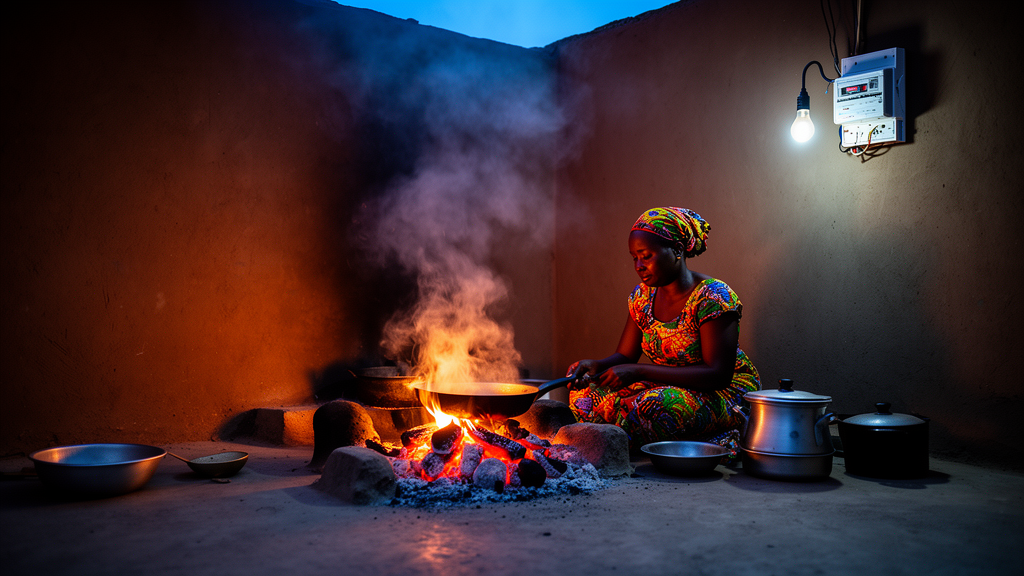
Ghana has pulled off one of the most dramatic household energy turnarounds in sub-Saharan Africa over the past two decades, but a new analysis reveals a starkly uneven story beneath the headline numbers. While electricity access surged from just over 60 percent of households to more than 85 percent, clean cooking fuel adoption crawled upward at less than half that pace, and the gap between the richest and poorest families widened to an astonishing 82 percentage points. The findings, drawn from nearly three decades of nationally representative survey data, suggest that the country’s celebrated energy expansion has left a critical dimension of modern energy access behind.
The study, published in Discover Sustainability, examined trends and socioeconomic inequalities in household access to electricity and clean cooking fuels in Ghana from 2003 to 2022. A research team led by Yula Salifu of the University of Ghana analyzed repeated cross-sectional data from the Ghana Demographic and Health Surveys and Malaria Indicator Surveys, processed through the World Health Organization’s Health Equity Assessment Toolkit. Rather than simply tracking national averages, the researchers deployed a sophisticated battery of inequality metrics, including difference and ratio measures, population attributable risk and fraction, absolute and relative concentration indices, and the Theil Index, each presented alongside 95 percent confidence intervals to support rigorous inferential interpretation.
The electricity results are genuinely remarkable. Household electricity access climbed from 60.5 percent in 2008 to 85.1 percent in 2022, an achievement that places Ghana among the leading performers in the region. More striking still is what happened to inequality during that expansion. The Absolute Concentration Index, a measure that captures how strongly access is concentrated among wealthier households, fell from 19.6 to 11.4, indicating that the gains were distributed substantially across the wealth spectrum rather than captured exclusively by the privileged. The Theil Index, which quantifies regional disparities, collapsed from 203.5 to 7.0, an extraordinary reduction suggesting that geographic inequality in electricity access has been nearly eliminated over the period.
This relatively inclusive electricity expansion reflects deliberate policy architecture. Ghana’s national electrification schemes, implemented through the Electricity Company of Ghana and the Northern Electricity Distribution Company, combined grid extension programs with targeted investments in underserved northern regions. The near-convergence of regional Theil Index values implies that these distribution companies, working across vastly different geographic and economic terrain, managed to bring connection rates in historically disadvantaged areas closer to national norms. For a country where northern households have long trailed southern counterparts in nearly every development indicator, the electricity story represents a genuine equity success.
Clean cooking fuels tell a profoundly different story. Use of modern cooking fuels, primarily liquefied petroleum gas, rose from just 13.6 percent of households in 2003 to 28.7 percent in 2022. That means nearly three-quarters of Ghanaian families still cook with biomass, charcoal, or other polluting fuels that release harmful particulates and contribute to deforestation. The pace of change, roughly 0.7 percentage points per year, would need to accelerate several-fold for Ghana to approach the Sustainable Development Goal 7 target of universal access to clean cooking by 2030. At the current trajectory, the country would not reach even half of households until well beyond mid-century.
But the raw adoption numbers understate the true problem, because inequality in clean cooking access has been widening, not narrowing. The gap between the richest and poorest wealth quintiles expanded from 55.0 percentage points in 2003 to 82.0 percentage points in 2022. The Absolute Concentration Index rose from 6.1 to 16.6, confirming that access has become increasingly concentrated among wealthier households. The Gini coefficient for clean cooking fuel access, calculated from quintile-based estimates, increased from 0.59 in 2003 to 0.61 in 2022, further corroborating the trend of widening wealth-related inequality. In plain terms, the benefits of LPG expansion have flowed disproportionately to families who were already better positioned to afford cylinders, refills, and the upfront costs of switching away from charcoal and firewood.
Persistent urban-rural and regional disparities compound the wealth divide. Northern households have remained consistently disadvantaged in clean cooking access throughout the entire study period, mirroring historical patterns of underinvestment in the country’s northern savannah zones. Rural families, who face longer supply chains for LPG distribution and higher per-unit costs, continue to lag urban counterparts by wide margins. The concentration of clean cooking access among southern, urban, and affluent populations means that the health and environmental benefits of modern fuels, including reduced household air pollution exposure and lower respiratory disease burden, have been distributed along the same fault lines of privilege that characterize other dimensions of Ghanaian development.
The technical architecture of the inequality analysis deserves attention because it moves beyond simple gap measures. Population attributable risk and fraction estimates quantify how much national clean cooking access would improve if the disparities between wealth quintiles were eliminated, providing a direct policy-relevant metric. Concentration indices, calculated by ranking households by wealth and plotting access against cumulative population share, capture the direction and magnitude of socioeconomic gradients with sensitivity to the entire distribution rather than just the extremes. The Theil Index, drawn from information theory, decomposes regional inequality into within-region and between-region components, allowing researchers to pinpoint where geographic disparities originate. Applying this full toolkit to energy access data, rather than the health outcomes for which it was originally designed, represents a methodological extension with significant implications for how energy equity is monitored across the region.
Why has clean cooking proven so much harder to equalize than electricity? The economics differ fundamentally. Electricity connection is largely a one-time infrastructure investment, subsidized through national programs and amortized over decades, whereas clean cooking requires recurring expenditure on cylinders, regulators, and refills that families must budget continuously. LPG supply chains depend on import infrastructure, distribution networks, and retail presence that thin out rapidly in rural and northern areas. Upfront switching costs, cultural preferences for traditional cooking methods, and uncertainty about fuel availability all reinforce the wealth gradient. The widening inequality suggests that Ghana’s LPG expansion has operated more as a market phenomenon than a public program, rewarding households with purchasing power rather than extending access as a universal service.
The authors conclude that while electricity expansion has been relatively inclusive, progress in clean cooking fuels has been slow with widening inequalities, and they call for accelerated, equity-focused clean cooking policies to ensure that no population group is left behind. The findings arrive at a pivotal moment, as Ghana and its neighbors confront the intertwined challenges of household air pollution, deforestation, and climate commitments under Sustainable Development Goals 7 and 10. The Ghanaian experience offers a sobering lesson for the broader sub-Saharan African region, where clean cooking access remains among the lowest in the world: expanding modern energy is not the same as expanding it equitably, and the two goals demand distinct policy instruments. Without deliberate intervention to subsidize access for poor and rural households, strengthen LPG distribution in northern regions, and address the recurring cost burden that keeps biomass in the kitchen, the wealth divide in clean cooking will continue to widen even as national averages inch upward.
Subject of Research: Three decades of trends and socioeconomic inequalities in household access to electricity and clean cooking fuels in Ghana from 2003 to 2022
Article Title: Three decades of trends and socioeconomic inequalities in household access to electricity and clean cooking fuels in Ghana from 2003 to 2022
Article References: Salifu, Y., Moro, A., Yakubu, M., Atubiga, B. A., Koomson, I. K., Salifu, T., Lasong, J., & Adong, J. W. (2026). Three decades of trends and socioeconomic inequalities in household access to electricity and clean cooking fuels in Ghana from 2003 to 2022. Discover Sustainability. https://doi.org/10.1007/s43621-026-04498-7
Image Credits: AI Generated
DOI: 10.1007/s43621-026-04498-7
Keywords: Three, decades, trends, socioeconomic, inequalities, household, access, electricity, clean, cooking, fuels, Ghana
Cite Scienmag News
Violet Maxwell. (October 17, 2026). Ghana’s Electricity Boom Leaves Clean Cooking Behind in Widening Wealth Divide. Scienmag. https://scienmag.com/ghanas-electricity-boom-leaves-clean-cooking-behind-in-widening-wealth-divide/
Violet Maxwell. "Ghana’s Electricity Boom Leaves Clean Cooking Behind in Widening Wealth Divide." Scienmag, 17 October 2026, https://scienmag.com/ghanas-electricity-boom-leaves-clean-cooking-behind-in-widening-wealth-divide/. Accessed 17 October 2026.
Violet Maxwell. "Ghana’s Electricity Boom Leaves Clean Cooking Behind in Widening Wealth Divide." Scienmag. October 17, 2026. https://scienmag.com/ghanas-electricity-boom-leaves-clean-cooking-behind-in-widening-wealth-divide/


