


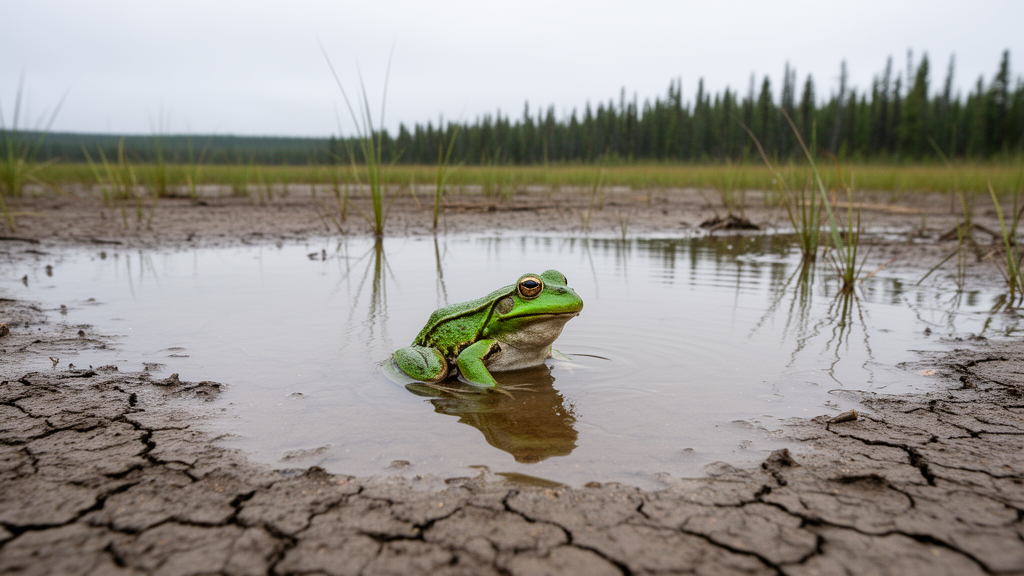
Across Canada, from the wetlands of southern Ontario to the boreal ponds of the Yukon, frogs, salamanders, and toads are quietly disappearing. A sweeping new review published in Frontiers in Amphibian and Reptile Science finds that 68 percent of the country’s amphibian species are now listed as at risk, a figure that places Canada’s frogs and salamanders among the most imperiled animal groups in the nation. The study, led by researchers applying the framework of the International Union for Conservation of Nature’s Amphibian Specialist Group, delivers the most comprehensive assessment to date of how Canadian amphibian conservation is actually working on the ground, and where it is falling short.
The timing of the review is significant. In 2024, the IUCN Amphibian Specialist Group released a new Amphibian Conservation Action Plan, a global blueprint designed to coordinate responses to what scientists widely recognize as the most severe vertebrate decline crisis on record. Amphibians worldwide have been collapsing for decades, battered by habitat destruction, disease, pollution, and a rapidly changing climate. The Canadian team took this international framework and asked a pointed question: how well does the country’s existing conservation machinery measure up when applied to species that, for the most part, exist at the very northern edge of their global ranges?
That northern-edge question is central to understanding Canada’s amphibian predicament. Most Canadian species survive in conditions that are marginal compared to the heart of their distributions farther south, meaning populations are often small, fragmented, and inherently vulnerable to disturbance. Compounding this, the review highlights a stark geographic irony: amphibian species richness is greatest in southern Canada, precisely where 90 percent of the country’s human population lives and where urban expansion, agriculture, and industrial development exert the heaviest pressure on wetlands, woodlands, and riparian corridors. The places where frogs and salamanders are most diverse are the same places where they are most likely to lose their habitat.
The researchers organized their synthesis around five thematic pillars drawn from the global action plan: conservation planning, assessing and managing wide-ranging threats, documenting distributions and population trends, ex-situ techniques and translocations, and amphibian genomics resources. In each area, they distilled findings from roughly the past ten to fifteen years of Canadian research and identified the gaps that most urgently need filling. The result is both a status report and a call to action, aimed at researchers, policymakers, and communities alike.
Habitat loss and fragmentation emerge as the dominant threat to many Canadian amphibians, despite decades of effort to protect and restore critical wetlands and breeding sites. Roads cut through migration corridors, agricultural drainage eliminates breeding ponds, and urban sprawl converts forested uplands into impervious surfaces. Even where habitat protection exists on paper, the review suggests that securing habitat of sufficient quantity and quality to sustain robust, self-perpetuating populations across working landscapes remains an unfinished task. Connectivity between breeding sites and overwintering grounds is often severed, leaving isolated populations susceptible to local extinction.
Climate change looms over the entire assessment as an overarching influence with potentially serious consequences that the authors describe as largely untracked. Shifting precipitation patterns alter the hydroperiod of ephemeral breeding ponds, warmer winters disrupt hibernation physiology, and increased frequency of drought and extreme weather events can desynchronize breeding with food availability. Because long-term monitoring data for most Canadian amphibian populations are sparse or absent, the full magnitude of climate-driven impacts remains difficult to quantify, a blind spot the review identifies as a priority for immediate research investment.
Pollution research in Canada has concentrated on three major fronts: the impacts of oil sands extraction in Alberta, the effects of agricultural runoff, and the growing presence of emerging contaminants such as pharmaceuticals and microplastics in aquatic systems. The review documents significant effects on amphibian growth, development, gene expression, and behavior across these exposure scenarios. Oil sands operations release complex mixtures of naphthenic acids and heavy metals into surrounding watersheds, while agricultural pesticides and fertilizers alter endocrine function and immune competence in larval amphibians. These sublethal effects, though harder to observe than outright mortality, can erode population fitness over generations.
Against this sobering backdrop, the review also highlights genuine grounds for optimism. Canadian researchers have been at the forefront of developing and applying innovative conservation tools, including genetic and genomic approaches that reveal phylogenetic relationships, quantify biodiversity, and evaluate how amphibian populations respond to environmental change, pollutants, and pathogens. Environmental DNA, or eDNA, analysis has emerged as a powerful non-invasive method, allowing scientists to detect the presence of rare or cryptic species from water samples alone, without the need to capture or disturb animals. These molecular tools are now being integrated into breeding programs, translocation planning, habitat protection strategies, and adaptive management frameworks across the country.
Several large-scale Canadian genomic projects have contributed substantially to amphibian reference resources, building the genetic infrastructure needed to support conservation decisions from population structure analysis to disease surveillance. Genomic data can identify evolutionarily significant units within widespread species, inform the selection of source populations for reintroductions, and track the spread of pathogens such as Batrachochytrium dendrobatidis, the fungus responsible for chytridiomycosis. The review argues that expanding these resources and making them accessible to practitioners should be a national priority, particularly as climate change accelerates the need for informed, rapid interventions.
Perhaps the most forward-looking element of the review concerns Indigenous-led environmental initiatives, which the authors note are gaining momentum across Canada but only rarely focus on amphibians specifically. The challenge, they argue, is to build conservation strategies that are inclusive of diverse perspectives, including Indigenous ways of knowing, which often encompass deep temporal understanding of ecological relationships and community-based stewardship practices. Integrating these knowledge systems with Western scientific approaches could transform how habitat is identified, secured, and managed across Canadian landscapes. The review closes with a clear message: the tools exist, the framework is in place, and the window for meaningful action is narrowing. What remains is the collective will to deploy conservation interventions at the scale and speed that Canada’s amphibians now require.
Subject of Research: Amphibian conservation status, threats, and conservation tools across Canada
Article Title: Amphibian conservation in Canada: state of the art and call for action
Article References: Ashpole, S. L., Bennett, A. M., Calatayud, N., Forzán, M. J., Garner, T. W. J., Helbing, C. C., Herman, T. B., Ovaska, K., Paszkowski, C., Randall, L., Robinson, S. A., & Winton, S. A. (2026). Amphibian conservation in Canada: state of the art and call for action. Frontiers in Amphibian and Reptile Science, 4, Article 1773591. https://doi.org/10.3389/famrs.2026.1773591
Image Credits: AI Generated
DOI: 10.3389/famrs.2026.1773591
Keywords: amphibian conservation, Canada, IUCN Amphibian Conservation Action Plan, habitat loss, climate change, environmental DNA, amphibian genomics, Indigenous-led conservation, Amphibian, conservation, state, call
Cite Scienmag News
Sloane Callahan. (October 17, 2026). Canada’s Amphibians Face a Silent Crisis as 68 Percent Slide Toward Extinction. Scienmag. https://scienmag.com/canadas-amphibians-face-a-silent-crisis-as-68-percent-slide-toward-extinction/
Sloane Callahan. "Canada’s Amphibians Face a Silent Crisis as 68 Percent Slide Toward Extinction." Scienmag, 17 October 2026, https://scienmag.com/canadas-amphibians-face-a-silent-crisis-as-68-percent-slide-toward-extinction/. Accessed 17 October 2026.
Sloane Callahan. "Canada’s Amphibians Face a Silent Crisis as 68 Percent Slide Toward Extinction." Scienmag. October 17, 2026. https://scienmag.com/canadas-amphibians-face-a-silent-crisis-as-68-percent-slide-toward-extinction/


