


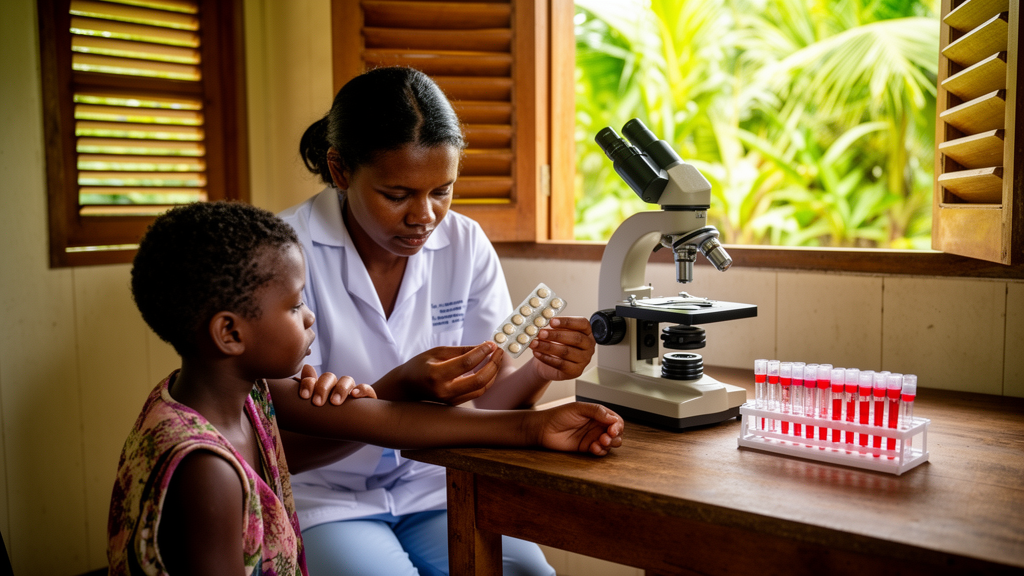
A large randomised clinical trial in the Solomon Islands has delivered an uncomfortable verdict on the standard treatment for relapsing malaria: the low-dose primaquine regimen practiced across much of the Western Pacific simply does not work well enough, no matter which modern antimalarial partner drug accompanies it. The study, conducted in the Tetere region of Guadalcanal Province between September 2017 and February 2019, enrolled 384 patients with uncomplicated Plasmodium vivax malaria and followed them for six months to see whether the dormant liver parasites responsible for relapse had truly been eradicated. The answer, published in Frontiers in Malaria, is that they had not.
Plasmodium vivax is the dominant cause of malaria in the Asia-Indo-Pacific and the Americas, and it poses a unique therapeutic challenge. Unlike Plasmodium falciparum, which lives only in the blood, P. vivax deposits dormant stages called hypnozoites in the liver. These sleeping parasites can reactivate weeks or months after the initial infection, causing repeated bouts of illness without any new mosquito bite. Over three billion people live at risk of P. vivax malaria, and in the Solomon Islands total malaria cases have doubled since 2010, with more than two-thirds identified as P. vivax. The only drug endorsed by the World Health Organization for killing hypnozoites is primaquine, an 8-aminoquinoline that has been in use since 1952.
Primaquine is a prodrug, meaning the parent compound itself is largely inert and must be converted by human liver enzymes, particularly cytochrome P450 2D6 (CYP2D6), into the reactive metabolites that actually attack the parasites. This pharmacology creates two layers of uncertainty. First, inherent human polymorphisms in CYP2D6 vary from person to person and can impair the generation of active metabolites. Second, primaquine has always been co-administered with a blood schizontocide that clears the parasites circulating in the blood, and poorly understood interactions between the two drugs could theoretically undermine therapeutic activity. With chloroquine resistance now widespread in P. vivax, radical cure requires pairing primaquine with one of several artemisinin-based combination therapies, or ACTs.
The trial was designed to test the national first-line regimen of the Solomon Islands, which pairs artemether-lumefantrine (AL) with primaquine at 0.25 mg/kg per day for 14 days, a total dose of 3.5 mg/kg, against the second-line ACT, dihydroartemisinin-piperaquine (DP), given with the same primaquine dose. A third arm received AL alone as a relapse control, reflecting the standard of care where glucose-6-phosphate dehydrogenase (G6PD) testing is unavailable. This lower primaquine dose is often practiced in settings without routine G6PD testing because the drug can trigger acute haemolytic anaemia in patients with this commonly inherited enzyme deficiency. Participants were screened with a triple rapid-diagnostic approach for G6PD deficiency, randomly assigned in permuted blocks with a 2:2:1 allocation ratio, and followed actively at scheduled visits through day 168.
The results showed a clear but inadequate benefit. Both primaquine-containing arms significantly reduced the hazard of recurrent P. vivax parasitemia relative to AL alone: by 50 percent for AL-primaquine (hazard ratio 0.50, 95 percent confidence interval 0.33 to 0.75) and by 66 percent for DP-primaquine (hazard ratio 0.34, 95 percent confidence interval 0.22 to 0.52), both with P less than 0.001. Yet neither regimen approached adequate clinical efficacy. Over six months, 43.7 percent of patients in the AL-primaquine arm and 34.1 percent in the DP-primaquine arm experienced microscopy-confirmed recurrences, compared with 60 percent in the control arm. The steepest rate of recurrence began between days 15 and 30 after enrollment and continued through the first 90 days of follow-up.
Statistical modelling revealed a further nuance. The assumption of proportional hazards did not hold for the primary endpoint, prompting time-stratified Cox regressions with an inflection point identified between days 42 and 56. During the first interval, day 0 through 42, the protective effect was strong: the hazard ratio for AL-primaquine was 0.26 and for DP-primaquine just 0.06 relative to AL alone. After day 42, the hazard ratios climbed toward unity and lost statistical significance, indicating that the modest primaquine dose delayed relapse but failed to prevent it. Notably, participants with early recurrences before day 42 had substantially lower carboxy-primaquine levels than those with later or no parasitemia, hinting that drug exposure may matter even at this inadequate dose.
To investigate whether impaired drug metabolism could explain the poor performance, the researchers genotyped CYP2D6 in 346 participants and mapped 274 of them to standardised phenotypic activity scores based on the PharmGKB database. The vast majority, 86.1 percent, were normal metabolisers, no poor metabolisers were observed, and only 7.3 percent were intermediate metabolisers. Crucially, the CYP2D6 activity score showed no association with treatment outcomes, with concentrations of primaquine or its metabolites, or with peak methaemoglobin levels. Mass spectrometry measurements on day 7 revealed no significant differences between the AL-primaquine and DP-primaquine arms in concentrations of the parent drug, the stable derivative 5,6-orthoquinone-primaquine of a putative active CYP2D6-derived metabolite, or the inactive metabolite carboxy-primaquine. The poor efficacy, in other words, stemmed not from a pharmacokinetic failure but from the inadequacy of the dose itself.
Safety findings carried their own warning. Two episodes of significant primaquine-induced acute haemolytic anaemia occurred early in the study, both in participants who had normal G6PD rapid-test results during screening and enrollment. A 16-year-old male who had completed six daily primaquine doses experienced the more severe event, with a 46 percent relative drop in haemoglobin to a nadir of 6.4 g/dL requiring hospitalisation and blood transfusion. Both patients were later confirmed to carry the Union G6PD-deficient genotype, one of the most severe variants, which is common in South and Southeast Asia and the Western Pacific where more than 90 percent of P. vivax infections occur. Enrollment was halted until quantitative next-day G6PD testing by ELISA could be implemented. Aside from these two severe events, all treatment arms were well tolerated, with methaemoglobin peaking at day 7 at median levels of about 1.4 percent, notably lower than the roughly 4 percent reported in other studies at the same dose.
The trial is the first from the Western Pacific or Southeast Asia to estimate the radical curative efficacy of the commonly used AL-primaquine and DP-primaquine combinations at the lower 3.5 mg/kg total dose, and it raises serious concerns about current policies. A 2012 critical review found that patients receiving the 7 mg/kg total dose were five times less likely to experience P. vivax recurrence than those on the 3.5 mg/kg regimen, and high radical cure rates with the higher dose have since been documented with a variety of partner drugs, including artesunate, artesunate-pyronaridine, and DP. A recent systematic review and individual patient data meta-analysis affirmed the superiority of the higher dose irrespective of the co-administered blood schizontocide or the geographic origin of infection. The equally poor performance of both ACT combinations in the Solomon Islands suggests that drug-drug interactions are not the problem and that both regimens may perform equivalently at higher primaquine dosing.
The stakes extend beyond individual patients. Chesson-like strains of P. vivax, first isolated from an American soldier in the Western Pacific in 1944, are characterised by high-frequency, rapid, and multiple relapses and tolerance to standard primaquine regimens, and they still appear to commonly occur in the region. Repeated relapses at intervals of less than two months lead to more frequent hospitalisations and are associated with higher all-cause mortality in the year following a P. vivax diagnosis compared with P. falciparum. Yet the therapeutic dilemma remains unresolved: withholding or lowering the primaquine dose risks recurrent attacks in the majority, while giving higher doses risks severe haemolysis in the G6PD-deficient minority, roughly eight percent of residents of malaria-endemic countries, or more than 400 million people globally. Recent work suggests that ascending primaquine doses may allow delivery of the full high-dose regimen in G6PD-deficient individuals while preventing haemolysis. Where G6PD testing is available, the WHO now recommends a higher total primaquine dose of 7 mg/kg for Africa, Southeast Asia, and Oceania. The Solomon Islands experience shows that no G6PD screening process is free of error, and that safer strategies for administering the higher dose, including improved diagnostics, early detection of haemolysis, and transfusion support, must be integral to any policy involving 8-aminoquinoline anti-relapse therapy if the frequent, dangerous relapses of P. vivax malaria in the Southwest Pacific are ever to be prevented.
Subject of Research: Efficacy of low-dose primaquine plus artemether-lumefantrine or dihydroartemisinin-piperaquine for radical cure of Plasmodium vivax in the Solomon Islands: a randomised clinical trial
Article Title: Efficacy of low-dose primaquine plus artemether-lumefantrine or dihydroartemisinin-piperaquine for radical cure of Plasmodium vivax in the Solomon Islands: a randomised clinical trial
Article References: James, R., Obadia, T., Wini, L., Bobogare, A., Charnaud, S., Ruybal-Pesántez, S., Bourke, C., Munro, J. E., Moore, B. R., Page-Sharp, M., Manning, L., Liligeto, U., Zaloumis, S. G., Baird, J. K., Karunajeewa, H., & Mueller, I. (2025). Efficacy of low-dose primaquine plus artemether-lumefantrine or dihydroartemisinin-piperaquine for radical cure of Plasmodium vivax in the Solomon Islands: a randomised clinical trial. Frontiers in Malaria, 3, Article 1604498. https://doi.org/10.3389/fmala.2025.1604498
Image Credits: AI Generated
DOI: 10.3389/fmala.2025.1604498
Keywords: Efficacy, low-dose, primaquine, plus, artemether-lumefantrine, dihydroartemisinin-piperaquine, radical, cure, Plasmodium, vivax, Solomon, Islands
Cite Scienmag News
Ophelia Keating. (October 17, 2026). Low-Dose Primaquine Falls Short Against Relapsing Malaria in Solomon Islands Trial. Scienmag. https://scienmag.com/low-dose-primaquine-falls-short-against-relapsing-malaria-in-solomon-islands-trial/
Ophelia Keating. "Low-Dose Primaquine Falls Short Against Relapsing Malaria in Solomon Islands Trial." Scienmag, 17 October 2026, https://scienmag.com/low-dose-primaquine-falls-short-against-relapsing-malaria-in-solomon-islands-trial/. Accessed 17 October 2026.
Ophelia Keating. "Low-Dose Primaquine Falls Short Against Relapsing Malaria in Solomon Islands Trial." Scienmag. October 17, 2026. https://scienmag.com/low-dose-primaquine-falls-short-against-relapsing-malaria-in-solomon-islands-trial/


