


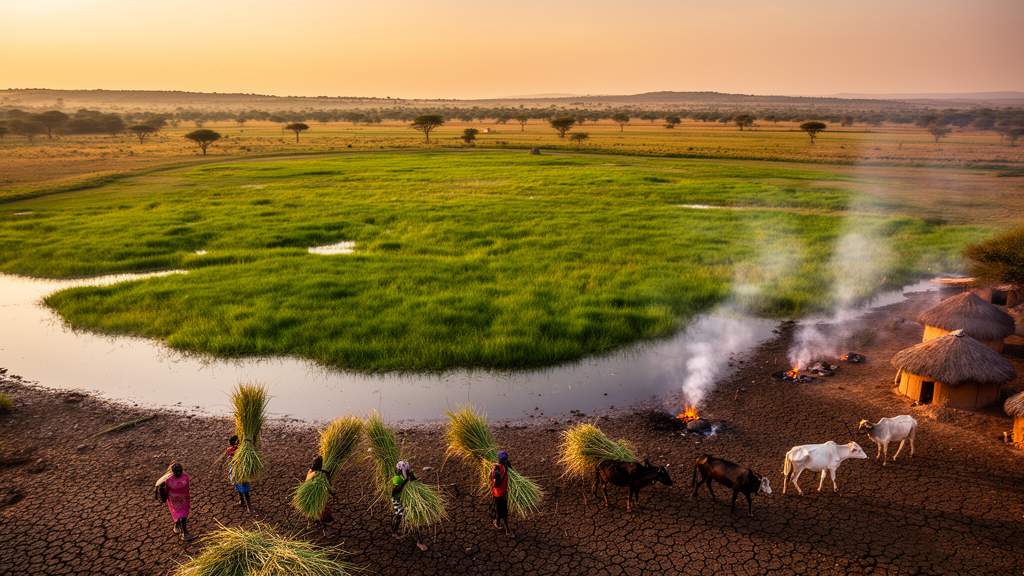
Deep in the highlands of West Gojam, Ethiopia, a wetland the size of a small city is quietly disappearing. Denbiq Wetland, a 3,123-hectare expanse of springs, reeds, and seasonal floodplain in Bure Woreda of the Amhara Region, has sustained farming communities for generations. Now, a new community-based study published in the journal BioRisk reveals just how much local people value this ecosystem—and how the very households that depend on it are unintentionally pushing it toward collapse. The findings offer a rare, statistically grounded portrait of the socio-economic forces degrading one of Ethiopia’s threatened highland wetlands, and they suggest that the solution may lie less in fences and fines than in understanding family size, land tenure, and the quiet wisdom of older farmers.
The research team, working across four kebeles—Wadera, Denbun, Tiya Tiya, and Alefa—surveyed 202 randomly selected households using structured questionnaires, focus group discussions, key informant interviews, and field observations. The sample was calculated with the Yamane formula at a 95 percent confidence level and ±7 percent precision, drawn from a total of 22,771 households in the sampling frame. Respondents were overwhelmingly agrarian: 83.7 percent identified as farmers, and 94.5 percent cited crop production as their primary source of income. The average family size was 5.19 persons, average livestock holdings stood at 7.2 animals, and cultivated land averaged just 1.38 hectares—figures that hint at the intense pressure smallholder families place on shared natural resources, including the wetland itself.
What emerges most strikingly from the data is the sheer breadth of ecosystem services Denbiq provides. Following the classification framework of Wallace, the researchers documented provisioning services such as freshwater for livestock drinking (recognized by 70.9 percent of respondents), domestic use (60.4 percent), and irrigation (40 percent), alongside fodder and grazing resources (65.3 percent), thatching grass (48.5 percent), fuelwood (30.5 percent), and medicinal plants (10.2 percent). Regulating services included erosion control (70.5 percent), water purification (63.6 percent), temperature regulation through carbon sequestration (50.5 percent), and sediment retention (47.4 percent). Cultural services—recreation (60.4 percent), spiritual activities (35.6 percent), and educational purposes (4 percent)—rounded out the picture, while supporting services encompassed habitat provision (50.2 percent), nutrient cycling (57.2 percent), breeding grounds (45.4 percent), and organic matter accumulation (45.2 percent).
The wetland’s biodiversity value is equally remarkable. According to the survey, Denbiq supports approximately 65 bird species, including the common crane, great white pelican, yellow-billed duck, Egyptian goose, African jacana, wattled crane, and crowned crane. Field observations confirmed that the eastern sections of the wetland retain native shrubs and grasses that provide critical habitat for wetland fauna, while the northern part has already been degraded by crop encroachment and overgrazing. Vegetation surveys noted stands of Typha latifolia and Cyperus papyrus reeds in Alefa and Wadera, Nile grass (Berbeza) in Denbun, and a conspicuous absence of buffer vegetation in Tiya Tiya—spatial patterns that mirror gradients of human pressure across the landscape.
Yet awareness of these services is far from universal. Only 11.4 percent of respondents described themselves as fully informed about the wetland’s ecological functions, while 36.6 percent admitted they were not informed at all. Chi-square analysis revealed that educational level and locality significantly influenced awareness (p < 0.01), with respondents holding secondary or college education demonstrating markedly greater recognition of regulating and supporting services. Age also mattered: perception of supporting ecosystem services varied significantly across age categories (p < 0.05), a trend the researchers attribute to the fact that better-educated respondents, generally aged 30 to 51, were more capable of understanding indirect ecological functions. Duration of residence similarly shaped perception of cultural services (p < 0.05), with long-term residents expressing deeper attachment to the wetland’s spiritual and communal identity.
The study’s most technically consequential contribution is its binary logistic regression, which tested eight socio-economic predictors of wetland sustenance or degradation. Four variables emerged as statistically significant at the 99 percent confidence level. Household size was negatively associated with wetland condition (β = -0.873, p = 0.006), meaning larger families exert greater pressure on wetland resources through heightened demands for farmland, water, and grazing. Age of the household head showed a positive and significant effect (β = 1.932, p = 0.009), suggesting older individuals—armed with greater ecological knowledge and long experience of the wetland’s benefits—are more likely to support conservation. Landholding size was positively associated with wetland sustainability (β = 3.025, p = 0.009), as households with more land have alternatives to wetland encroachment. Livestock numbers positively influenced wetland use (β = 0.312, p = 0.008), indicating that livestock-dependent households rely heavily on wetland water and forage, a relationship that implies potential overuse if grazing is not managed properly.
Community perceptions of degradation drivers reinforce these statistical findings. Respondents identified inadequate grazing land (86 percent), lack of awareness (77 percent), unclear wetland boundaries (70.3 percent), youth unemployment (58.1 percent), absence of alternative livelihoods (51.9 percent), sedimentation (47 percent), farmland scarcity (22.3 percent), low productivity of nearby upland fields (30.2 percent), expansion of settlements (13.7 percent), and deforestation (11.2 percent) as the principal forces eroding the wetland. Focus group participants and key informants described declining water levels and shrinking wetland extent, attributing these trends to agricultural expansion, seasonal recession farming, and unsustainable resource harvesting. The monomodal rainfall pattern—1386 to 1757 millimeters concentrated between May and September—combined with steep highland slopes and intensive lowland cultivation, accelerates sediment deposition and compromises the wetland’s natural retention capacity and groundwater recharge.
Encouragingly, the study found strong community support for conservation interventions. Respondents proposed awareness creation (64 percent), shoreline fencing (49.23 percent), reducing grazing around the wetland (41 percent), developing buffer zones (38.39 percent), avoiding deforestation (12.42 percent), and controlling wetland water use for irrigation (3 percent). Many emphasized the importance of educating both local communities and the wider public on wetland benefits such as water purification, flood control, biodiversity support, and carbon sequestration. The researchers argue that these locally generated proposals, grounded in lived experience, represent a critical foundation for participatory management that top-down initiatives have repeatedly failed to achieve.
The institutional dimension emerges as perhaps the most intractable challenge. While some government and community-led conservation actions exist, their impact has been limited by weak enforcement, unclear mandates among responsible bodies, and poor coordination. Respondents expressed concern over the absence of clear wetland ownership and accountability, which has led to open-access exploitation. Ethiopia’s national Wetland Strategy under the Ministry of Water and Energy provides a policy framework, but implementation at the local level remains insufficient. The study’s authors conclude that stronger institutional mechanisms—including community-based governance, inter-sectoral coordination, and consistent monitoring—are essential to translate policy intent into on-the-ground protection.
The implications extend well beyond Denbiq. As Ethiopian highland wetlands face accelerating pressure from population growth, agricultural intensification, and climate variability, the Denbiq study demonstrates that effective conservation must be statistically informed, community-driven, and institutionally supported. Targeting large households, younger and less experienced land users, and livestock-dependent families through education, livelihood diversification, and wetland-friendly land-use planning could relieve pressure on the ecosystem. Enhancing upland cropland productivity, creating alternative livelihoods, and establishing buffer zones address the root socio-economic incentives that fuel unsustainable use. The researchers acknowledge limitations—data were collected during a single season and perspectives from regional planners and NGOs were not fully explored—but they recommend longitudinal monitoring and evaluation of climate variability impacts. With appropriate policy support, genuine community participation, and sustainable practices, Denbiq Wetland may yet continue providing its extraordinary array of ecosystem services for generations to come.
,
Subject of Research: Community perceptions, degradation drivers, and conservation actions for Denbiq Wetland, Ethiopia
Article Title: Community perceptions of ecosystem services, drivers of degradation, and proposed conservation actions for Denbiq Wetland in West Gojam, Ethiopia
Article References: Alem, K. M. (2025). Community perceptions of ecosystem services, drivers of degradation, and proposed conservation actions for Denbiq Wetland in West Gojam, Ethiopia. BioRisk, 23, 45-61. https://doi.org/10.3897/biorisk.23.156866
Image Credits: AI Generated
DOI: 10.3897/biorisk.23.156866
Keywords: wetlands, Ethiopia, ecosystem services, conservation, community-based management, Community, perceptions, ecosystem, services, drivers, degradation, proposed
Cite Scienmag News
Margaret Porter. (October 17, 2026). Ethiopian Wetland Faces Collapse as Households Reveal What Drives Its Destruction. Scienmag. https://scienmag.com/ethiopian-wetland-faces-collapse-as-households-reveal-what-drives-its-destruction/
Margaret Porter. "Ethiopian Wetland Faces Collapse as Households Reveal What Drives Its Destruction." Scienmag, 17 October 2026, https://scienmag.com/ethiopian-wetland-faces-collapse-as-households-reveal-what-drives-its-destruction/. Accessed 17 October 2026.
Margaret Porter. "Ethiopian Wetland Faces Collapse as Households Reveal What Drives Its Destruction." Scienmag. October 17, 2026. https://scienmag.com/ethiopian-wetland-faces-collapse-as-households-reveal-what-drives-its-destruction/


