


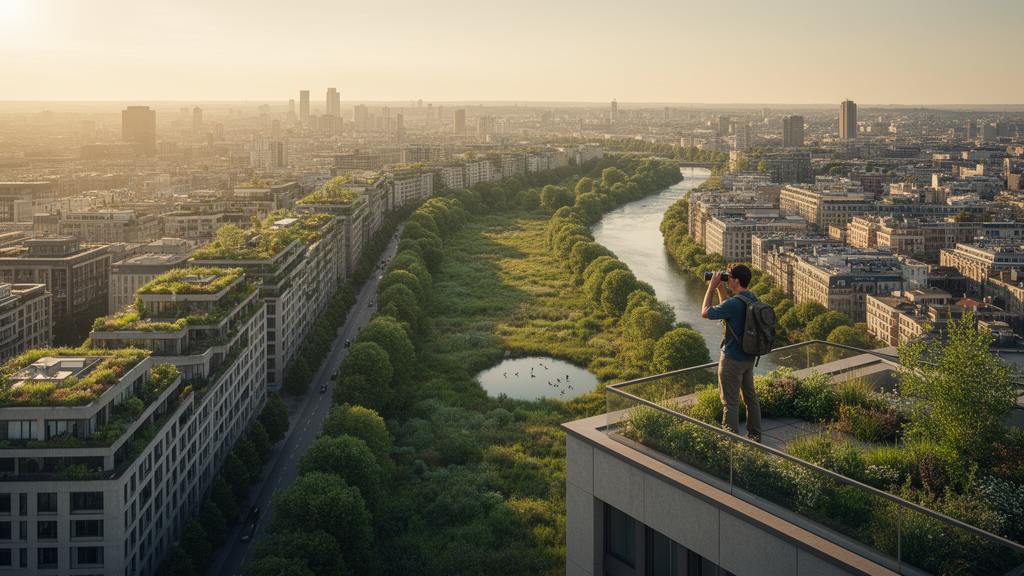
Cities are often portrayed as ecological dead zones, places where pavement has replaced prairie and where wildlife survives only at the margins. A growing body of research is dismantling that assumption. The second volume of a research collection on the spatial aspects of urban animal ecology and conservation biology, published in Frontiers in Ecology and Evolution, brings together studies spanning amphibians, birds, bats, bears, and mixed-species animal groups, and it delivers a message that is increasingly hard to ignore: the fate of wildlife in the twenty-first century will be decided largely in human-dominated landscapes, and the deciding factor is spatial arrangement.
The collection, edited by Rusty Gonser of Indiana State University together with Ryan Jensen and Steven Petersen of Brigham Young University, builds on a first volume that framed urban animal ecology around broad questions of habitat fragmentation, green corridors, and comparisons between urban and less urbanized environments. Volume II shifts the emphasis from description toward application. Its studies examine how animals respond to specific features of the built environment, including artificial light, green infrastructure, water availability, food attractants, and nesting or foraging opportunities. The unifying theme is that urban conservation depends on understanding where human disturbance, habitat resources, and animal responses intersect on the ground.
One of the most striking reframings in the volume is the treatment of humans as habitat modifiers and urban landscapes as fragmented habitats in their own right. Rather than asking simply whether a species is present in a city or absent from it, the researchers ask how the patchwork of roads, buildings, green spaces, water bodies, and residential neighborhoods shapes movement, habitat use, and avoidance. This mosaic is not static. Climate change adds dynamic disturbances such as urban heat islands and altered water distribution, which continuously redraw the map of usable habitat. Meanwhile, anthropogenic light, sound, and attractants accumulate, further sculpting the sensory landscape through which animals navigate.
Several of the studies move beyond the familiar urban-versus-rural comparison to examine direct and indirect anthropogenic pressures as stressors with physiological consequences. The editors argue that each of these factors should be treated as a potential stressor capable of affecting an organism’s physiology, morphology, and behavior across its entire lifetime, with downstream effects on reproductive success and therefore on population persistence. Stress, in this view, is not an abstract concept but a measurable biological currency that links the design of a neighborhood to the demographic trajectory of the animals living in it.
A case in point comes from research on the white stork, a species often classified as an urban adapter, meaning it is presumed to tolerate or even thrive alongside human development. The study found elevated stress responses in storks exposed to anthropogenic influences and environmental stressors, demonstrating that even the most adaptable city dwellers are not immune to the pressures of urban life. The finding carries a warning for conservation planning: species labels such as adapter or avoider are not permanent verdicts, and tolerance can erode when the cumulative burden of disturbance crosses physiological thresholds.
The spatial distribution of resources emerges as the volume’s central practical concern. Whether the resource in question is green infrastructure, open water surfaces, food attractants, nesting sites, or the broader ecosystem services that urban areas provide, the editors argue that effective conservation hinges on knowing where resources are located and how animals actually access them. That kind of landscape data, they contend, should be a prerequisite for conservation policy rather than an afterthought. A corridor that looks connected on a map may be functionally impassable; a pond may be abundant but unreachable; a nesting site may sit in a location that exposes its occupants to lethal levels of disturbance.
Urban planning and design, the editors argue, should incorporate these spatial data to reduce human-animal interactions before they become conflicts. This is complicated by the fact that urban growth can occur rapidly, while species with different natural histories and life histories perceive and respond to habitat modification in markedly different ways. The relative rate of change among urban landscapes matters as well: a city that transforms within a decade presents a fundamentally different selective environment than one that changes incrementally over a century. The editors call for more experimental research on approaches that reduce the attractants drawing wildlife into proximity with people, on ways to identify and modify anthropogenic sources of disturbance, and on the influence of physical clutter on habitat use and avoidance.
The volume also makes a case for rethinking the role of the public in urban ecology. Citizen scientists have traditionally been cast as collectors of presence and absence data, but the editors argue that residents should also be understood as subjects of the data collection. People’s perceptions of nature influence policy and urban planning, and a community’s attitude toward a species can matter as much as the species’ biology. Research in the collection suggests that individuals may hold positive perceptions of particular animals, yet communities can still benefit from targeted environmental education that improves knowledge and fosters emotional ties to nature, producing a more conservation-friendly public and, ultimately, better urban management.
Looking forward, the editors advocate a holistic approach that goes beyond indicator species and links the health of all species in an urban landscape across a scale from microbes to animals to humans, in line with a One Health viewpoint. They also highlight a gap in the literature concerning mixed-species groups, the aggregations of different species that forage or move together. There are fitness benefits to membership in such groups, but all participants are exposed to anthropogenic disturbances that could negate those benefits, making mixed-species groups an underexplored unit of urban conservation. The breadth of taxa covered in the volume, from amphibians to bears, suggests that urban conservation biology must move beyond single-species case studies and compare responses across animals with different mobility, habitat needs, and tolerance of disturbance.
The collection closes with a research agenda that reads as a challenge to the field. Which urban design interventions actually improve animal fitness rather than merely animal presence? How do multiple urban stressors interact spatially and synergistically? Can cities be designed as connected habitat networks across taxa? How does urban wildlife respond to habitat changes across seasons and life stages? How can human-wildlife coexistence be measured spatially, and which metrics predict the best outcomes? Which conservation actions can be scaled across cities, and how will climate change reshape urban animal ecology? The overarching question, the editors write, is how spatial urban ecology can identify the specific designs, policies, and community practices that allow animal populations, not just individual animals, to persist in cities under increasing disturbance and a changing climate. The shift they propose, from documenting urban animal responses to testing mechanisms and interventions, may determine whether the next century of urbanization is a story of retreat or one of coexistence.
Subject of Research: Spatial ecology of animal responses to urban landscapes and its application to urban conservation planning
Article Title: Editorial: Spatial aspects of urban animal ecology and conservation biology, volume II
Article References: Gonser, R., Jensen, R., & Petersen, S. (2026). Editorial: Spatial aspects of urban animal ecology and conservation biology, volume II. Frontiers in Ecology and Evolution, 14, Article 2000120. https://doi.org/10.3389/fevo.2026.2000120
Image Credits: AI Generated
DOI: 10.3389/fevo.2026.2000120
Keywords: urban ecology, spatial ecology, conservation biology, habitat fragmentation, anthropogenic stressors, green infrastructure, wildlife corridors, urban planning, One Health, mixed-species groups, climate change, human-wildlife coexistence
Cite Scienmag News
Margaret Porter. (October 17, 2026). Mapping the Urban Wild: How Spatial Ecology Is Redefining City Conservation. Scienmag. https://scienmag.com/mapping-the-urban-wild-how-spatial-ecology-is-redefining-city-conservation/
Margaret Porter. "Mapping the Urban Wild: How Spatial Ecology Is Redefining City Conservation." Scienmag, 17 October 2026, https://scienmag.com/mapping-the-urban-wild-how-spatial-ecology-is-redefining-city-conservation/. Accessed 17 October 2026.
Margaret Porter. "Mapping the Urban Wild: How Spatial Ecology Is Redefining City Conservation." Scienmag. October 17, 2026. https://scienmag.com/mapping-the-urban-wild-how-spatial-ecology-is-redefining-city-conservation/


