


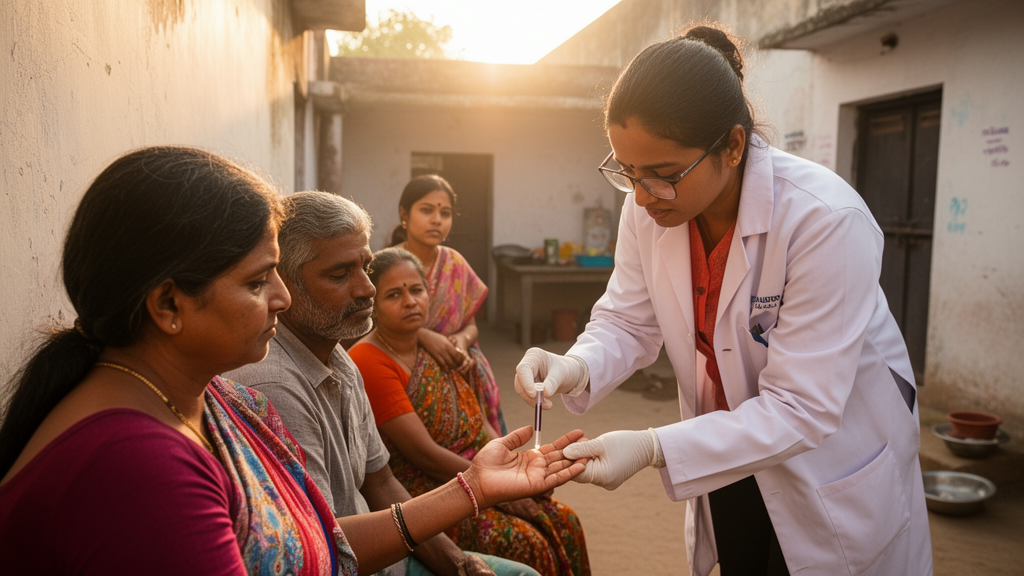
A year-long prospective study of people sharing homes with tuberculosis patients in southern India has delivered a sobering verdict on some of the most celebrated blood-based gene signatures in the TB field. The interferon-gamma-inducible transcriptional biosignatures RISK6, Sweeney3, and a locally derived ten-gene panel could discriminate, at best weakly, between household contacts who later developed culture-confirmed tuberculosis and those who did not. None of the multi-gene signatures approached the World Health Organization’s minimum accuracy target for predicting progression from infection to active disease, and the single-gene transcripts GBP2 and FCGR1B actually outperformed the composite panels in this population.
The study, led by Synne Jenum of Oslo University Hospital and the University of Bergen together with colleagues from Denmark and St. John’s Research Institute in Bangalore, was nested within a prospective observational cohort of tuberculosis household contacts conducted in Palamaner and Kuppam Taluks in Chittoor district, Andhra Pradesh, between September 2010 and April 2012. The team recruited 525 household contacts from 176 adults diagnosed with smear-positive pulmonary tuberculosis at microscopy centers of India’s Revised National Tuberculosis Control Program, covering 94.3 percent of all eligible households in the study area. Contacts who had previously had pulmonary tuberculosis or were already on tuberculosis treatment or prophylaxis were excluded, as were all concomitant tuberculosis cases identified at baseline.
During twelve months of follow-up, with visits at 1, 2, 5, 6, 9, and 12 months, twelve participants progressed to tuberculosis as defined by growth of Mycobacterium tuberculosis in respiratory specimens, a microbiological case definition that deliberately includes both subclinical and clinical pulmonary disease. Five progressors had positive cultures at six months and seven at twelve months. Six cases occurred among children aged 5 to 14 years, five among adults aged 40 to 55, and one among a 19-year-old; no progressors were found among children under five. The 180 non-progressors who remained culture-negative throughout the year served as controls, restricted to contacts with paired tuberculin skin test and QuantiFERON-TB Gold results at baseline and twelve months, with individuals showing QuantiFERON reversion excluded because diverging results are difficult to interpret in high-endemic settings.
The progressors carried clear immunological hallmarks of mycobacterial exposure. Their tuberculin skin test indurations were larger than those of non-progressors, with a median of 11.0 versus 7.0 millimeters, and 58 percent had a tuberculin reaction of at least 10 millimeters compared with 26 percent of controls. Ten of the twelve progressors were QuantiFERON positive at baseline, against 39 percent of non-progressors, a highly significant difference. Two progressors converted their QuantiFERON test at two months. Diabetes mellitus was more frequent among progressors, and, intriguingly, progressors were more often exposed to liquefied petroleum gas within the household. Two progressors had baseline chest X-rays already interpreted as abnormal, probable tuberculosis, and both had positive cultures at six months, yet only one had a symptom, a two-week cough in a 13-year-old boy, that triggered referral without a diagnosis being made at the time.
The technical heart of the study was a head-to-head adaptation of three transcriptional signatures to the Fluidigm microfluidic RT-qPCR platform, the BioMark HD system, as part of the PARSISign project evaluating signatures for triage, progression prediction, and treatment response. RISK6, a six-gene signature comprising FCGR1B, GBP2, SERPING1, SDR39U1, TRMT2A, and TUBGCP6, and Sweeney3, comprising DUSP3, KLF2, and GBP5, were both successfully ported without assay failure. The locally derived INDIA11 signature, designed to detect subclinical and incipient tuberculosis, lost one gene target when the assay for the long intergenic non-coding RNA CTC-543D15.3 failed on the platform, yielding a modified INDIA10 signature with an overall failure rate of 5.7 percent, since calculating the INDIA10 score required results for all ten remaining targets. The researchers verified assay specificity rigorously: double melting peaks observed for TRMT2A and ABLIM2 were resolved by agarose gel electrophoresis and Sanger sequencing, confirming an intended 81-base-pair amplicon for TRMT2A alongside a non-specific 267-base-pair fragment that was excluded, and a single 87-base-pair target fragment for ABLIM2 even in ambiguous melting profiles.
On prognostic performance, the results were uniformly modest. Measured as the area under the receiver operating characteristic curve at baseline, RISK6 achieved an AUC of 0.61 with a 95 percent confidence interval of 0.41 to 0.82, Sweeney3 an AUC of 0.61 (0.41 to 0.80), and INDIA10 an AUC of 0.59 (0.46 to 0.72), all comparable but statistically non-significant, with lower confidence bounds below 0.50. To facilitate comparison, the team fixed sensitivity at 75 percent, the WHO minimum target for a tuberculosis progression test, and estimated the corresponding specificities: RISK6 reached 0.49 (0.41 to 0.56), Sweeney3 only 0.32 (0.25 to 0.39), and INDIA10 0.42 (0.35 to 0.50). The single-gene transcripts told a more interesting story. FCGR1B achieved an AUC of 0.70 (0.55 to 0.84) and GBP2 an AUC of 0.66 (0.51 to 0.80), both with significant discriminatory capacity, and at the fixed 75 percent sensitivity their specificities were 0.56 (0.49 to 0.64) and 0.50 (0.43 to 0.58) respectively, while SERPING1 matched Sweeney3 at the bottom with a specificity of 0.32.
In subgroup analyses stratifying non-progressors by longitudinal tuberculin and QuantiFERON responses, the multi-gene signatures performed equally poorly across all groups, with AUCs ranging from 0.54 to 0.63, and the single-gene transcripts ranged from 0.60 to 0.71 with wide uncertainty. The researchers had assumed that the discriminatory power of host transcriptional signatures, which reflect unstimulated innate and adaptive immune activation in the living subject, would be highest between tuberculosis progressors and contacts without detectable Mtb-specific responses. That was not the case: the patterns for both multi-gene and single-gene signatures were very similar across tuberculin/QuantiFERON groups, with the possible exception of INDIA10 performing somewhat better among consistent positives, though overlapping confidence intervals limited interpretation.
The contrast with previous validation studies is striking and informative. In the prospective CORTIS-01 community cohorts of adults in South Africa, RISK6 predicted progression within six months with an AUC of 0.91, and Sweeney3 with an AUC of 0.80, though even there performance weakened by twelve months. A recent individual participant data meta-analysis by Greenan-Barrett and colleagues, pooling RNA sequencing and quantitative PCR data from roughly 5,000 participants in South Africa, Gambia, Ethiopia, Brazil, and the United Kingdom with discovery datasets excluded from each evaluation, reported twelve-month AUCs of 0.74 for RISK6 and 0.72 for Sweeney3, with neither signature meeting the WHO minimum target product profile of at least 75 percent sensitivity and specificity. The Indian cohort’s AUC values were about 0.1 lower still. The authors attribute this divergence to important differences in case composition and study design: in the meta-analysis, roughly 60 percent of cases represented prevalent tuberculosis or progressors within the first six months after sampling, whereas the Indian study excluded prevalent cases, only 42 percent of progressors developed disease within six months, and children aged 14 or under constituted 32 percent of the study population, compared with fewer than 25 percent of participants under 21 in the pooled dataset, a relevant factor given known age-related differences in host immune responses. The nested case-control cohorts in the meta-analysis also carried progressor fractions of nearly 19 to 24 percent, against just 6.25 percent in the Indian cohort, and disease spectrum bias is a well-known risk of case-control designs.
The INDIA10 story carries its own methodological caution. In the original discovery study, the INDIA11 signature, derived from RNA sequencing data comparing subclinical and incipient tuberculosis cases within the same Indian household-contact cohort, discriminated subclinical tuberculosis from household controls with an AUC of 0.99, sensitivity of 1.0, and specificity of 0.85. The failed CTC-543D15.3 transcript carried a strong positive coefficient of plus 1.78 in the original LASSO model, and its omission likely weakened the composite signal. Adaptation to the RT-qPCR system without retraining the model may have introduced scaling bias, and the original case-control discovery design likely overestimated performance, so prospective testing probably revealed the true, more modest predictive capacity of the remaining ten-gene panel. The authors also acknowledge that their culture-based case definition likely misses non-infectious subclinical pulmonary cases as well as extrapulmonary and pediatric cases, and that the restricted selection of non-progressors, tied to preselected samples from prior biomarker studies, is a limitation, though the thorough symptom-focused follow-up with referral for chest X-ray limits the likelihood of misclassified progressors.
The broader conclusion is one the field is increasingly forced to confront. Nearly half of all tuberculosis cases are asymptomatic, and the interferon-gamma-inducible gene signatures evaluated here, while demonstrably generalizable to an underexplored Indian population of adults and children, support the feasibility of translating RNA technology into point-of-care formats such as the Cepheid Xpert MTB-Host Response fingerstick cartridge. But their prognostic accuracy appears time-limited, typically strongest within six months of sampling, and their sensitivity and specificity remain limited in all populations studied. The authors argue that sustained progress in early case identification will require structured longitudinal follow-up of high-risk individuals and integrated diagnostic algorithms rather than reliance on any single biosignature: digital chest radiography and non-sputum microbiological methods such as tongue swabs tested with Xpert MTB/RIF Ultra as deployable screening tools for contagious cases, combined with high-sensitivity immunological assays and transcriptional signatures as rule-in tools, paired with high-specificity biosignatures to guide targeted treatment of early disease stages spanning the subclinical-to-clinical spectrum.
Subject of Research: Evaluation of the performance of promising host transcriptional biosignatures in predicting TB progression during a 1-year prospective cohort study in Indian household contacts
Article Title: Evaluation of the performance of promising host transcriptional biosignatures in predicting TB progression during a 1-year prospective cohort study in Indian household contacts
Article References: Jenum, S., Hadasch, S., Sivakumaran, D., Saghaug, C. S., Høgberg, J., Larsen, K. C., Selvan, S., Larsen, H., Ritz, C., & Grewal, H. M. S. (2026). Evaluation of the performance of promising host transcriptional biosignatures in predicting TB progression during a 1-year prospective cohort study in Indian household contacts. Frontiers in Tuberculosis, 4, Article 1750007. https://doi.org/10.3389/ftubr.2026.1750007
Image Credits: AI Generated
DOI: 10.3389/ftubr.2026.1750007
Keywords: tuberculosis, biosignatures, RISK6, Sweeney3, transcriptomics, India, household contacts, diagnostics, Evaluation, performance, promising, host
Cite Scienmag News
Juliet Wilcox. (October 17, 2026). Blood Gene Signatures Fall Short in Predicting Who Will Develop Tuberculosis in Indian Households. Scienmag. https://scienmag.com/blood-gene-signatures-fall-short-in-predicting-who-will-develop-tuberculosis-in-indian-households/
Juliet Wilcox. "Blood Gene Signatures Fall Short in Predicting Who Will Develop Tuberculosis in Indian Households." Scienmag, 17 October 2026, https://scienmag.com/blood-gene-signatures-fall-short-in-predicting-who-will-develop-tuberculosis-in-indian-households/. Accessed 17 October 2026.
Juliet Wilcox. "Blood Gene Signatures Fall Short in Predicting Who Will Develop Tuberculosis in Indian Households." Scienmag. October 17, 2026. https://scienmag.com/blood-gene-signatures-fall-short-in-predicting-who-will-develop-tuberculosis-in-indian-households/


