


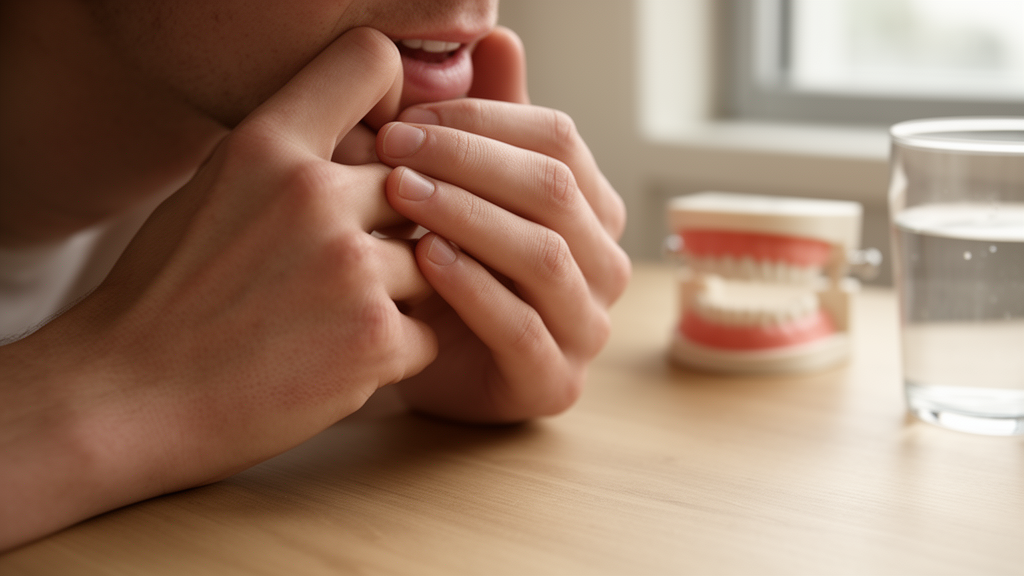
Everyone knows someone who grinds their teeth during a tense meeting, bites their nails through an exam, or chews the inside of their cheek while scrolling through bad news. These behaviors are so common that they rarely attract a second thought. Yet a growing body of research suggests they may be far more than harmless nervous habits. A new scoping review published in Frontiers in Oral Health has systematically mapped the evidence connecting repetitive oral behaviors to psychological factors, and its findings point toward an intriguing possibility: the mouth may be one of the most accessible windows into the mind.
The review, led by Diego De Nordenflycht of Universidad Andres Bello in Chile and Giancarlo De La Torre Canales of the Egas Moniz School of Health & Science in Portugal and Karolinska Institutet in Sweden, set out to answer a deceptively simple question: what psychological factors have been associated with oral behaviors, and how have those associations been conceptualized and measured? The team searched PubMed, Web of Science, and Scopus in November 2024, updating the search in August 2025, and screened more than 12,000 records according to the PRISMA-ScR guidelines for scoping reviews. After two independent reviewers filtered titles, abstracts, and full texts, 42 studies published within the last decade made the final cut.
The behaviors under investigation fall under what researchers call parafunctional oral activities: repetitive or sustained motor actions of the mouth that serve no functional purpose in chewing, swallowing, breathing, or speaking. The list includes awake bruxism (daytime clenching and grinding), nail-biting, lip and cheek biting, object biting, sucking habits, and jaw play, the small non-functional mandibular movements people make without tooth contact. Some form of repetitive oral behavior affects up to 90 percent of the population at some point, according to prior estimates cited in the review, though prevalence figures vary widely with age, sex, country, and socioeconomic status.
What makes these behaviors scientifically interesting is their position at the intersection of dentistry and psychiatry. In the DSM-5-TR, body-focused repetitive behaviors such as hair-pulling and skin-picking are classified within obsessive-compulsive and related disorders, and oral behaviors like nail-biting and lip-cheek biting are cited as examples typically coded under the category of other specified obsessive-compulsive and related disorders. Their physical consequences are well documented: non-nutritive sucking is associated with malocclusions such as anterior open bite and posterior crossbite, nail-biting with gingival swelling, infections, and incisor crowding, and multiple parafunctional behaviors with a 16-fold increase in the odds of chronic temporomandibular disorders compared with reporting only a few.
To bring order to a fragmented literature, the researchers grouped the psychological constructs reported across the 42 studies into six analytical domains: anxiety and obsessive-compulsive symptoms; mood and affective symptoms; somatic symptoms; personality-related traits; emotional processing and regulation; and cognitive, executive, and behavioral functioning. The results were striking in their pattern. While five studies reported no significant associations, the majority identified links between oral behaviors and multiple psychological domains. The domains of anxiety-obsessive/compulsive symptoms and mood/affective symptoms were the most frequently represented, particularly in studies of awake bruxism and nail-biting.
Awake bruxism dominated the evidence base, accounting for most of the available studies. It has been associated with anxiety symptoms, post-traumatic stress disorder symptoms, social phobia, perceived stress, depression, lower psychological resilience, sadness, somatization, neuroticism, alexithymia, and adapted stress-coping strategies. A recent systematic review cited in the paper reported a prevalence of 25.9 percent for self-reported possible awake bruxism and 16.0 percent for clinically probable awake bruxism in the general population, with substantially higher rates in patients with temporomandibular disorders. Nail-biting, meanwhile, was significantly associated with anxiety, stress, depression, lower resilience, negative self-image, somatization, hostility, introversion, low agreeableness, hyperactivity, internalizing behaviors, and poorer adaptive functioning. Nail-biters were found to be 3.34 times more likely to carry a psychiatric disorder diagnosis than non-biters.
Perhaps the most technically compelling finding involves dose-response relationships. One retrospective medical record study included in the review demonstrated that the odds of reporting waking-state oral behaviors, including clenching, grinding, and holding the jaw in a rigid or tense position, depend on the severity of depression, anxiety, and stress. Another study found that the occurrence of anxiety symptoms led to a twofold increase in the odds of having oral behaviors, while anxiety combined with distress and somatization was associated with a more than threefold higher probability. Individuals with greater trait anxiety and somatosensory amplification, a heightened perception of bodily sensations, reported more frequent oral behaviors, suggesting that repetitive tooth-to-tooth and tongue-to-teeth contact may serve to scan the intraoral environment in search of possible threats.
The review’s authors propose a conceptual framework to interpret these patterns. They organize psychological constructs along a distal-to-proximal continuum: relatively stable personality traits sit at the far end, psychological states and symptoms in the middle, and regulatory and cognitive-behavioral processes closest to the observable behavior itself. From this perspective, oral behaviors may represent behavioral outputs emerging from the interaction between these domains. Predisposing traits may increase vulnerability to distress, affective symptoms may act as triggers, and deficits in emotional regulation may facilitate repetitive oral behaviors as maladaptive strategies for modulating internal states. This interpretation aligns with existing emotion regulation models of body-focused repetitive behaviors, which hold that such behaviors help avoid, modulate, or alleviate aversive emotional experiences. The authors are careful to note, however, that this framework is hypothesis-generating rather than evidence of causal pathways, since reverse causation, residual confounding, and shared psychological determinants remain possible explanations.
The methodological picture tempers enthusiasm. Thirty-four of the 42 included studies were cross-sectional, with only one longitudinal observational study, one prospective cohort, and four case-control designs. Sample sizes ranged from 18 to 5,328 participants with a median of 263, and populations spanned schoolchildren, university students, dental students, community samples, and clinical groups. Terminology was remarkably inconsistent: the same behaviors were described as body-focused repetitive behaviors, oral parafunctional habits, deleterious oral habits, non-functional waking-state oral behaviors, and non-physiological awake oral behaviors, often interchangeably and without conceptual distinction. Assessment methods varied just as widely, from dichotomous yes/no questionnaires to the Oral Behavior Checklist, the Nordic Orofacial Test-Screening, and even a smartphone-based application for ecological momentary assessment of awake bruxism. The Oral Behavior Checklist, the most frequently used instrument and part of the DC/TMD Axis II protocol, captures many clinically relevant behaviors but omits others such as sucking habits, mouth breathing, jaw play, and toenail biting.
These heterogeneities limit causal inference and direct comparison across studies, and the authors acknowledge additional constraints including restriction to English-language publications, potential publication bias, heavy reliance on self-report, and the inclusion of a notable proportion of dental students, a group known to experience elevated stress and heightened awareness of oral behaviors, which may inflate self-reported rates. Still, the implications for clinical practice are provocative. Because dental appointments occur regularly over extended periods, dentists may be well positioned to recognize behavioral and psychosocial factors that remain unidentified in other healthcare settings. Routine assessment of oral behaviors, combined with brief psychological screening when clinically justified, could encourage earlier recognition of distress and reduce the risk of future complications including temporomandibular disorders, dental wear, traumatic periodontal lesions, and malocclusions. The authors stress that oral behaviors are neither specific nor diagnostic of mental health disorders, and that whether systematic assessment improves identification of psychological distress or referral pathways remains to be established through longitudinal and mechanistic studies. But the message is clear: the nervous habits we dismiss as trivial may deserve a closer look, not as isolated bad habits, but as observable indicators of broader biopsychosocial patterns relevant to both dental and mental health.
Subject of Research: Mapping the evidence on oral behaviors and mental health: a scoping review with implications for integrated oral healthcare
Article Title: Mapping the evidence on oral behaviors and mental health: a scoping review with implications for integrated oral healthcare
Article References: De Nordenflycht, D., Curtze, G., Antúnez, C., Espinoza, R., Morán-Kneer, J., & De La Torre Canales, G. (2026). Mapping the evidence on oral behaviors and mental health: a scoping review with implications for integrated oral healthcare. Frontiers in Oral Health, 7, Article 1906938. https://doi.org/10.3389/froh.2026.1906938
Image Credits: AI Generated
DOI: 10.3389/froh.2026.1906938
Keywords: oral behaviors, mental health, bruxism, nail-biting, psychology, scoping review, dentistry, anxiety, Mapping, evidence, oral, behaviors
Cite Scienmag News
Glenn Wilkins. (October 17, 2026). Why Biting Nails and Clenching Jaws May Signal More Than a Nervous Habit. Scienmag. https://scienmag.com/why-biting-nails-and-clenching-jaws-may-signal-more-than-a-nervous-habit/
Glenn Wilkins. "Why Biting Nails and Clenching Jaws May Signal More Than a Nervous Habit." Scienmag, 17 October 2026, https://scienmag.com/why-biting-nails-and-clenching-jaws-may-signal-more-than-a-nervous-habit/. Accessed 17 October 2026.
Glenn Wilkins. "Why Biting Nails and Clenching Jaws May Signal More Than a Nervous Habit." Scienmag. October 17, 2026. https://scienmag.com/why-biting-nails-and-clenching-jaws-may-signal-more-than-a-nervous-habit/


