


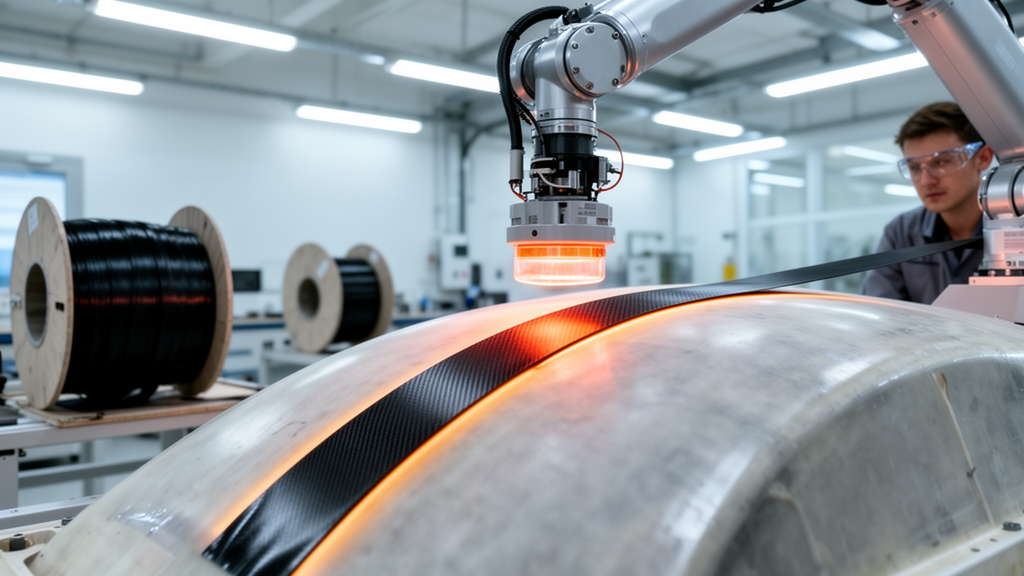
Polycarbonate occupies a distinctive niche among thermoplastic matrices for automated fiber placement. Unlike the semi-crystalline polymers that dominate most AFP research, such as PEEK, PPS, and polyamide 6, polycarbonate is amorphous, meaning it softens gradually over a temperature range rather than melting sharply at a defined point. This characteristic has practical consequences for in-situ consolidation. The window of temperatures over which the material becomes processable is comparatively wide, which gives the IR heating system more tolerance against fluctuations in lamp output, robot speed, and ambient conditions. Amorphous matrices also lack the crystallization kinetics that semi-crystalline polymers exhibit during cooling, so the consolidated laminate does not develop the same degree of crystallinity-dependent property variation through its thickness. The trade-off is that amorphous polymers generally offer lower chemical resistance and lower maximum service temperatures than their semi-crystalline counterparts, which positions CF/PC laminates for semi-structural roles, such as interior aerospace components, automotive panels, and enclosures, rather than primary load-bearing structures exposed to harsh environments.
The choice of infrared heating in this study also reflects a deliberate engineering trade-off. Laser-assisted tape placement offers precise, concentrated energy delivery and is well established in aerospace production, but the equipment is expensive and requires careful safety management. Hot-gas torch heating is gentler but less energy-efficient and can be difficult to control across varying layup geometries. An IR lamp sits between these extremes: it delivers radiant energy that can be tuned in intensity, it heats the tow and substrate without physical contact, and the hardware cost is a fraction of that of a laser system. Radiant heating also couples reasonably well with dark carbon fiber surfaces, which absorb infrared radiation efficiently, reducing the amount of energy wasted on the surrounding air. For a material like CF/PC, whose processing temperatures are moderate compared with high-temperature matrices such as PEEK, the IR lamp provides sufficient heat flux without the need for the extreme power densities that laser systems are designed to deliver.
The two parameters isolated in the design of experiments, compaction force and tool temperature, act on consolidation through complementary mechanisms. Compaction force governs the mechanical squeeze flow of the softened polymer at the interface between the newly placed tow and the substrate beneath it. When the matrix reaches a sufficiently low viscosity, pressure from the roller spreads the polymer across surface asperities, displaces entrapped air, and increases the real contact area between layers. Insufficient force leaves interlaminar gaps and voids that act as crack initiation sites under flexural and shear loading. Excessive force, however, can squeeze matrix material out from the tow edges, thin the resin-rich layer at the interface, and in extreme cases damage the fiber architecture or distort the placed tow. Tool temperature, by contrast, controls the thermal boundary condition of the process. A warmer tool reduces the rate at which heat is drawn away from the bond line, extending the time available for polymer diffusion and wetting before the material cools below its processing range. The heat-sink effect documented in prior AFP studies, in which bond quality degrades through the laminate thickness as successive layers cool the growing stack, is directly moderated by tool temperature. A heated tool essentially raises the baseline from which each new layer must be heated, narrowing the thermal gradient that drives heat away from the interface.
The selection of flexural strength and lap-shear strength as the primary response variables is well matched to the failure modes that poor consolidation produces. Flexural testing loads the laminate in a bending configuration that places the outer plies in tension and compression, making the measurement sensitive to interlaminar weaknesses that allow plies to separate or delaminate under the bending-induced shear stresses. Lap-shear testing, in which two overlapping bonded regions are pulled in opposite directions, directly interrogates the quality of the fusion bond between layers. Fractographic examination of the tested specimens by digital microscopy provides the mechanistic link between process parameters and mechanical outcomes: surfaces that fail cohesively through the polymer, leaving polymer residue on both mating faces, indicate that the fusion bond achieved full integrity, whereas clean interfacial separation with exposed fiber surfaces indicates incomplete wetting and bonding. This combination of quantitative mechanical data and qualitative fractography allows the researchers to distinguish between defects that merely reduce stiffness and those that fundamentally compromise the bond.
The demonstration of laying CF/PC tows onto a rotating three-dimensional printed polyetherimide cylindrical mold deserves particular attention, because it addresses one of the persistent practical barriers to AFP adoption. Conventional AFP tooling is typically machined from metal, which is expensive, heavy, and time-consuming to produce for each new geometry. Additively manufactured tooling offers rapid, low-cost production of complex shapes, but it introduces challenges: printed polymers generally tolerate lower surface temperatures than metals, their thermal conductivity is far lower, and their surface finish and dimensional stability under heat can be inferior. Polyetherimide is a high-temperature amorphous thermoplastic with a glass transition temperature well above the processing temperatures needed for polycarbonate, making it a plausible candidate material for a mold that must withstand repeated exposure to IR heating and hot tows. The low thermal conductivity of a polymer mold, which would be a liability in processes requiring rapid heat extraction, may actually be advantageous here, since it reduces the heat-sink effect that pulls thermal energy away from the bond line during placement. Successfully laying tows on such a mold without secondary machining demonstrates a pathway from printed design to consolidated composite part in a single workflow, which is significant for low-volume production, prototyping, and geometrically complex structures such as ducts, fuselage sections, and pressure vessels.
The drone frame application mentioned in the study illustrates the market segment where CF/PC via IR-assisted AFP is most immediately competitive. Unmanned aerial vehicles demand high stiffness-to-weight ratios, moderate mechanical loads, and increasingly, production volumes that exceed what manual layup or autoclave processing can economically deliver. Thermoplastic matrices add further advantages relevant to this sector: they can be welded for assembly and repair, they resist impact damage better than brittle thermoset matrices in many cases, and they can be re-melted at end of life for recycling, an attribute of growing importance as environmental regulation tightens across the automotive and electronics industries where this material was originally targeted by its supplier.
It is worth situating the reported achievement in the broader context of AFP process science. The finding that IR power and robot speed emerged as the most critical parameters from screening is consistent with the fundamental physics of the process: the energy delivered per unit length of tow, which is the ratio of heating power to layup speed, determines whether the matrix reaches the viscosity needed for bonding. Too little energy per unit length leaves the polymer too stiff to flow and wet the substrate; too much energy degrades the matrix through thermal oxidation or chain scission, and can also cause excessive tow sagging and buckling under the compaction roller. The subsequent identification of compaction force and tool temperature as the next most influential parameters reflects the two-stage nature of consolidation: heating first brings the polymer to a processable state, and the combination of pressure and retained heat then determines how completely the polymer flows and bonds before cooling. The comparison of steel and silicone compaction rollers adds a further dimension, since roller compliance affects how pressure is distributed across the tow and how the roller conforms to curved surfaces, which matters greatly for the cylindrical mold demonstration.
The claim that this is the first investigation of an amorphous matrix, specifically CF/PC, using IR-assisted AFP highlights a gap in the literature. Most published AFP parameter studies have concentrated on semi-crystalline aerospace matrices, partly because certification requirements in aerospace have historically favored materials with well-characterized melting behavior and established databases. Extending AFP process knowledge to amorphous, lower-cost matrices broadens the accessible application space toward consumer products, electronics housings, and ground transportation, where cost per kilogram and cycle time weigh more heavily than ultimate temperature capability. The reported demonstration of improved mechanical properties at optimized settings, achieved out-of-autoclave without secondary consolidation, supports the argument that IR-assisted AFP can produce CF/PC laminates of sufficient quality for semi-structural duty, and the combination of a cost-effective heat source, a moderately priced matrix, and additive tooling suggests a manufacturing chain whose economics could favor adoption in industries where autoclave-grade thermoplastic AFP has remained out of reach.
Subject of Research: Infrared-assisted automated fiber placement of carbon fiber-polycarbonate thermoplastic composites
Article Title: Enhanced manufacturing quality of thermoplastic composites through infrared-assisted automated fiber placement
Article References: Venkatesan, C., Ridhwan, M., Zulkifli, F., Gupta, U., & Silva, A. (2025). Enhanced manufacturing quality of thermoplastic composites through infrared-assisted automated fiber placement. Frontiers in Manufacturing Technology, 5, Article 1649798. https://doi.org/10.3389/fmtec.2025.1649798
Image Credits: AI Generated
DOI: 10.3389/fmtec.2025.1649798
Keywords: automated fiber placement, carbon fiber, thermoplastic composites, infrared heating, process optimization, mechanical properties, polycarbonate, in-situ consolidation, flexural strength, lap-shear strength, 3D printed mold, manufacturing
Cite Scienmag News
Denise Maddox. (October 17, 2026). Infrared-Heated Robot Lays Down Stronger Carbon Fiber Composites. Scienmag. https://scienmag.com/infrared-heated-robot-lays-down-stronger-carbon-fiber-composites/
Denise Maddox. "Infrared-Heated Robot Lays Down Stronger Carbon Fiber Composites." Scienmag, 17 October 2026, https://scienmag.com/infrared-heated-robot-lays-down-stronger-carbon-fiber-composites/. Accessed 17 October 2026.
Denise Maddox. "Infrared-Heated Robot Lays Down Stronger Carbon Fiber Composites." Scienmag. October 17, 2026. https://scienmag.com/infrared-heated-robot-lays-down-stronger-carbon-fiber-composites/


