


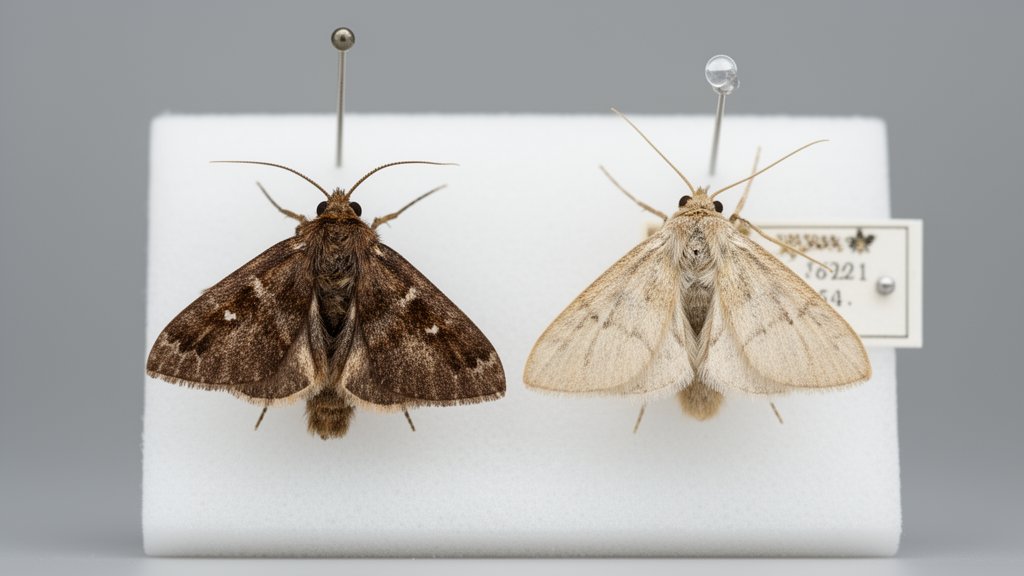
Deep in the Meghri mountains of southern Armenia, at a spot called Alvank in Syunik Province, a light trap switched on one July night in 2022 quietly rewrote the moth map of the South Caucasus. Among the insects drawn to the lamp were specimens belonging to two genera of carpenter moths that had never before been documented anywhere in the region. The find, published in the journal Caucasiana, adds the genera Phragmacossia and Stygia to the regional checklist and hints that the Caucasus, one of the world’s great biodiversity crossroads, still holds surprises for entomologists willing to look closely.
The specimens were collected on 16 July 2022 at Alvank, at 484 meters above sea level, with coordinates recorded using a Garmin GPS device. In total, ten male specimens of Phragmacossia territa, a species first described by Staudinger in 1879, were taken, seven of them destined for the personal collection of Jari Junnilainen and three for that of Lasha-Giorgi Japaridze. A single female of Stygia mosulensis, described by Daniel in 1965, was also captured at the same site and entered Junnilainen’s collection. All were attracted by a light trap, a standard but remarkably effective tool for surveying nocturnal Lepidoptera.
Carpenter moths belong to the family Cossidae, a lineage whose caterpillars are famous for boring into the wood of trees and shrubs, sometimes causing serious damage to orchards and vineyards. The adults are often heavy-bodied, cryptically patterned insects that can be difficult to tell apart by eye. That is why the team behind the new study, which included Risto Haverinen as collector and researchers working with material distributed between two private collections, relied on both external appearance and internal anatomy to confirm the identifications.
The diagnostic work followed established laboratory protocols. Genital dissection, the gold standard for separating closely related cossid species, was performed using the technique published by Robinson in 1976 with modifications suggested by Fibiger and Goater in 1997. Whole abdomens were macerated in a 15 percent potassium hydroxide solution to clear soft tissue before examination. Photographic documentation was equally rigorous: images of Stygia mosulensis were taken with an Olympus OM-D E-M1 Mark II camera fitted with a 60 millimeter macro lens and stacked with Helicon Focus software, while Phragmacossia territa was photographed with a Canon EOS 90D and a Canon EF 60 millimeter f/2.8 macro lens, with images prepared using Zerene Stacker and Adobe Photoshop.
The results are striking because of what they reveal about biogeography. Phragmacossia is a genus of sixteen known nocturnal species with a mainly Palaearctic distribution, and P. territa itself was already known from the Middle East and North Africa, Central and Southwest Asia, including adjacent areas of Türkiye and Iran. Stygia, by contrast, is a far smaller and stranger genus, with only four known species scattered across Southern Europe, the Canary Islands, Morocco, Iran, Türkiye and Iraq. S. mosulensis had previously been recorded in Iraq, Iran, Greece, southern Bulgaria and southern Türkiye, and probably Morocco, so its appearance in Armenia fills a conspicuous gap between its Turkish and Iranian populations.
Perhaps the most intriguing question raised by the new record concerns the daily rhythm of Stygia mosulensis. Members of the subfamily Stygiinae, to which the genus belongs, are generally reported as diurnal, and related species such as Stygia australis and Stygia hades have been described as day-flying insects. Yet both the historical literature and the new Armenian specimen suggest something different for S. mosulensis: it was collected at night, at a light trap, just as earlier records indicate. The authors propose that this species may in fact be nocturnal or crepuscular, a hypothesis that can only be tested through further investigation into its biology and life cycle.
That uncertainty is compounded by a basic gap in knowledge: the host plant and immature stages of S. mosulensis remain entirely unknown. No one has described its caterpillar, its pupa, or the woody plants its larvae may bore into. For a species now documented on three sides of the Armenian border, the absence of any life-history data is a reminder of how little is known even about insects living within easy reach of research institutions. The same applies to several recently described Caucasus cossids, some of which are known only from their type specimens and others from a single sex.
The new records arrive amid a remarkable run of discoveries in the South Caucasus. Recent collecting has yielded Holcocerus didmanidzae from Georgia, Stygiodies nupponenorum from Türkiye, Isoceras shevnini from Armenia, Phragmataecia effendii from Azerbaijan, Dieida versicolor from Türkiye, and, as recently as 2025, Dyspessa gayane from Armenia. New genera have been documented for Georgia, and new species have been described from both Azerbaijan and Armenia. Yet the family’s regional fauna remains poorly studied, with only general overviews published for Georgia and Azerbaijan to date.
The authors argue that the limited state of knowledge makes further discoveries likely. Given how little the Cossidae of the South Caucasus have been surveyed, they consider it probable that additional representatives of the genus Stygia still await discovery in remote regions of Georgia and Azerbaijan. The Alvank site, perched at the southern edge of Armenia near the Iranian border, sits in exactly the kind of transitional zone where Palaearctic and Middle Eastern faunas meet, making the Meghri area a promising target for future surveys.
For now, the ten males of Phragmacossia territa and the lone female of Stygia mosulensis stand as the first evidence that these two genera occur in the South Caucasus, extending the known ranges of both across a mountain barrier that has long shaped the distribution of life in the region. The study, published on 17 June 2025 in Caucasiana under the DOI 10.3897/caucasiana.4.e158970, is a small paper with an outsized message: even in a well-traveled corner of Eurasia, a single night at a light trap can still add entire genera to the map.
Subject of Research: First records of the carpenter moth genera Phragmacossia and Stygia in Armenia and the South Caucasus
Article Title: First records of two genera Phragmacossia Schawerda, 1924 and Stygia Latreille, [1802] in the South Caucasus ( Lepidoptera , Cossidae )
Article References: Japaridze, L.-G., Haverinen, R., Junnilainen, J., Kalashian, M., & Pototskin, A. (2025). First records of two genera Phragmacossia Schawerda, 1924 and Stygia Latreille, [1802] in the South Caucasus (Lepidoptera, Cossidae). Caucasiana, 4, 59-64. https://doi.org/10.3897/caucasiana.4.e158970
Image Credits: AI Generated
DOI: 10.3897/caucasiana.4.e158970
Keywords: entomology, Lepidoptera, Cossidae, Armenia, South Caucasus, biodiversity, new records, First, records, genera, Phragmacossia, Schawerda
Cite Scienmag News
Gavin Prescott. (October 17, 2026). Two carpenter moth genera recorded in the South Caucasus for the first time. Scienmag. https://scienmag.com/two-carpenter-moth-genera-recorded-in-the-south-caucasus-for-the-first-time/
Gavin Prescott. "Two carpenter moth genera recorded in the South Caucasus for the first time." Scienmag, 17 October 2026, https://scienmag.com/two-carpenter-moth-genera-recorded-in-the-south-caucasus-for-the-first-time/. Accessed 17 October 2026.
Gavin Prescott. "Two carpenter moth genera recorded in the South Caucasus for the first time." Scienmag. October 17, 2026. https://scienmag.com/two-carpenter-moth-genera-recorded-in-the-south-caucasus-for-the-first-time/


