


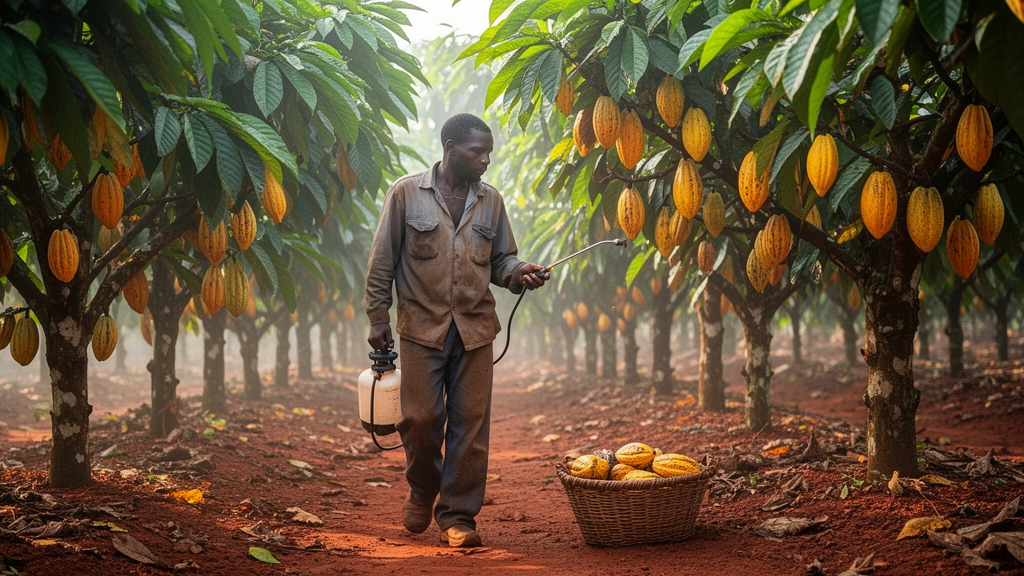
Chocolate begins its journey on small farms scattered across the humid lowlands of southwestern Nigeria, where cocoa trees yield the beans that feed a global industry worth billions. Yet the productivity of these farms hinges on a decision many consumers never think about: which chemicals farmers spray on their crops. A new study from Osun State, Nigeria, published in Frontiers in Environmental Economics, offers some of the most detailed evidence yet that sticking to officially approved pesticides is not just a regulatory box-ticking exercise—it measurably boosts harvests.
The research, led by Pelumi Esther Odunmorayo of the University of Ibadan alongside colleagues at the University of Zululand and the University of Abuja, surveyed 240 cocoa farmers across four major cocoa-producing local government areas in Osun State. Using a multistage sampling design, the team selected villages in Ife South, Atakunmosa West, Ayedaade, and Ife East, then randomly recruited farmers proportionate to village size. The survey, conducted between May and July 2024, achieved a 90 percent response rate and captured detailed information on pesticide use, farm characteristics, and yields.
The headline finding is striking: nearly every farmer in the study—94.58 percent—exclusively used pesticides officially approved for cocoa production, while just 5.42 percent mixed approved products with banned ones. Approved pesticides are those registered and recommended by Nigeria’s Cocoa Research Institute of Nigeria in collaboration with the Federal Ministry of Agriculture and Food Security, chosen for their efficacy against pests and diseases and their safety for humans and the environment. Banned pesticides, by contrast, are prohibited because they pose risks to health, ecosystems, or international residue standards.
Among the approved products, certain brand names dominated. Red Force was the most widely used fungicide, applied by 38.8 percent of farmers, followed by Ultimax Plus at 29.6 percent and Mackecknie Gold at 27.5 percent. For insecticides, a product called Best led at 37.9 percent, while the herbicide Force Up was by far the most popular, used by 58.3 percent of respondents. Yet the small minority who broke the rules turned to chemicals such as Rocket, Copper Sulfate, and Gammalin 20—substances that have been prohibited precisely because of their dangers.
To understand what drives compliance, the researchers employed a double hurdle model, a statistical framework that separates two distinct decisions: whether a farmer complies exclusively with approved pesticides, and how intensively those pesticides are applied. The first hurdle, modeled with probit regression, revealed that age, education, and farming experience all significantly increased the likelihood of compliance. Each additional year of education raised the probability of compliance by 4.36 percent, while each additional year of farming experience boosted it by 11.18 percent. Age showed a positive but diminishing effect, suggesting an optimal age range beyond which compliance declines.
The second hurdle, a truncated regression, examined how frequently farmers applied approved pesticides. Here, age, farming experience, farm size, and previous cocoa yield all significantly influenced intensity of use. Larger farms and higher past yields were associated with more frequent applications, hinting that farmers who see the payoff from pest control invest more heavily in it. Notably, access to credit and total income did not significantly predict compliance—a surprise given that financial constraints are often cited as barriers to adopting improved practices. The authors suggest that widespread availability of approved products and strong extension support in the region may have reduced the importance of financial capital.
The study’s most consequential analysis used an endogenous switching regression model to estimate the productivity impact of compliance while correcting for self-selection bias—the fact that farmers who choose to comply may differ systematically from those who do not. The results showed that compliant farmers achieved a mean cocoa yield of 0.482 tons per hectare, compared with 0.430 tons per hectare among non-compliant farmers, a difference that was statistically significant in a Welch’s t-test. Treatment effect estimates suggested that compliance generated an 11 percent productivity gain for those who complied, while non-compliant farmers could potentially increase yields by 12.8 percent if they switched to full compliance.
However, the authors urge caution. The Wald test comparing treatment effects was not statistically significant, meaning the estimated productivity differences should be viewed as suggestive rather than definitive. The small number of non-compliant farmers—just 13 out of 240—also limits the precision of the estimates. Moreover, because compliance was self-reported, some underreporting of banned pesticide use cannot be ruled out, despite assurances of confidentiality. The researchers acknowledge these limitations and call for longitudinal or experimental studies to confirm the relationship.
Beyond the numbers, the study highlights persistent obstacles to full compliance. Farmers cited weather fluctuations, labor shortages, and high input costs as major constraints, with 65.83 percent pointing to weather-related challenges. All farmers reported that their current spray frequency was inadequate, suggesting that even compliant farmers struggle to apply pesticides as often as optimal. These barriers underscore that compliance is embedded within broader production systems shaped by climate, labor markets, and economics—not simply a matter of individual choice.
The implications extend well beyond Nigeria. Cocoa is grown across West Africa, Southeast Asia, and Latin America, and many producing countries face similar challenges of weak pesticide regulation, counterfeit products, and limited extension services. The authors argue that strengthening extension services, expanding farmer education, and enforcing pesticide regulations are essential for sustainable cocoa sector transformation. They also recommend subsidies, credit facilities, and cooperative-based input distribution to improve access to affordable approved pesticides. As global demand for chocolate continues to rise, ensuring that the beans behind it are grown safely and productively may depend on getting these fundamentals right—farm by farm, spray by spray.
Subject of Research: Effect of compliance with approved pesticide use on cocoa productivity among smallholder farmers in Osun State, Nigeria
Article Title: Approved pesticide compliance, productivity enhancement, and sustainable cocoa production among smallholder farmers in Nigeria
Article References: Odunmorayo, P. E., Obi-Egbedi, O., Olaleye, P. J., & Kolapo, A. (2026). Approved pesticide compliance, productivity enhancement, and sustainable cocoa production among smallholder farmers in Nigeria. Frontiers in Environmental Economics, 5, Article 1885584. https://doi.org/10.3389/frevc.2026.1885584
Image Credits: AI Generated
DOI: 10.3389/frevc.2026.1885584
Keywords: cocoa production, pesticide compliance, Nigeria, smallholder farmers, agricultural economics, food safety, sustainable agriculture, Approved, pesticide, compliance, productivity, enhancement
Cite Scienmag News
Alan Morgan. (October 17, 2026). Playing by the Rules Pays: Approved Pesticides Boost Cocoa Yields in Nigeria. Scienmag. https://scienmag.com/playing-by-the-rules-pays-approved-pesticides-boost-cocoa-yields-in-nigeria/
Alan Morgan. "Playing by the Rules Pays: Approved Pesticides Boost Cocoa Yields in Nigeria." Scienmag, 17 October 2026, https://scienmag.com/playing-by-the-rules-pays-approved-pesticides-boost-cocoa-yields-in-nigeria/. Accessed 17 October 2026.
Alan Morgan. "Playing by the Rules Pays: Approved Pesticides Boost Cocoa Yields in Nigeria." Scienmag. October 17, 2026. https://scienmag.com/playing-by-the-rules-pays-approved-pesticides-boost-cocoa-yields-in-nigeria/


