


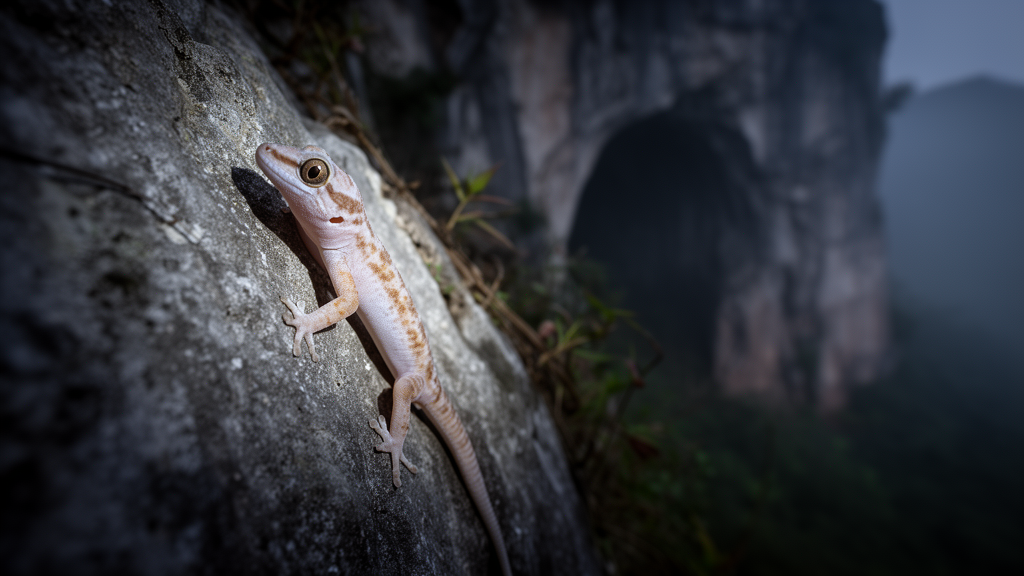
On the walls of a driving school in Changshun County, southern Guizhou Province, China, geckos clung to wooden cabins and an abandoned concrete building. Field surveys in June and August 2025 collected nine specimens that, after months of molecular and morphological analysis, proved to belong to a species new to science. Described in the journal Zoosystematics and Evolution as Gekko (Japonigekko) qiannanensis, the reptile is the latest addition to a rapidly growing roster of karst-adapted geckos from South China’s limestone landscapes, and it brings the number of recognized species in the subgenus Japonigekko to 42 globally, of which 28 are now recorded from China.
The discovery is significant not merely because it adds a name to a checklist, but because of what it reveals about how life diversifies in one of Earth’s most fragmented habitats. Karst terrain, sculpted over millions of years from soluble limestone, is riddled with fissured cliffs, deep caves, and isolated outcrops separated by unsuitable lowland. This patchwork creates ecological islands. Species that specialize on karst become trapped on individual fragments, gene flow between populations is severed, and over evolutionary time each isolated population follows its own trajectory. The result is allopatric speciation, the generation of new species through geographic isolation, and it is precisely the pattern that the new gecko’s phylogenetic position supports.
To establish that the Changshun specimens were indeed a distinct species, the research team, led by Jie Huang of Jishou University, applied an integrative taxonomy approach that combined DNA sequence data with detailed morphometrics. Liver tissues from four individuals yielded fragments of two mitochondrial genes, 16S rRNA and NADH dehydrogenase subunit 2, which together provide sufficient species coverage across Japonigekko. Maximum-likelihood and Bayesian-inference phylogenetic analyses, based on 1,549 base pairs of concatenated sequence, placed the new gecko in a highly supported lineage as the sister species to G. paucituberculatus, with uncorrected genetic distances of 5.1 percent for the 16S gene and 9.5 percent for the ND2 gene between the two species. Those distances are large enough to confirm species-level separation.
The phylogenetic tree tells a striking biogeographic story. The new species clusters with G. fengshanensis, G. liboensis, G. kwangsiensis, G. paucituberculatus, and G. tesselatus in a well-supported clade. With the exception of G. tesselatus, a dry-hot valley species from Sichuan Province far to the northwest, every member of this group is karst-adapted and has diversified within a relatively small area along the boundary between Guizhou Province and the Guangxi Zhuang Autonomous Region. Two-thirds of the species in this clade have been described in the past three years alone, a rate of discovery that suggests the intervening karst regions may harbor substantial undiscovered gecko diversity.
Morphologically, G. qiannanensis is a moderate-sized gecko. Adult males measure 65.4 to 82.9 millimeters in snout-vent length, while adult females are slightly larger at 77.7 to 91.7 millimeters. The dorsum is earth gray with six dirty-white bands between the nape and sacrum, and the tail carries seven additional bands. The species bears two enlarged postmentals, nares in contact with the rostral and no internasal, 28 to 38 interorbital scales, 134 to 155 midbody scale rows, and 10 to 11 precloacal pores in males. But the single most diagnostic trait, the one that separates it from all its karst-adapted congeners, is the development of its toe webbing.
Interdigital webbing is the defining synapomorphy of the subgenus Japonigekko, yet its extent varies enormously among species, from rudimentary to extensive. In G. qiannanensis the webbing is moderately developed and originates proximal to the subdigital lamellae, the enlarged scales beneath the digits. In its phylogenetic sister species G. paucituberculatus, webbing is weakly developed and typically begins distal to the lamellae. The new species also has more subdigital lamellae on the fourth fingers and fourth toes, 14 to 16 and 14 to 17 respectively, compared with 12 to 13 and 11 to 13 in G. paucituberculatus. Principal component analysis of body proportions, adjusted for body size, produced distinct non-overlapping clusters for the new species in both sexes, and a canonical discriminant analysis correctly assigned all 39 individuals to their species with zero error.
The webbing character also exposes a methodological problem in gecko taxonomy. Previous studies have quantified webbing in at least three incompatible ways: counting scale rows across the deepest point of the web, applying a binary present-or-absent criterion based on whether webbing spans one-third of the digit length, or using a multistate system of developmental degrees ranging from none to well developed. The authors argue that the multistate framework is far more informative. Under the binary system, weakly webbed species must be lumped with non-webbed ones, obscuring real differences. The discovery that G. ichangensis can be distinguished from G. japonicus precisely by the presence of weakly developed webbing demonstrates how much information the coarser framework discards, and how trait descriptions may ultimately reflect degrees of long-term environmental adaptation.
Field observations added an unexpected behavioral note. During a January 2026 revisit to the collection site, when temperatures hovered near 10 degrees Celsius and no geckos were active, the researchers found 16 adhesive gecko eggs attached to a wall roughly three meters high at the corner of an old dilapidated house. Fourteen had already hatched and two were in the process of hatching. The eggs were clustered and adhered to one another, some in groups of up to six, suggesting that this species practices communal egg-laying and may lay two or more eggs at a time. Two hatching eggs, collected with attached wall fragments, were kept under observation; one hatched on 23 January 2026, producing a juvenile that was photographed 13 days later.
The type locality sits at approximately 1,030 meters above sea level in the Miaoling Mountain area, a subtropical monsoon humid region of typical karst landforms. Geckos were collected on overcast, drizzly evenings near 20 degrees Celsius, found on the walls of human structures at the remote edge of town. This association with buildings, common among geckos, does not diminish the species’ karst affinity; rather, it illustrates how karst specialists exploit the artificial cliff faces that human construction provides. The holotype and six paratypes are deposited at Jishou University, with two additional paratypes at the Chengdu Institute of Biology of the Chinese Academy of Sciences.
The description of G. qiannanensis underscores a broader truth about South China’s karst regions: they are biodiversity arks, generating and sustaining unique biota through adaptive radiation, yet their herpetofaunal diversity remains incompletely documented. Studies on other karst-specialist reptile genera such as Goniurosaurus and Cyrtodactylus have shown the same signature of fragmented limestone driving allopatric speciation. As surveys continue across the fissured cliffs and cave systems of Guizhou and Guangxi, the growing roster of Japonigekko geckos, now 42 species strong, is a reminder that some of the planet’s richest evolutionary laboratories are hiding in plain sight on limestone walls, waiting for a flashlight and a patient observer.
Subject of Research: Biodiversity
Article Title: Gekko ( Japonigekko ) qiannanensis , a new karst-adapted gecko ( Squamata , Gekkonidae ) from southern Guizhou, China
Article References: Huang, J., Ma, S., Xiao, Y., Zhang, F., Pu, Z., Ran, J., Zhu, J., Jiang, W., & Wu, J. (2026). Gekko (Japonigekko) qiannanensis, a new karst-adapted gecko (Squamata, Gekkonidae) from southern Guizhou, China. Zoosystematics and Evolution, 102(4), 973-987. https://doi.org/10.3897/zse.102.189932
Image Credits: AI Generated
Keywords: gecko, karst, Guizhou, China, new species, herpetology, speciation, taxonomy, Gekko, Japonigekko, qiannanensis, karst-adapted
Cite Scienmag News
Drew Townsend. (October 17, 2026). New karst gecko from southern Guizhou brings China’s Japonigekko tally to 28. Scienmag. https://scienmag.com/new-karst-gecko-from-southern-guizhou-brings-chinas-japonigekko-tally-to-28/
Drew Townsend. "New karst gecko from southern Guizhou brings China’s Japonigekko tally to 28." Scienmag, 17 October 2026, https://scienmag.com/new-karst-gecko-from-southern-guizhou-brings-chinas-japonigekko-tally-to-28/. Accessed 17 October 2026.
Drew Townsend. "New karst gecko from southern Guizhou brings China’s Japonigekko tally to 28." Scienmag. October 17, 2026. https://scienmag.com/new-karst-gecko-from-southern-guizhou-brings-chinas-japonigekko-tally-to-28/


