


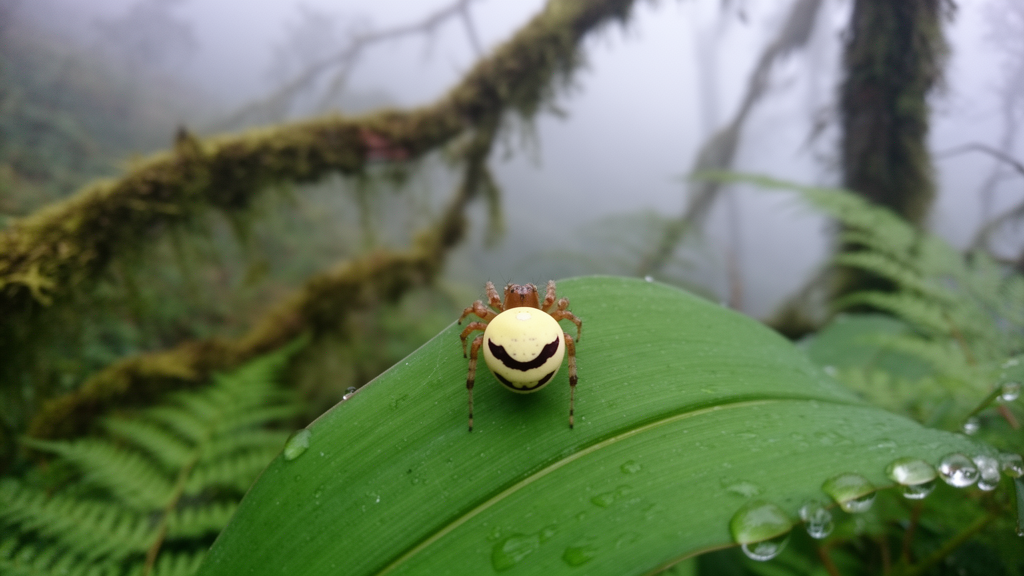
Deep in the moist temperate deciduous forests of Uttarakhand, at altitudes between 2,000 and 2,200 metres, a spider no larger than a grain of rice is wearing a smile on its abdomen. Researchers surveying the Western Himalayas have described a new species of comb-footed spider, Theridion himalayana, whose abdomen bears patterns of red, black and white dots arranged like a smiling face — the same striking motif made famous by the Hawaiian Happy-Face Spider, Theridion grallator. The discovery, published in the journal Evolutionary Systematics, is remarkable not only because the smiling-face archetype has now appeared on a second continent, but because the Himalayan species exhibits 32 distinct colour morphs in both sexes, rivaling the polymorphic diversity of its Hawaiian counterpart while being genetically a completely separate lineage.
The new species was collected during fieldwork in Chamoli and Rudraprayag districts from April to October of 2023 and 2024, using direct capture, bush beating, pitfalls and sweeping across sixteen 100-metre by 50-metre plots. In total, 61 individuals were analysed — 24 males and 37 females, including 40 juveniles — drawn from three localities: Makku, Tala and Mandal. Each specimen was examined under a stereo zoom microscope, its abdominal pattern hand-illustrated and later digitized, yielding 32 distinct morphs that the team organized into five major groups: Red Blob White Ring (RBWR), Red Blob Black Ring (RBBR), Planarian Base (PB), Non-Planarian Base (NPB) and Whole Ring (WR). The RBWR morph, with its red pigmentation surrounded by a white reflective ring of guanine deposits, was the most common, accounting for 45.9 percent of individuals, followed by the unpatterned NPB baseline at 34.4 percent.
What emerged from the statistical analysis was perhaps the most intriguing finding of the study. Colour morph frequencies showed a highly significant association with sex, with a chi-square value of 52.92, a p-value below 0.001 and a Cramér’s V effect size of 0.93 — a near-perfect segregation. Males were almost entirely NPB, the cryptic, unpatterned morph, at 87.5 percent, with no RBWR or WR individuals at all. Females showed the mirror image: 75.7 percent were RBWR, the boldly patterned smiling-face morph, and the NPB morph was completely absent. This near-complete mutual exclusion of phenotypes between the sexes stands in sharp contrast to the Hawaiian and Californian polymorphic spiders, in which colour morphs are inherited through autosomal Mendelian mechanisms at broadly equivalent frequencies in both sexes. The authors suggest, as a hypothesis to be tested, that the primary NPB–RBWR dichotomy could be governed by a sex-linked locus, most plausibly X-linked, though reared populations will be needed for confirmation.
The taxonomic description itself is meticulous. The female holotype, deposited at the Zoological Survey of India in Berhampur, Odisha, measures just 2.94 millimetres in total length, with a translucent yellow carapace radiating green hues from the centre. The male, at 2.23 millimetres, has a smaller body but relatively longer legs and a narrower abdomen. Scanning electron microscopy revealed the fine architecture of the spinnerets — roughly 35 to 40 piriform gland spigots on the anterior lateral spinnerets — and six types of sensory structures on the legs, including trichobothria, lyriform organs and the tarsal comb typical of the subfamily Theridiinae. Pollen grains were even found adhering to the base of mechanosensory sensilla on the tarsal comb, a hint of the spider’s intimate association with the leaf surfaces it inhabits.
Genitalia provided the decisive diagnostic characters. In T. himalayana, the copulatory ducts are elongate, strongly curved and protrude forward in a distinctive sew-hook–like configuration, running almost parallel before terminating downward, while the short fertilisation ducts diverge upward in a V-shape. This combination differs clearly from the S-shaped, coiled copulatory ducts of T. odisha, the sickle-shaped fertilisation ducts of T. melanostictum and the bow-tie genitalia of the Hawaiian T. grallator. Although the new species resembles T. grallator most closely in general morphology and abdominal pattern, the genital structures of both sexes are entirely different — a classic case of convergent external appearance masking deep anatomical divergence. The paper also presents a dichotomous key to the six Theridion species now described from India, based on female genitalia.
The phylogenetic analysis added a further layer of surprise. Using the mitochondrial COI marker, the team compared the new species against 44 theridiid species, including members of Theridion, Coleosoma, Meotipa, Parasteatoda, Chrysso and other genera, with two non-theridiid outgroups. Maximum-likelihood reconstruction with 1,000 ultrafast bootstrap replicates and Bayesian inference with four Markov chain Monte Carlo runs of two million generations placed T. himalayana in a well-supported subclade with T. ohlerti and Coleosoma acutiventer — entirely separate from the Nearctic group containing T. californicum and from the Hawaiian lineage, in which T. grallator clusters with T. posticatum and T. kauaiense near Exalbidion. Pairwise COI distances from the Hawaiian Happy-Face Spider came to about 10.7 percent, and the abstract reports roughly 8.5 percent divergence, well within the range of interspecific differentiation for the family. In other words, the Himalayan smiling-face spider is not a stray relative of the Hawaiian radiation but a separately evolved Asian species.
The convergence of the smiling-face pattern across three geographically and phylogenetically distant lineages — Hawaii, the Himalayas and Chile, where Selkirkiella alboguttata shows a related red-front pattern — raises compelling evolutionary questions. The authors hypothesize that the repetition of specific pattern motifs may reflect a conserved genomic ground plan, a developmental framework channeling phenotypic variation toward recurrent combinations of yellow, red, dark-brown and white guanine-based pigmentation. Equally puzzling is the ecological parallel: all major polymorphic theridiid species are associated with the undersides of broad leaves, an open two-dimensional substrate exposed to visual predators from above and below. T. himalayana lives on the abaxial side of leaves of Daphniphyllum himalense, Machilus sp., Cinnamomum tamala and Hedychium sp., building sparse webs of long silk strands parallel to the leaf surface — and, intriguingly, T. grallator has also been reported on Hedychium, a ginger lily native to the Eastern Himalayas that was introduced to the Hawaiian archipelago.
The sex-linked dimorphism may also carry ecological meaning. The authors propose that mature males, which wander obligately in search of females, face intense visual predation from gleaning birds, and the dominant cryptic NPB morph may offer background matching against leaf undersurfaces during this high-risk dispersal phase. Sedentary adult females guarding egg sacs, by contrast, wear the patterned RBWR morph, which may function as disruptive coloration. If correct, this would challenge the classical apostatic selection theory, which predicts that polymorphism is maintained by predator search images favouring rare morphs — the complete absence of the cryptic NPB morph in females violates that prediction outright. Instead, sex-linked genetic control may enable role-specific polymorphisms, with each sex evolving phenotypes optimized for its own life-history stage, and balancing selection operating within each sex rather than across the population as a whole.
The natural history notes add vivid texture to the description. The spiders were found nesting singly on healthy leaves, sometimes on leaves of Daphniphyllum himalense infested by gall-forming psyllids, which may serve as a food source. Prey captured in the underside webs were mostly dipteran flies and crane flies. Mature adults appeared mainly in October, apparently ready for copulation, and no egg sacs were found, suggesting eggs are laid after that month. Notably, the species was never recorded from pitfall traps, confirming an exclusively arboreal lifestyle restricted to leaf undersides, as in T. californicum and T. grallator. Unlike many theridiids, the spider is not aggressive or fast-moving and does not drop or feign death when disturbed. Even more strikingly, insects, amphibians and other arachnids sharing the same habitat — from psyllids and aphids to the frog Amolops formosus — were found wearing similar combinations of red, green, yellow and black on their backs, hinting at possible Batesian or Müllerian mimicry and parallel evolution within the montane forest community.
The discovery also carries a conservation warning. The known localities lie close to a National Highway bordering the Kedarnath Wildlife Sanctuary, where tourist movement and construction activities are disturbing the habitat. Because juveniles dominate the population before October, disturbance during that window could significantly reduce the species’ ability to mature, reproduce and proliferate. The authors emphasize that mapping the spider’s association with native flora across seasons will be essential to understanding its microhabitat requirements and vulnerability. Beyond the immediate threat, T. himalayana offers science an apt new model for studying polymorphism: a species in which the smiling-face archetype has evolved independently in a landlocked temperate forest, sex-linked genetic control appears to reshape the very mechanisms maintaining colour variation, and 32 morphs persist despite extreme dimorphism. Future work — controlled laboratory crosses, cytogenetic analysis, transcriptomic comparisons and aviary predation experiments — will determine how sexual dimorphism, ecological specialization and genetic architecture interact to shape one of the most vivid examples of convergent evolution yet documented in spiders.
Subject of Research: Discovery and description of a new polymorphic Happy-Face Spider species, Theridion himalayana, from the Western Himalayas, India
Article Title: On the discovery of a new polymorphic Happy-Face Spider ( Araneae , Theridiidae ) from the Western Himalayas, India, with notes on its natural history
Article References: Tripathy, A., & Priyadarshini, D. (2026). On the discovery of a new polymorphic Happy-Face Spider (Araneae, Theridiidae) from the Western Himalayas, India, with notes on its natural history. Evolutionary Systematics, 10(1), 63-84. https://doi.org/10.3897/evolsyst.10.174338
Image Credits: AI Generated
DOI: 10.3897/evolsyst.10.174338
Keywords: Theridion himalayana, Happy-Face Spider, colour polymorphism, spiders, Himalayas, convergent evolution, Theridiidae, Uttarakhand, taxonomy, COI phylogeny, discovery, polymorphic
Cite Scienmag News
Gavin Prescott. (October 17, 2026). New Happy-Face Spider With 32 Colour Morphs Discovered in the Himalayas. Scienmag. https://scienmag.com/new-happy-face-spider-with-32-colour-morphs-discovered-in-the-himalayas/
Gavin Prescott. "New Happy-Face Spider With 32 Colour Morphs Discovered in the Himalayas." Scienmag, 17 October 2026, https://scienmag.com/new-happy-face-spider-with-32-colour-morphs-discovered-in-the-himalayas/. Accessed 17 October 2026.
Gavin Prescott. "New Happy-Face Spider With 32 Colour Morphs Discovered in the Himalayas." Scienmag. October 17, 2026. https://scienmag.com/new-happy-face-spider-with-32-colour-morphs-discovered-in-the-himalayas/


