


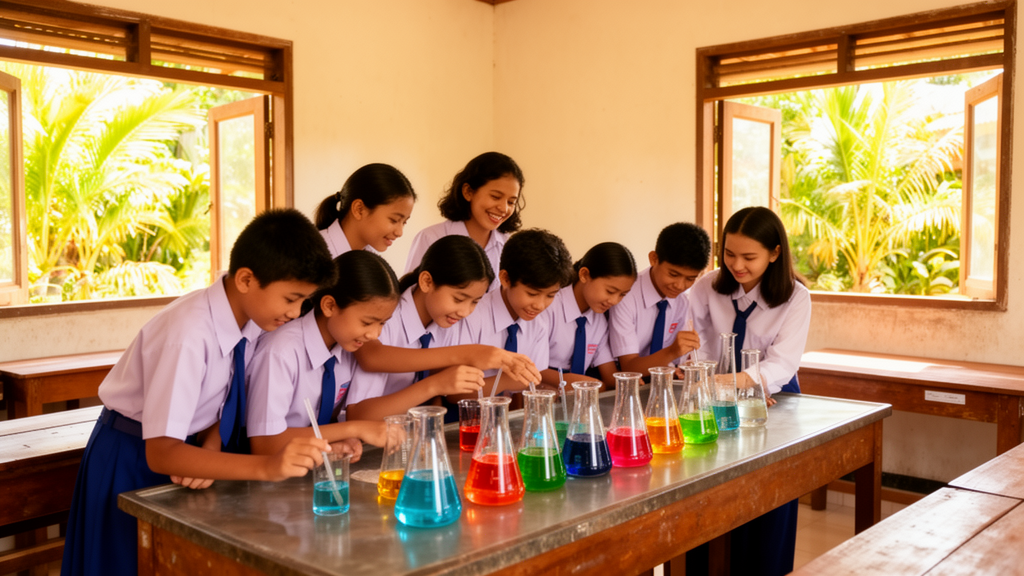
Chemistry classrooms in Bali have become the unlikely testing ground for a teaching model that its designers say can sharpen not one but three kinds of thinking at once. In a quasi-experimental study published in Discover Education, researchers from Universitas Pendidikan Ganesha and partner institutions compared a new instructional framework, known by the acronym CHASICA, with conventional problem-based learning among 300 Grade 12 students from four public high schools in Bali Province, Indonesia. The results suggest that weaving authentic challenges, socioscientific issues and structured counterargumentation into a single learning cycle produces markedly stronger gains in critical, creative and caring thinking than problem-based learning alone.
The study rests on a theoretical idea that has long circulated in philosophy of education but has rarely been operationalized in chemistry classrooms. Drawing on Matthew Lipman’s framework of multidimensional thinking, the authors treat critical, creative and caring thinking as three interlocking dimensions of higher-order reasoning. Critical thinking allows students to evaluate claims and evidence; creative thinking supports the generation and refinement of alternative solutions; and caring thinking directs attention to empathy, ethical reflection and social responsibility. In learning built around socioscientific issues, these dimensions are inseparable, because students must interpret scientific information while weighing moral, social and environmental consequences.
CHASICA, which stands for Challenge-Socioscientific Issues-Counterargumentation, integrates three instructional approaches that are usually applied separately. Challenge-based learning functions as the organizing cycle, engaging students with authentic problems that require them to identify issues, investigate information, design solutions, take action and reflect. Socioscientific issues supply the socially and ethically meaningful context, connecting chemistry concepts such as electrical conductivity and colligative properties of solutions to real-world concerns like water quality, energy policy and public health. Counterargumentation adds a discursive mechanism, requiring students to construct evidence-based claims, examine competing perspectives, respond to critique and revise their positions when the evidence warrants it.
The intervention unfolded over ten sessions, each lasting three class periods of 135 minutes, following the standard chemistry timetable in the participating schools. One session served as the pretest, eight sessions carried the core instruction for either CHASICA or problem-based learning, and one session served as the posttest. In the CHASICA classrooms, students began with a socioscientific trigger that introduced a socially and scientifically relevant chemistry problem, then transformed the issue into an authentic challenge through the challenge-based learning structure. They formulated essential questions, investigated chemical concepts, designed possible solutions, engaged in counterargumentation to evaluate competing ideas, and closed with reflection and publication, where they communicated conclusions and considered the ethical, social and environmental implications of their proposals. The control group progressed through problem orientation, investigation, solution development, presentation and evaluation without explicit socioscientific framing or structured counterargumentation.
Participants were aged between 16 and 18 and enrolled in Indonesia’s Independent Curriculum. Within each school, the same chemistry teacher taught both the CHASICA and problem-based learning classes, a design choice intended to reduce teacher-related variation in instructional style and classroom management. Before the intervention, all participating teachers received standardized training on both models, including the core procedures of challenge-based learning, socioscientific issue integration and collaborative argumentation. Implementation fidelity was monitored through structured classroom observations, which indicated that more than 90 percent of the planned core instructional components were delivered as intended. Intact classes were retained because individual randomization was not feasible, so the study estimates adjusted between-group differences rather than a definitive individual-level causal effect.
The instruments were built from established theoretical frameworks and reviewed by three experts in science education and educational assessment. Critical thinking skills were measured with a 25-item multiple-choice test based on the Delphi Project framework, covering interpretation, analysis, inference, evaluation and explanation, with internal consistency reliability of 0.789 using the Kuder-Richardson Formula 20. Creative thinking skills were assessed with a 25-item instrument grounded in Torrance’s framework, comprising 20 objective items on flexibility, originality and elaboration plus five open-ended fluency tasks, yielding a Cronbach’s alpha of 0.793. Caring thinking dispositions were measured with a 20-item Likert-scale inventory developed from Lipman’s conceptualization, spanning appreciative, affective, active, normative and empathetic dimensions, with a high internal consistency of 0.921. Aiken’s V coefficients for example items ranged from 0.789 to 0.878, indicating strong expert agreement, and item-total correlations fell within acceptable ranges.
The statistical analysis was deliberately conservative. Because several analysis of covariance assumptions were not fully met, the researchers used Pillai’s Trace as the primary multivariate statistic owing to its robustness under assumption violations. The multivariate analysis of covariance, with pretest scores entered as covariates, revealed a significant difference between the learning groups after controlling for students’ prior abilities, Pillai’s Trace = 0.757, F(3, 293) = 304.49, p < 0.001, indicating a large multivariate effect. Follow-up univariate analyses showed that the learning group had a significant effect on all three dimensions. For critical thinking skills, F(1, 297) = 181.02, p < 0.001, with a large effect size of 0.379 in partial eta squared; for creative thinking skills, F(1, 297) = 266.31, p < 0.001, with an effect size of 0.473; and for caring thinking dispositions, F(1, 297) = 783.15, p < 0.001, with an effect size of 0.725. The homogeneity of regression slopes assumption was met for caring thinking dispositions but not fully for critical and creative thinking skills, so those results were interpreted cautiously, and interaction terms were included where the relationship between pretest and posttest scores differed across groups.
The raw score patterns tell a striking story. Students in the CHASICA group improved from a mean of 60.84 to 78.00 on critical thinking skills, from 54.32 to 72.74 on creative thinking skills, and from 65.18 to 83.79 on caring thinking dispositions, all converted to a standardized 0-100 scale. The problem-based learning group improved more modestly, reaching posttest means of 67.56, 63.68 and 73.22 on the same dimensions. After adjusting for pretest scores, the CHASICA group outperformed the control group on all three dimensions, with the largest adjusted mean difference observed in caring thinking dispositions, followed by creative thinking skills and critical thinking skills. The relatively small standard errors across variables indicated stable estimates and adequate statistical precision.
The largest effect appeared in caring thinking, a dimension that the authors note is rarely designed as an explicit instructional outcome in science education. They attribute this to the socioscientific framing and counterargumentation activities, which prompted ethical reflection and consideration of societal consequences. In their discussion, the researchers suggest that caring thinking may act as a catalyst for engaging critical and creative processes, because students who reflect on the human and environmental stakes of a chemistry problem become more invested in evaluating evidence and refining solutions. They also acknowledge a potential tension: extended ethical reflection or social discussion may reduce time available for deeper symbolic or quantitative chemical problem-solving, so the model should be implemented with careful balance between conceptual chemistry work, solution design, counterargumentation and ethical reflection.
Perception data reinforced the quantitative findings, although the authors treat them as descriptions of classroom experience rather than independent evidence of effectiveness. Teachers reported a higher overall mean rating for CHASICA at 4.48 on a five-point scale, compared with 3.99 for problem-based learning, while students rated CHASICA at 4.01 versus 3.55. Across reported dimensions, CHASICA was generally perceived as more supportive of critical thinking, creativity, collaboration, learning independence and real-world relevance. The authors acknowledge limitations, including the quasi-experimental design with intact classrooms, the focus on chemistry topics with strong socioscientific characteristics, and reliance on quantitative measures. They call for future research employing randomized or longitudinal designs across diverse disciplines and educational levels, potentially using mixed methods to capture the dynamics of multidimensional thinking. The study was funded by Indonesia’s Ministry of Higher Education, Science, and Technology and received ethical approval from the Cenderawasih University Health Research Ethics Committee, with informed consent obtained from all participants and their guardians where applicable.
Subject of Research: Fostering multidimensional thinking in chemistry education through an integrated challenge-based learning model with socioscientific issues and counterargumentation
Article Title: Fostering multidimensional thinking in chemistry education through an integrated challenge-based learning model with socioscientific issues and counterargumentation
Article References: Redhana, I. W., Suardana, I. N., Aditya, D. M. K. W. P., Ishwariasih, N. P. I., Selamet, K., Haryani, S., & Triwiyono (2026). Fostering multidimensional thinking in chemistry education through an integrated challenge-based learning model with socioscientific issues and counterargumentation. Discover Education, 5(1), Article 1189. https://doi.org/10.1007/s44217-026-02163-9
Image Credits: AI Generated
DOI: 10.1007/s44217-026-02163-9
Keywords: Fostering, multidimensional, thinking, chemistry, education, integrated, challenge-based, learning, model, socioscientific, issues, counterargumentation
Cite Scienmag News
Bethany Barker. (October 17, 2026). New Chemistry Model CHASICA Boosts Critical, Creative and Caring Thinking in Bali Schools. Scienmag. https://scienmag.com/new-chemistry-model-chasica-boosts-critical-creative-and-caring-thinking-in-bali-schools/
Bethany Barker. "New Chemistry Model CHASICA Boosts Critical, Creative and Caring Thinking in Bali Schools." Scienmag, 17 October 2026, https://scienmag.com/new-chemistry-model-chasica-boosts-critical-creative-and-caring-thinking-in-bali-schools/. Accessed 17 October 2026.
Bethany Barker. "New Chemistry Model CHASICA Boosts Critical, Creative and Caring Thinking in Bali Schools." Scienmag. October 17, 2026. https://scienmag.com/new-chemistry-model-chasica-boosts-critical-creative-and-caring-thinking-in-bali-schools/


