


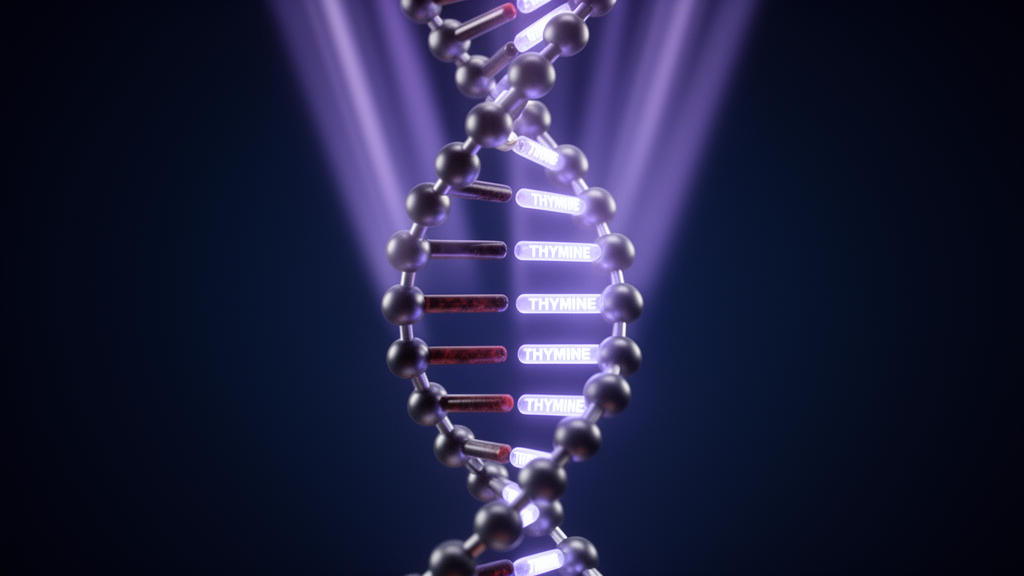
One of the deepest puzzles in molecular evolution may finally have an answer, and it comes not from a biology laboratory but from an electrical engineering lab. Researchers at Texas A&M University, led by Dr. Peter Rentzepis of the Department of Electrical and Computer Engineering, together with research assistants Keyvan Khosh Abady and Negar Karpourazar, have used light-based techniques to probe why DNA replaced RNA as the primary carrier of genetic information on the early Earth. Their findings, published in Proceedings of the National Academy of Sciences, suggest that a seemingly risky chemical swap billions of years ago was in fact a sophisticated survival strategy that allowed the first genomes to endure the brutal radiation environment of the primordial planet.
The mystery centers on a single molecular substitution. In RNA, one of the four main building blocks is uracil, a pyrimidine base that pairs with adenine. When life transitioned to DNA, uracil was replaced by thymine, a methylated version of the same molecule. Chemically, the two bases are nearly identical, differing only by a single methyl group, so the substitution has long appeared redundant. What makes the change genuinely puzzling is that thymine is more susceptible to ultraviolet damage than uracil, at least by conventional measures. On the young Earth, before photosynthetic organisms built up a protective ozone layer, the surface was bathed in intense solar UV radiation. Choosing the more fragile base would seem to be an evolutionary blunder, and generations of scientists have asked why nature made such an unconventional choice.
To resolve the paradox, the Texas A&M team subjected thymine and uracil to controlled ultraviolet conditions designed to mimic the radiation environment of primordial Earth. Rather than relying on standard biochemical assays, they turned to biophotonics, an interdisciplinary field that applies light-based spectroscopic methods to biological molecules. Using absorption, fluorescence and Raman spectroscopy, the researchers tracked in real time how UV energy was absorbed, redistributed and dissipated within each base. This approach allowed them to observe not just whether the molecules were damaged, but precisely what form the damage took and how the excited molecules behaved in the instants after absorbing a photon.
The measurements revealed a striking difference between the two bases. Thymine, the team found, tends to channel UV damage into a more reversible form. Instead of allowing absorbed ultraviolet energy to break chemical bonds in ways that permanently corrupt the molecule, thymine funnels the excitation into pathways from which the molecule can recover. In other words, the base absorbs the harmful energy and then releases it in a way that leaves the genetic information intact. This behavior suggests that early genetic molecules may have survived intense sunlight not by avoiding damage altogether, but by controlling it and making it easier to self-repair.
Keyvan Khosh Abady, one of the research assistants on the project, described the finding in vivid terms. According to the team, thymine may have acted as a molecular sunscreen, absorbing harmful UV energy and keeping the damage confined to the genetic bases themselves rather than allowing it to spread to more vulnerable parts of the molecule. This interpretation reframes the UV vulnerability of thymine as a feature rather than a flaw. A base that soaks up radiation and converts it into a benign, recoverable form could protect the surrounding sugar-phosphate backbone and the delicate machinery of the early cell, effectively sacrificing itself in a controlled manner to shield the rest of the genetic system.
The implications of this microscopic discovery extend far beyond the question of how life began. Understanding how nucleobases dissipate ultraviolet energy informs a wide range of modern research areas, from radiation biology to astrobiology, where scientists assess whether genetic molecules could survive on planets with thin or absent ozone layers. The Texas A&M work provides quantitative spectral data on thymine and uracil under UV exposure, giving researchers a rigorous physical basis for modeling how the first genomes coped with radiation and for evaluating whether similar chemistry could operate on other worlds.
The team’s measurements also establish a new reference framework with immediate practical applications. The distinct spectral signatures they recorded for thymine and uracil could support faster and more sensitive pathogen detection, since the bases of microbial DNA and RNA produce characteristic optical responses that can be exploited for identification. The same signatures could be used to monitor whether UV disinfection systems have effectively inactivated microorganisms, a question of particular importance in water-treatment facilities where ultraviolet lamps are relied upon to render pathogens harmless. Khosh Abady noted that the framework could eventually underpin both detection and verification technologies, allowing operators to confirm in real time that disinfection doses have done their job.
For Rentzepis, whose career has spanned pioneering work in ultrafast spectroscopy and picosecond photography, the study represents a natural extension of light-based engineering methods into the origins of life. By treating the nucleobases as optical systems whose response to ultraviolet light can be measured and characterized with precision, the team has demonstrated how tools developed for photonics and electrical engineering can answer questions that conventional molecular biology approaches have struggled to settle. The interdisciplinary strategy highlights a growing trend in which engineers contribute decisive insights to fundamental problems in chemistry and evolutionary science.
The Texas A&M group is not stopping with the UV-shielding question. In future work, the researchers plan to move to an earlier stage of the origin-of-life process by investigating the forces that brought thymine, uracil and other components of early genetic systems together in the first place. A central goal is to determine whether life’s chemical building blocks formed and assembled entirely on Earth or whether some were delivered to the planet from elsewhere by meteorites and later incorporated into early genetic systems. Khosh Abady expressed gratitude to Texas A&M University and the research sponsors for supporting the work and enabling the team to explore such fundamental questions about life’s origins.
If the early findings hold up under continued scrutiny, the thymine paradox may come to be regarded as a textbook example of how evolution optimizes for survival under extreme conditions rather than for chemical elegance. A single methyl group, once dismissed as an inexplicable substitution, now appears to have been a deliberate molecular strategy that helped the first genomes weather the harshest sunlight our planet has ever known. The research, published in Proceedings of the National Academy of Sciences under DOI 10.1073/pnas.2615278123, offers a vivid reminder that the story of life on Earth was written in the language of light as much as in the language of chemistry, and that engineers armed with lasers and spectrometers are now fluent readers of that ancient text.
Subject of Research: Biophotonics study of why thymine replaced uracil in DNA under primordial UV radiation
Article Title: Electrical engineering research unlocks DNA mystery
Article References: Electrical engineering research unlocks DNA mystery. Original publication (Bibliographic details unavailable.)
Image Credits: AI Generated
DOI: Not provided
Keywords: Texas A&M University, thymine, uracil, DNA, biophotonics, UV radiation, molecular evolution, PNAS, origins of life, Rentzepis, Electrical, engineering
Cite Scienmag News
Drew Townsend. (October 17, 2026). Electrical Engineers Trace How Thymine Shielded Early DNA From Deadly UV Light. Scienmag. https://scienmag.com/electrical-engineers-trace-how-thymine-shielded-early-dna-from-deadly-uv-light/
Drew Townsend. "Electrical Engineers Trace How Thymine Shielded Early DNA From Deadly UV Light." Scienmag, 17 October 2026, https://scienmag.com/electrical-engineers-trace-how-thymine-shielded-early-dna-from-deadly-uv-light/. Accessed 17 October 2026.
Drew Townsend. "Electrical Engineers Trace How Thymine Shielded Early DNA From Deadly UV Light." Scienmag. October 17, 2026. https://scienmag.com/electrical-engineers-trace-how-thymine-shielded-early-dna-from-deadly-uv-light/


