


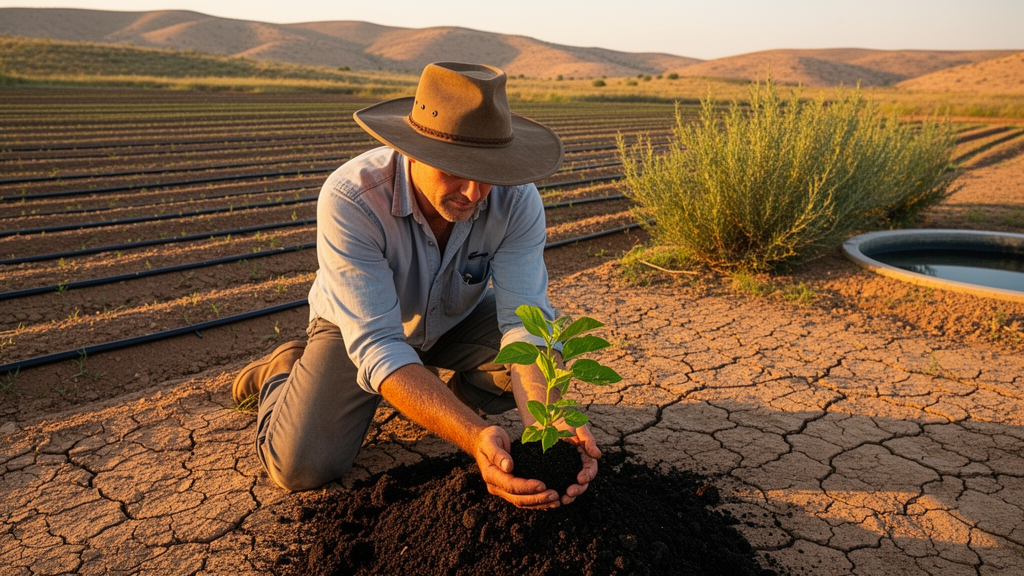
Drylands cover roughly 40 percent of the global land surface and support the livelihoods of more than 2 billion people, yet they remain among the most challenging environments on Earth for growing food. Characterized by chronic water scarcity, soils with low organic-matter content and increasing variability in precipitation and temperature, these hyper-arid, arid, semi-arid and dry-subhumid regions face accelerating land degradation that threatens crop production and food security. A new editorial published in Frontiers in Agronomy synthesizes a dedicated Research Topic on climate-smart agriculture, arguing that sustainable crop production in arid and semi-arid environments depends not on isolated technological fixes but on the integrated conservation of the natural resources that underpin all farming: soil, water, crops and biodiversity.
Climate-smart agriculture, or CSA, is best understood as a comprehensive framework that simultaneously pursues three objectives: sustainable productivity and economic profitability, enhanced resilience to climate-related stresses, and reduced greenhouse-gas emissions where feasible. The editorial, led by Debankur Sanyal of the University of Arizona’s Center for Agroecosystem Research in the Desert, together with Biswanath Dari of North Carolina Agricultural and Technical State University and Swarupa Nanda Mandal of the University of California, Davis, emphasizes that in water-scarce agroecosystems these goals cannot be achieved solely through intensification. Instead, they rest on a shared principle of natural-resource preservation, including judicious management of soil, water and biodiversity, which the authors describe as the foundation upon which the productivity, adaptation and mitigation pillars of CSA are built.
Water emerges as the primary constraint on agricultural output in dryland environments. Although dryland regions contain both rainfed and irrigated production systems, much dryland cropping relies on rainfall-derived soil moisture, commonly termed green water, as opposed to the blue water of rivers, lakes and aquifers. Irrigated agriculture is expanding to buffer the unpredictability of precipitation, but water policy and investment have historically focused on expanding irrigation while comparatively neglecting the productivity of rainfed systems, despite their central role in sustaining dryland communities. The editorial argues that this imbalance needs correcting if the full potential of dryland agriculture is to be realized.
Climate extremes make the water problem worse by increasing rainfall variability, often delivering the same annual total in fewer but more intense events. Recent research cited in the editorial, including a 2024 study in Nature on global-scale vegetation sensitivity to daily rainfall variability, shows that crops respond strongly to how precipitation is distributed through the year, not merely to how much falls. To reduce the resulting yield gaps, the authors argue that emphasis should be placed less on acquiring additional water and more on capturing and conserving the water already received. Regenerative management strategies such as conservation tillage, mulching and rainwater harvesting can retain moisture within the rooting zone for extended periods, converting erratic rainfall into dependable green water for crops.
If water availability sets the ceiling on production, soil determines how much of each rain event actually becomes available to the plant. Soils in arid and semi-arid regions are typically low in organic matter, which compromises fertility, water-holding capacity, structural stability and overall soil health. Poor soil aggregation in these environments further fuels degradation through erosion and structural instability. The editorial highlights the role of soil biology, especially the rhizomicrobiome, the community of microorganisms surrounding plant roots, which provides essential ecosystem services such as nutrient cycling, pathogen control and support for terrestrial biogeochemical cycles, and helps plants mitigate environmental stress. Notably, the composition and functions of these microbial communities in dryland agroecosystems are different, diverse and relatively less explored compared with cooler, humid agricultural soils, representing a significant frontier for research.
Conservation and regenerative practices, including reduced tillage, cover cropping and organic-matter buildup, improve soil structure, enrich soil biological communities and diversity, and thereby strengthen overall soil functionality. The editorial frames this as a technical cascade: better aggregation increases infiltration and water-holding capacity, richer microbial communities accelerate nutrient cycling and stress buffering, and improved structure reduces erosion losses. In dryland systems where every millimeter of stored moisture counts, these soil improvements translate directly into more stable yields under climatic uncertainty.
Crop diversity provides the third pillar of the CSA toolkit. Concentrating agricultural production on a narrow set of crops and varieties leaves farming systems more vulnerable to both climatic and market uncertainties. Diversification across species, across varieties and across the seasonal calendar spreads that risk and measurably stabilizes agricultural production and food security from year to year, a finding supported by national-scale evidence that crop diversity stabilizes food production. This strategy also promotes investment in stress-tolerant, resource-efficient germplasm and advanced breeding approaches to develop crop varieties with enhanced tolerance to biotic and abiotic stresses. Predictive models can help assess whether particular crops are likely to remain viable as regional conditions change, making the matching of the right diversity to the right place an exercise in foresight as much as in agricultural science.
The Research Topic combines six contributions that collectively advance CSA from broad principles toward region-specific, decision-ready evidence across water management, soil health and biological diversity. Two original research studies from India offer a common lesson from contrasting production systems. In Bihar, a moist sub-humid region facing aridity, resilient productivity in winter-maize fields depended on combinations of agronomic practices rather than any single intervention. In Telangana, in the semi-arid tropics, grafting combined with protected cultivation increased tomato yield and farm profitability under climatic stress. The main message is that improvements in productivity and adaptation in arid and semi-arid regions result from integrated management, not from isolated inputs.
Three synthesis pieces then map the broader landscape and its limits. A systematic review of rainfed systems in Ethiopia quantifies yield and water-productivity gaps and recommends the inclusion of green-water management in national policies. A review of regenerative practices shows that their benefits for soil health and climate mitigation are context-dependent and constrained by agronomic, economic and adoption factors. A systematic mapping of Mediterranean-type climates found the knowledge base substantially lacking in information about what can be implemented to adapt to or mitigate climate change, as well as the net climate impacts of various interventions. A modeling study projected declining environmental suitability for oilseed crops in the Northern Great Plains, with a greater decline for canola than for camelina, underscoring the need for region-specific crop adaptation planning under future climates.
A key takeaway from this body of work is a productive tension: while individual field studies show productivity gains, reviews and modeling research indicate that the extent and longevity of these benefits rely on specific site conditions, system design and future climate scenarios. The editorial identifies a major limitation in the evidence base, namely that most studies come from limited geographic areas or particular production systems, with only sparse validation across different agroecological regions. The authors conclude that CSA in drylands requires integrated management of soil, water, crops and biodiversity rather than reliance on isolated interventions, and they point to three priorities for the future: integrating the socioeconomic determinants of CSA adoption into biophysical research, extending evidence to underrepresented dryland regions, and developing decision-support tools that translate research findings into actionable guidance for growers.
Subject of Research: Climate-smart agriculture for sustainable crop production and natural-resource conservation in arid and semi-arid drylands
Article Title: Editorial: Climate-smart agriculture: enhancing sustainable crop production in arid and semi-arid environments through conservation of natural resources
Article References: Sanyal, D., Dari, B., & Mandal, S. N. (2026). Editorial: Climate-smart agriculture: enhancing sustainable crop production in arid and semi-arid environments through conservation of natural resources. Frontiers in Agronomy, 8, Article 1954855. https://doi.org/10.3389/fagro.2026.1954855
Image Credits: AI Generated
DOI: 10.3389/fagro.2026.1954855
Keywords: climate-smart agriculture, drylands, soil health, water conservation, crop diversity, food security, regenerative agriculture, Frontiers in Agronomy, Editorial, Climate-smart, agriculture, enhancing
Cite Scienmag News
Alan Morgan. (October 17, 2026). Climate-smart agriculture: why conserving soil, water and biodiversity holds the key to farming the world’s drylands. Scienmag. https://scienmag.com/climate-smart-agriculture-why-conserving-soil-water-and-biodiversity-holds-the-key-to-farming-the-worlds-drylands/
Alan Morgan. "Climate-smart agriculture: why conserving soil, water and biodiversity holds the key to farming the world’s drylands." Scienmag, 17 October 2026, https://scienmag.com/climate-smart-agriculture-why-conserving-soil-water-and-biodiversity-holds-the-key-to-farming-the-worlds-drylands/. Accessed 17 October 2026.
Alan Morgan. "Climate-smart agriculture: why conserving soil, water and biodiversity holds the key to farming the world’s drylands." Scienmag. October 17, 2026. https://scienmag.com/climate-smart-agriculture-why-conserving-soil-water-and-biodiversity-holds-the-key-to-farming-the-worlds-drylands/


