


Improving quality of life in rural India is one of the most stubborn challenges on the global development agenda. More than two thirds of India’s population still lives outside its megacities, and the United Nations Sustainable Development Goals that promise health, prosperity and justice by 2030 will succeed or fail largely in villages rather than in urban centers. A new study published in Humanities and Social Sciences Communications takes a systematic, data-driven approach to this problem, asking a deceptively simple question: which factors actually matter most for quality of life in rural communities, and in what order should policymakers tackle them?
The research, led by Wen-Kuo Chen of the National Kaohsiung University of Science and Technology together with Venkateswarlu Nalluri of Chaoyang University of Technology, Sai Manideep Appana and Yogesh Vinayak Hadole of Vignan’s Foundation for Science, Technology and Research, and Madhavaiah Chendragiri of Pondicherry University, combines two established decision-science techniques into a single analytical framework. The team first used Interpretive Structural Modelling, or ISM, to map how the many determinants of rural quality of life influence and depend on one another. They then applied the Fuzzy Technique for Order Preference by Similarity to Ideal Solution, known as Fuzzy TOPSIS, to rank those determinants while explicitly accounting for the uncertainty and subjectivity that inevitably color expert judgments about social priorities.
The methodological pairing matters because neither technique alone can answer the question the researchers posed. ISM excels at revealing hierarchy: it takes a set of criteria identified through an extensive literature review and, through structured pairwise judgments, determines which factors are foundational drivers that shape everything else and which are surface outcomes that depend on deeper variables. Fuzzy TOPSIS, by contrast, is a ranking engine. It compares each candidate factor against an idealized best case and a worst case, calculating how close each one sits to the ideal. By replacing crisp numerical judgments with fuzzy sets, the technique absorbs the vagueness inherent in statements like one criterion is somewhat more important than another, producing rankings that are more robust to the imprecision of human assessment.
Applied to rural India, the integrated model produced a striking result. Three critical areas rose above the rest for enhancing quality of life in rural communities: cultural preservation, which corresponds to SDG 11 on sustainable cities and communities; transparency and accountability, which corresponds to SDG 16 on peace, justice and strong institutions; and agricultural innovation, which corresponds to SDG 2 on zero hunger and SDG 9 on industry, innovation and infrastructure. The finding challenges the intuitive assumption that income growth or basic service delivery must always come first. Instead, the analysis suggests that protecting local cultural identity, ensuring honest and responsive governance, and modernizing farming practices form the most powerful levers for improving daily life in the countryside.
Cultural preservation ranking at the top is perhaps the most unexpected of the three. Development economics has long treated cultural heritage as a luxury concern, something to address after material needs are met. But the ISM hierarchy indicates that cultural continuity functions as a foundational element of rural wellbeing rather than a decorative one. Villages that maintain their traditions, languages and community institutions tend to retain social cohesion, and that cohesion underpins collective action on everything from water management to school attendance. The alignment with SDG 11 signals that sustainable communities, in the sense the United Nations intended, depend on more than infrastructure; they depend on the intangible fabric that makes people want to stay, invest and participate in the places they live.
Transparency and accountability, mapped to SDG 16, occupy a similarly structural position in the model. Rural development programs in India are vast, involving subsidies, employment guarantees, housing schemes and food distribution networks, and their effectiveness hinges on whether resources actually reach intended beneficiaries. When governance is opaque, leakage erodes even well-funded initiatives, and trust between citizens and institutions collapses. The study’s ranking suggests that strengthening accountability mechanisms is not merely an administrative nicety but a precondition for progress across the entire spectrum of rural quality of life determinants. In the ISM hierarchy, governance quality sits among the variables that other factors depend upon, meaning improvements here cascade outward through economic and social outcomes.
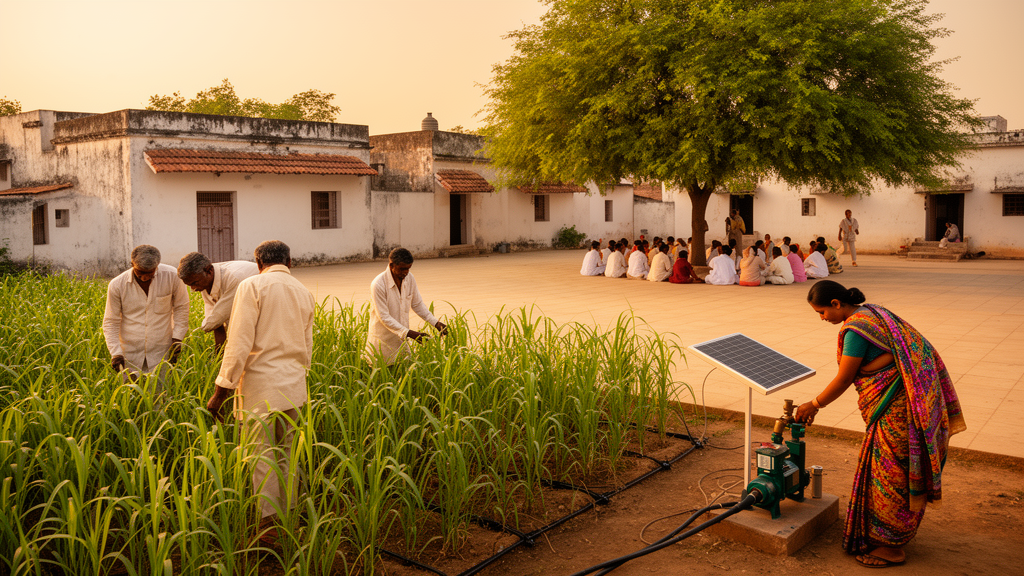
Agricultural innovation, linked to SDG 2 and SDG 9, completes the top tier. Farming remains the economic backbone of rural India, and the gap between traditional practices and available modern techniques represents one of the largest untapped reservoirs of productivity in the country. Innovations in seeds, irrigation, mechanization and digital market access can raise incomes directly while also reducing vulnerability to climate shocks. The model’s placement of agricultural innovation among the highest-ranked determinants reflects its dual role: it is simultaneously an economic driver that lifts household welfare and an infrastructure challenge that requires investment in research, extension services and rural connectivity. Its coupling of SDG 2 and SDG 9 in the analysis underscores that hunger eradication and technological upgrading are two faces of the same rural transformation.
Beyond the headline rankings, the combined application of ISM and Fuzzy TOPSIS offers something the study argues is genuinely new: a thorough analytical approach that permits an in-depth examination of the intricate interconnectedness of various socio-economic elements. The researchers organized the quality of life criteria into social, economic, environmental and government categories, and the appendices to the paper document the level partitioning process for each, showing how the criteria stratify into hierarchical layers of drivers and dependent outcomes. This layered structure gives policymakers a roadmap that is more informative than a simple priority list. It tells them not only what to work on first but also which interventions will naturally reinforce others once foundational variables improve.
The practical implications extend to how rural development projects are evaluated and aligned with the Sustainable Development Goals. The techniques adopted, the authors argue, are effective tools for assessing rural development initiatives and ensuring they contribute to a more inclusive and fair growth path for India’s rural territories. A district administrator deciding between investments in cultural programming, grievance redress systems or agricultural extension could, in principle, apply the same hybrid framework locally, feeding in expert judgments specific to that region and obtaining a defensible ranking tailored to local conditions. The approach is transparent, reproducible and computationally light, which makes it feasible for use in settings where sophisticated modelling resources are scarce.
The study, which received no external financial support and was published open access under a Creative Commons license, ultimately fulfills its central aim of prioritizing the key challenges in enhancing quality of life in rural India through the Sustainable Development Goals. Its message for the global development community is that the path to better rural lives runs through cultural vitality, clean governance and farm innovation as much as through conventional economic metrics. As the 2030 deadline for the SDGs approaches, research of this kind offers a reminder that sustainable development is not a checklist of isolated targets but a web of mutually reinforcing conditions, and that identifying the strongest threads in that web is the first step toward pulling the whole structure upward.
Subject of Research: Development studies
Article Title: Prioritizing quality of life determinants for sustainable development goals in rural India: an integrated ISM-fuzzy TOPSIS approach
Article References: Chen, W.-K., Nalluri, V., Appana, S. M., Hadole, Y. V., & Chendragiri, M. (2026). Prioritizing quality of life determinants for sustainable development goals in rural India: an integrated ISM-fuzzy TOPSIS approach. Humanities and Social Sciences Communications. https://doi.org/10.1057/s41599-026-09249-7
Image Credits: AI Generated
DOI: 10.1057/s41599-026-09249-7
Keywords: quality of life, rural India, sustainable development goals, ISM, fuzzy TOPSIS, cultural preservation, transparency and accountability, agricultural innovation, development studies, science technology and society, Prioritizing, quality
Cite Scienmag News
Courtney Benton. (October 17, 2026). Cultural Roots, Clean Governance and Farm Innovation Emerge as Top Priorities for Rural India’s Quality of Life. Scienmag. https://scienmag.com/cultural-roots-clean-governance-and-farm-innovation-emerge-as-top-priorities-for-rural-indias-quality-of-life/
Courtney Benton. "Cultural Roots, Clean Governance and Farm Innovation Emerge as Top Priorities for Rural India’s Quality of Life." Scienmag, 17 October 2026, https://scienmag.com/cultural-roots-clean-governance-and-farm-innovation-emerge-as-top-priorities-for-rural-indias-quality-of-life/. Accessed 17 October 2026.
Courtney Benton. "Cultural Roots, Clean Governance and Farm Innovation Emerge as Top Priorities for Rural India’s Quality of Life." Scienmag. October 17, 2026. https://scienmag.com/cultural-roots-clean-governance-and-farm-innovation-emerge-as-top-priorities-for-rural-indias-quality-of-life/


