


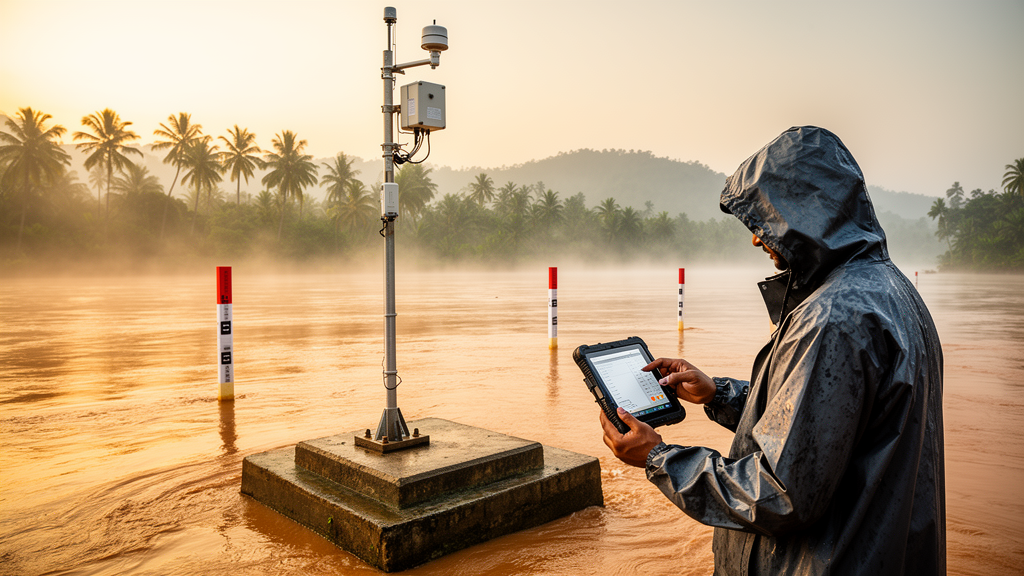
Deep in the flood-prone downstream reaches of Sri Lanka’s Gal Oya River, a solar-powered box of sensors has been quietly watching the water rise. The device, developed by engineers at South Eastern University of Sri Lanka together with collaborators in Abu Dhabi and Malaysia, feeds a continuous stream of rainfall and river-level measurements into two artificial intelligence models that vote on whether tomorrow will bring a flood. Their verdict is published each night on a cloud dashboard, where disaster managers can see the next-day flood risk for one of the country’s most vulnerable river basins. The system, described in Frontiers in Artificial Intelligence, is among the first field-deployed attempts in Sri Lanka to fuse real-time Internet of Things sensing with machine learning for operational flood forecasting.
The stakes could hardly be higher. Flooding has caused average annual losses of US$240 million in Sri Lanka and affected more than 10 million people over the past three decades, making it the most frequent and destructive disaster among the 25,000 extreme weather events recorded between 1975 and 2022. Germanwatch’s Climate Risk Index once ranked the island nation fourth among the ten most affected countries globally. Yet the traditional monitoring systems still in use rely on manual observations and static threshold alarms that offer no predictive analytics at all. When a river crests faster than an observer can file a report, the warning arrives late—or never.
The research team attacked this gap with a deliberately safety-oriented design philosophy. Rather than chasing headline accuracy, they optimized their models for recall: the proportion of genuine flood conditions the system manages to catch. In flood forecasting, the two types of error carry wildly asymmetric costs. A false alarm wastes resources and erodes trust, but a missed flood—a false negative—can delay evacuations and cost lives. The team therefore built their ensemble around a simple logical-OR rule: if either of the two models flags a positive flood risk, the system sounds the warning. Only when both models agree the river is safe does the dashboard stay quiet.
The two voters bring complementary architectures to the problem. The first is a Long Short-Term Memory network, a form of recurrent neural network whose internal memory gates allow it to learn the sequence and delay between rainfall and the resulting river response. The LSTM was configured to forecast the next day’s numerical water level at the Kaliodai River using five predictor variables: catchment rainfall, downstream rainfall, reservoir water level, reservoir discharge rate, and the current river stage. Its stacked layers of 64 and 32 hidden units were trained with the Adam optimizer on roughly five years of daily observations—1,873 entries spanning March 2020 to April 2025—obtained from Sri Lanka’s Department of Irrigation and Department of Meteorology.
The second model, Extreme Gradient Boosting, or XGBoost, is an ensemble of decision trees built sequentially, where each new tree corrects the errors of its predecessors. Instead of forecasting a number, XGBoost classifies the next day’s flood risk directly as positive or negative. Because genuine flood days are vanishingly rare in the historical record, the training data was severely imbalanced, and the team applied the Synthetic Minority Oversampling Technique to generate synthetic examples of the minority flood class for the XGBoost classifier. A gain-based feature importance analysis revealed that the current Kaliodai River water level dominated the classifier’s decisions, followed by the reservoir water level, while reservoir discharge contributed almost nothing—its information apparently already embedded in the correlated river stage.
Labeling the data required an empirical threshold. The team examined official flood-warning records for the Gal Oya Basin and found that documented flood conditions corresponded to river levels of at least 3.0 meters, a value reviewed by a civil engineer familiar with local conditions. Every daily observation at or above that mark was labeled positive. The historical record contained just nine such positive observations, forming two continuous flood episodes: January 11 to 15, 2024, and November 25 to 28, 2024. The models were trained on 80 percent of the data using a strict chronological split, with no random shuffling, so that future observations never leaked into training.
The evaluation results tell a nuanced story. On the chronological holdout, the rule-based ensemble with a one-day input window achieved 98.73 percent overall accuracy and, critically, 100 percent positive-class recall—correctly classifying all four positive-labeled observations in the test set, which occurred consecutively from November 25 to 28, 2024, representing one continuous flood episode. Positive-class precision was 50.00 percent, reflecting four false alarms, and the F1-score was 66.67 percent. The team calculated exact binomial confidence intervals to quantify the uncertainty: the 95 percent interval for recall spanned 39.8 to 100 percent, a sobering reminder that four samples from a single episode cannot establish population-level performance. The authors are explicit that the perfect recall is a sample-level result, not proof of generalized flood detection across independent events.
A benchmark comparison sharpened the interpretation. A simple current-water-level threshold—predicting a flood whenever the river already stood at or above 3.0 meters—achieved 99.37 percent accuracy, 75 percent precision, and 75 percent recall on the same test set. The benchmark missed the flood onset on November 25, 2024, when the previous day’s level was 2.9 meters, just below the threshold. The ensemble caught that rising episode, suggesting that the models’ additional hydrological information and the safety-first fusion rule provided genuine sensitivity to the onset of flood conditions, at the cost of extra false alarms. Notably, the LSTM alone achieved 98.72 percent accuracy with a 21-day window but zero recall for flood cases—a vivid demonstration that accuracy alone is a treacherous metric for imbalanced safety-critical datasets.
The field deployment demonstrated operational feasibility rather than predictive validation. The IoT node pairs a JSN SR-04T waterproof ultrasonic sensor, which measures river level from ultrasonic pulse travel time, with an XS-RS01 tipping-bucket rain gauge whose reed-switch tips each correspond to 0.3 millimeters of rainfall. An ESP32 microcontroller aggregates the readings and transmits them via NB-IoT or Wi-Fi to a ThingsBoard cloud platform, powered by a 12-volt solar panel and rechargeable battery for autonomous off-grid operation. During the ten-day observation window, the system correctly classified all days as negative, consistent with real conditions, and the LSTM’s water-level forecasts tracked observed rises during heavy rainfall, with a percentage error of 10.77 percent on November 29, 2025. The dashboard even captured dam spilling effects downstream during dry days.
The authors caution that no flood occurred during the deployment period, so flood-event detection under real conditions remains unproven, and future work must include longer-term field validation, sequence-aware imbalance handling for recurrent networks, rolling-origin time-series validation, and explainable AI techniques such as Shapley additive exPlanations. Still, the framework offers a template for smaller nations with abundant rivers and limited monitoring infrastructure: a localized, automated, scalable system that can be centrally monitored and expanded to other basins. As climate change intensifies extreme rainfall across South Asia, the marriage of cheap solar-powered sensors with safety-first machine learning may prove one of the most consequential tools in the flood-warning arsenal.
Subject of Research: AI flood forecasting
Article Title: A recall-optimized LSTM–XGBoost ensemble model for river flood forecasting using multivariate time-series data—case study in Sri Lanka
Article References: Sankalpa, T. H. S., Sandaruwan, G. H. C., Saja, A. M. A., Sajith, N. T. M., & Ishqy, M. F. M. (2026). A recall-optimized LSTM–XGBoost ensemble model for river flood forecasting using multivariate time-series data—case study in Sri Lanka. Frontiers in Artificial Intelligence, 9, Article 1903150. https://doi.org/10.3389/frai.2026.1903150
Image Credits: AI Generated
DOI: 10.3389/frai.2026.1903150
Keywords: flood forecasting, machine learning, LSTM, XGBoost, Internet of Things, Sri Lanka, early warning systems, hydrology, recall-optimized, ensemble, model, river
Cite Scienmag News
Violet Maxwell. (October 17, 2026). Safety-first AI ensemble catches every flood signal in Sri Lanka river trial. Scienmag. https://scienmag.com/safety-first-ai-ensemble-catches-every-flood-signal-in-sri-lanka-river-trial/
Violet Maxwell. "Safety-first AI ensemble catches every flood signal in Sri Lanka river trial." Scienmag, 17 October 2026, https://scienmag.com/safety-first-ai-ensemble-catches-every-flood-signal-in-sri-lanka-river-trial/. Accessed 17 October 2026.
Violet Maxwell. "Safety-first AI ensemble catches every flood signal in Sri Lanka river trial." Scienmag. October 17, 2026. https://scienmag.com/safety-first-ai-ensemble-catches-every-flood-signal-in-sri-lanka-river-trial/


