


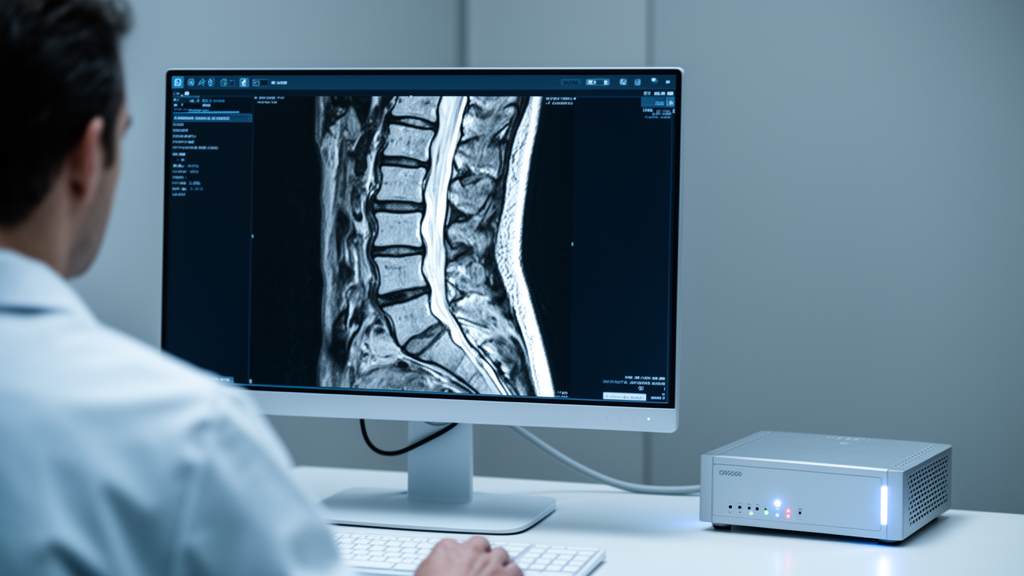
Deep learning has conquered lungs, breasts, and brains in the eyes of regulators, but the lower spine has remained stubbornly untouched. Now a team of Portuguese researchers reports a multi-stage artificial intelligence pipeline that can automatically find herniated discs in lumbar spine MRI scans, and their results carry a counterintuitive lesson: once the anatomy is precisely mapped, a small, old-fashioned convolutional network beats the fashionable transformers that dominate today’s AI headlines.
The study, published in Frontiers in Radiology, was motivated by a striking regulatory gap. According to the updated Grand Challenge database cited by the authors, 223 AI applications in radiology have been approved by CE or FDA authorities, with 46 focused on neuroradiology. Not one of them evaluates pathologies in the lumbar spine. That absence matters because low back pain is among the most common forms of disability worldwide, and lumbar spine MRI is the most frequently requested examination for diagnosing its causes. Meanwhile, the demand for imaging exams far outstrips the supply of radiologists, producing delays, fatigue-driven errors, and reports with insufficient detail.
The clinical problem is also technically harder than it looks. In a standard lumbar MRI, a radiologist must analyse at least five disc levels, each with five spatial locations: central, both paracentral, and both foraminal regions. Beyond the discs, the spinal canal, cauda equina, nerve roots, vertebral bodies, facet joints, and posterior elements all require individual assessment. These judgments are largely subjective, with low interobserver and intraobserver reproducibility, and many published AI approaches classify whole images or volumes without explicitly localizing individual discs, creating ambiguity when several discs with different pathological states coexist in one exam.
To build their dataset, the researchers collected 484 lumbar spine MRI examinations from scanners made by four manufacturers: GE Healthcare, Philips, Toshiba, and Siemens. The multi-vendor design was deliberate, since most prior studies relied on homogeneous single-vendor data and scanner-related variability in image appearance and file structure remains an underrepresented challenge. The exams arrived in DICOM format with significant heterogeneity; in some cases, such as Philips equipment, an entire series was stored in a single file, while other manufacturers distributed images across many files. The team developed specific routines for reading, standardizing, and volumetric reconstruction so all samples could be processed uniformly, and the pipeline adapted to different formats without performance loss.
Annotation was the labor-intensive heart of the project. Five radiologists with experience ranging from 2 to 15 years manually segmented a subset of 165 studies, yielding 325 sagittal series and 5,200 images, with each case taking about 90 minutes. They outlined vertebral bodies from L1 to S1, including endplates and cortices, and intervertebral discs including protrusions, hernias, sequestrations, and Schmorl’s nodes. For each of the five lumbar segments, L1-L2 through L5-S1, disc morphology was labelled as present for any structural abnormality, including bulging, protrusion, extrusion, and sequestration, or absent when radiologically negative. The authors justified grouping bulging with herniation because both represent measurable deviations from normal disc anatomy, ensuring diagnostic consistency and algorithmic sensitivity.
The pipeline itself unfolds in three stages. First, a segmentation model distinguishes intervertebral discs, vertebrae, and background. Because limited sampling made a fine-grained 18-class model impractical, the team simplified the task to three classes, which increased sample density per class and improved robustness. Second, an anatomically informed post-processing step refines the 3D masks, separates structures along the Z-axis, removes noise using morphological thresholds, and assigns correct labels to each disc and vertebra. Third, disc-centered 3D patches are extracted from the original MRI volumes and fed to a binary classifier that decides whether each disc is herniated. All dataset splits were performed strictly at the patient level to prevent data leakage.
The segmentation results were impressive. The team systematically paired four encoders, ResNet34, EfficientNet-B2, VGG16, and Mix ViT, with five decoders, U-Net, U-Net++, DeepLabV3+, SegFormer, and MAnet, under identical hyperparameters, including the Adam optimizer and Dice Loss. The best performance came from MAnet with an EfficientNet-B2 backbone, achieving a macro-averaged Dice Score of 0.898 across the three classes. Notably, purely attention-based models such as the Mix ViT struggled to capture fine anatomical details, while the hybrid architecture, which combines deep convolutions with attention-inspired mechanisms, proved most effective, suggesting that balancing local spatial detail with global context is essential for medical segmentation.
For classification, the researchers evaluated 3D ResNet-18, EfficientNet-B2, SENet, and a 3D Vision Transformer, all receiving input volumes of 20 by 80 by 80 pixels and trained with identical hyperparameters using Binary Cross-Entropy with Logits Loss. On a fixed 100-case patient-level hold-out test set, F1-scores ranged from 0.66 to 0.73, with the ResNet18-based model achieving the best performance at an F1-score of 0.72, an AUC of 0.82, and an accuracy of 0.71. The F1-score was chosen as the primary metric because of class imbalance, and the fact that it exceeded accuracy indicates the models were more effective at identifying abnormal discs than overall accuracy suggests. The authors calibrated a combined loss function averaging BCE and F1 Loss, since BCE alone raised accuracy but dropped the F1-score.
The most telling insight is architectural. Once segmentation and post-processing handle anatomical localization and spatial normalization, the classifier operates on isolated disc-centered volumes with reduced structural variability, and a small ResNet18 proved sufficient, even preferable, to deeper or attention-heavy models. The moderate classification scores reflect intrinsic data limitations rather than pipeline shortcomings: relatively few annotated samples per class, high intra- and inter-patient variability across vendors and protocols, and annotation uncertainty, since labels from different radiologists remained subjectively challenging even after standardization. Borderline cases, such as mild disc bulging in elderly patients, are often interpreted with broader clinical context unavailable to a model given only isolated disc volumes.
The methodology also lays a foundation for scalable annotation. Because the pipeline automatically generates the anatomical centres of discs from segmentation masks, future disc-level annotations can be added without reviewing entire series slice by slice, making dataset expansion less labor-intensive for experts. The authors envision future work incorporating multimodal data such as clinical reports and patient histories, explainable AI mechanisms tailored to spine diagnostics, and external validation on independent multi-institutional cohorts. In the medium term, such tools could enhance diagnostic efficiency, reduce radiologist workload, and improve reproducibility in identifying disc pathologies, closing a translational gap in a region of the body where AI has yet to earn regulatory approval.
Subject of Research: Artificial intelligence in radiology
Article Title: The application of deep neural networks to the detection of lumbar hernias: results from the approaches based on convolutional networks and transformers
Article References: Fernandes, A., Rodriguez, J. P. M., Moleirinho, S., Trofimenko, I., Guseva, E., Martinovich, A., de Oliveira Morais, I. M., Bisolo, L., Mendes Gomes, L., & Machado, J. (2026). The application of deep neural networks to the detection of lumbar hernias: results from the approaches based on convolutional networks and transformers. Frontiers in Radiology, 6, Article 1722312. https://doi.org/10.3389/fradi.2026.1722312
Image Credits: AI Generated
DOI: 10.3389/fradi.2026.1722312
Keywords: deep learning, lumbar spine MRI, disc herniation, medical image segmentation, vision transformer, radiology automation, application, deep, neural, networks, detection, lumbar
Cite Scienmag News
Ophelia Keating. (October 17, 2026). AI pipeline detects lumbar disc herniation on MRI, with a twist: smaller networks win once anatomy is mapped. Scienmag. https://scienmag.com/ai-pipeline-detects-lumbar-disc-herniation-on-mri-with-a-twist-smaller-networks-win-once-anatomy-is-mapped/
Ophelia Keating. "AI pipeline detects lumbar disc herniation on MRI, with a twist: smaller networks win once anatomy is mapped." Scienmag, 17 October 2026, https://scienmag.com/ai-pipeline-detects-lumbar-disc-herniation-on-mri-with-a-twist-smaller-networks-win-once-anatomy-is-mapped/. Accessed 17 October 2026.
Ophelia Keating. "AI pipeline detects lumbar disc herniation on MRI, with a twist: smaller networks win once anatomy is mapped." Scienmag. October 17, 2026. https://scienmag.com/ai-pipeline-detects-lumbar-disc-herniation-on-mri-with-a-twist-smaller-networks-win-once-anatomy-is-mapped/


