


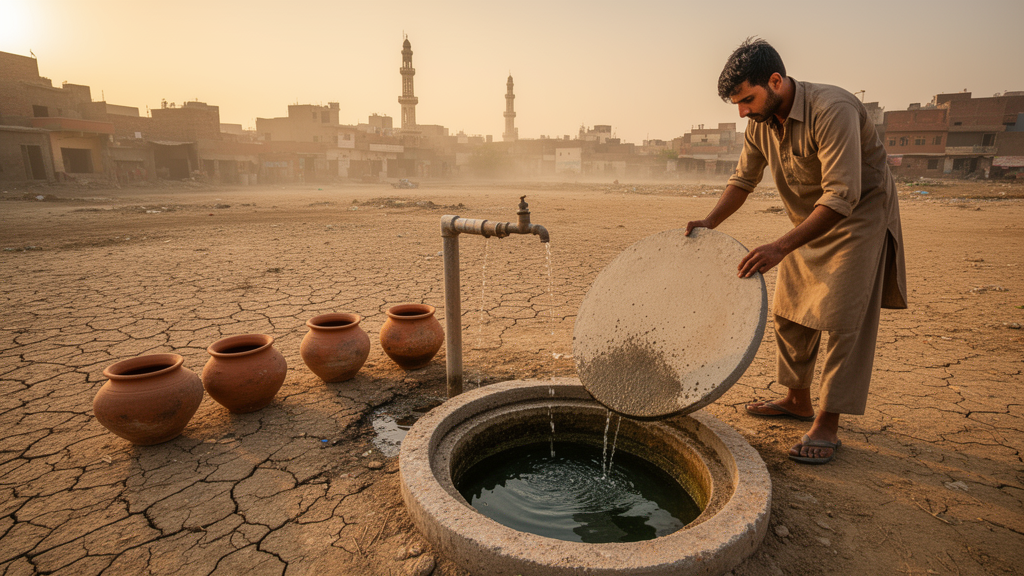
Pakistan’s cities are quietly running out of water, and the crisis is unfolding faster than most residents realize. A comprehensive new review published in Frontiers in Environmental Economics synthesizes nearly a decade of research on urban water management in Pakistan and delivers a stark diagnosis: the country’s rapidly growing cities face a tangled web of groundwater depletion, deteriorating water quality, urban flooding, and fragmented governance that no single intervention can untangle. The study, led by researchers at Government College University Lahore, argues that only an integrated, climate-resilient overhaul of how Pakistani cities capture, distribute, and reuse water can avert a deepening emergency.
The numbers behind the crisis are sobering. Pakistan has one of the highest urbanization rates in South Asia, with roughly 40 percent of its population now living in cities—a share projected to climb as demographic growth, rural-urban migration, and economic transformation continue. Per capita water availability has collapsed from around 5,260 cubic meters in 1951 to approximately 1,100 cubic meters in 2020, placing the country below the global water scarcity threshold of 1,700 cubic meters per person per year. Only about 20 percent of the urban population has access to properly managed water, leaving more than 35 million city dwellers without reliable clean water access.
Groundwater tells perhaps the most alarming part of the story. Pakistan ranks among the world’s largest groundwater consumers, extracting an estimated 60 to 65 billion cubic meters annually for domestic and agricultural use. In Lahore, abstraction rates have far outpaced natural recharge, with water tables dropping between 0.5 and 1 meter per year in some areas—figures that translate into rising pumping costs and, eventually, the specter of saline water intrusion rendering remaining reserves unusable for drinking or irrigation. The Indus Basin aquifer, which underlies much of the country, is now considered the second most overstressed groundwater system on Earth, trailing only the North China Plain aquifer.
The paradox, the researchers note, is that the same urbanization driving water demand is simultaneously destroying the mechanisms that replenish supply. As cities like Lahore and Karachi expand, impervious surfaces—roads, rooftops, parking lots—replace the permeable ground that once allowed rainwater to percolate into aquifers. Stormwater that could recharge groundwater instead rushes into inadequate drainage systems, triggering flash floods. Lahore’s drainage infrastructure, largely constructed between 1971 and 1990, was never designed for the population densities or the intense monsoon bursts the city now experiences. In 2025, severe urban flooding struck Lahore after intense monsoon rainfall combined with encroachment on the Ravi River’s floodplains, underscoring how climate change and poor land-use planning compound each other.
Water quality presents an equally grave challenge. The Pakistan Council of Research in Water Resources has reported that roughly 85 percent of samples collected from the Indus River were unfit for human consumption due to elevated levels of heavy metals, nitrates, and coliform bacteria. Groundwater fares little better: PCRWR data indicate that about 64 percent of drinking water sources across Pakistan are contaminated. Arsenic, a potent carcinogen linked to cardiovascular and neurological disorders as well as skin lesions, exceeds the World Health Organization’s recommended limit of 10 parts per billion across broad swaths of Punjab and Sindh. One study cited in the review estimates that approximately 60 million people in the Indus River Basin face risk from arsenic-contaminated water. Meanwhile, more than 90 percent of Pakistani industries discharge untreated effluent directly into rivers and streams, contributing an estimated 8 billion cubic meters of polluted wastewater annually.
The institutional architecture meant to manage these problems is itself a source of dysfunction. Water and Sanitation Agencies (WASAs), municipal corporations, cantonment boards, and development authorities share overlapping and often unclear mandates across federal, provincial, and local levels. In Lahore, 98 percent of water connections remain unmetered, making it nearly impossible to bill accurately or discourage waste. Financial working ratios for WASAs—essentially the ratio of operating costs to revenue—range from 1.13 to 2.8, meaning utilities consistently spend more than they collect. The consequences are visible in service delivery: in Karachi, residents in low-income districts receive as little as 60 liters per capita per day of subsidized water, while wealthy neighborhoods consume up to 340 liters daily. Roughly a quarter of Karachi’s households relied on tanker water in 2019, paying up to 29 times the municipal rate, and the city’s water theft economy generates more than half a billion dollars annually through over 100 illegal hydrants.
Against this backdrop, the review identifies a suite of approaches with demonstrated potential to transform urban water systems. Integrated Water Resources Management (IWRM)—the principle that water, land, and environmental resources should be managed holistically rather than in silos—sits at the center of the proposed framework. Nature-based Solutions (NbS), including urban wetlands, green roofs, permeable pavements, bioswales, and retention ponds, can restore natural hydrological processes that concrete infrastructure destroys. China’s Sponge City Program, launched in 2015, offers a compelling precedent: by integrating wetlands, permeable surfaces, and rainwater retention systems into urban design, participating cities have achieved estimated reductions in urban runoff of 20 to 40 percent while improving water quality and reducing heat stress.
Singapore provides perhaps the most ambitious model. The city-state’s Public Utilities Board manages the entire urban water cycle under one roof, and its Four National Taps strategy diversifies supply across local catchment water, imports, desalination, and reclaimed wastewater. NEWater, Singapore’s advanced reclaimed water produced through microfiltration, reverse osmosis, and ultraviolet disinfection, currently supplies about 40 percent of national demand and is projected to reach 55 percent by 2060. While Pakistan cannot replicate Singapore’s financial resources or institutional capacity wholesale, the review argues that elements—particularly integrated governance, wastewater reuse, and smart metering—are transferable with adaptation. India’s experience with mandatory rooftop rainwater harvesting in Chennai, Bengaluru, and Delhi, which measurably improved groundwater recharge after severe shortages, offers a closer analogue given the two countries’ shared climate profile and governance challenges.
Pakistan has begun responding. The National Water Policy of 2018 formally endorsed IWRM principles, groundwater conservation, and climate adaptation, though implementation remains hampered by weak institutional coordination and limited enforcement. More recently, in July 2025, the Federal Cabinet approved a Green Building Code mandating rainwater harvesting in all new construction—a policy directly modeled on interventions that have worked elsewhere in South Asia. The review’s authors argue these steps must be scaled dramatically and paired with managed aquifer recharge systems, decentralized wastewater treatment, and digital governance tools including smart meters, GIS-based monitoring, and real-time leak detection to tackle non-revenue water losses that in many developing countries exceed 30 to 40 percent of supplied water.
Ultimately, the researchers contend that Pakistan’s urban water future hinges on whether governance can catch up with hydrology. Short-term priorities include establishing coordination mechanisms between federal, provincial, and municipal agencies, mandating well registration and abstraction permits, and metering commercial and industrial users. Medium-term investments should target decentralized treatment plants, recharge wells, and permeable infrastructure embedded in urban planning. Long-term, the country must embed water-sensitive design into development policy, protect wetlands and floodplains through land-use regulation, and build the technical capacity to sustain these systems. Without such coordinated action, the review warns, urban water stress will deepen public health crises, accelerate environmental degradation, and widen socioeconomic vulnerability across Pakistan’s fastest-growing cities—making the coming decade decisive for whether its urban centers remain livable.
Subject of Research: Sustainable urban water management challenges and policy directions in Pakistan
Article Title: Sustainable water management in urban areas of Pakistan: challenges and future policy directions
Article References: Azhar, B., Ghafoor, G. Z., Ghafoor, N., Sharif, F., & Sarfraz, E. (2026). Sustainable water management in urban areas of Pakistan: challenges and future policy directions. Frontiers in Environmental Economics, 5, Article 1779738. https://doi.org/10.3389/frevc.2026.1779738
Image Credits: AI Generated
DOI: 10.3389/frevc.2026.1779738
Keywords: urban water management, Pakistan, groundwater depletion, water scarcity, Integrated Water Resources Management, Nature-based Solutions, rainwater harvesting, wastewater reuse, urban flooding, water governance, climate resilience, smart water technologies
Cite Scienmag News
Violet Maxwell. (October 17, 2026). Pakistan’s Cities Are Running Out of Water—and the Fix May Lie Underground. Scienmag. https://scienmag.com/pakistans-cities-are-running-out-of-water-and-the-fix-may-lie-underground/
Violet Maxwell. "Pakistan’s Cities Are Running Out of Water—and the Fix May Lie Underground." Scienmag, 17 October 2026, https://scienmag.com/pakistans-cities-are-running-out-of-water-and-the-fix-may-lie-underground/. Accessed 17 October 2026.
Violet Maxwell. "Pakistan’s Cities Are Running Out of Water—and the Fix May Lie Underground." Scienmag. October 17, 2026. https://scienmag.com/pakistans-cities-are-running-out-of-water-and-the-fix-may-lie-underground/


