


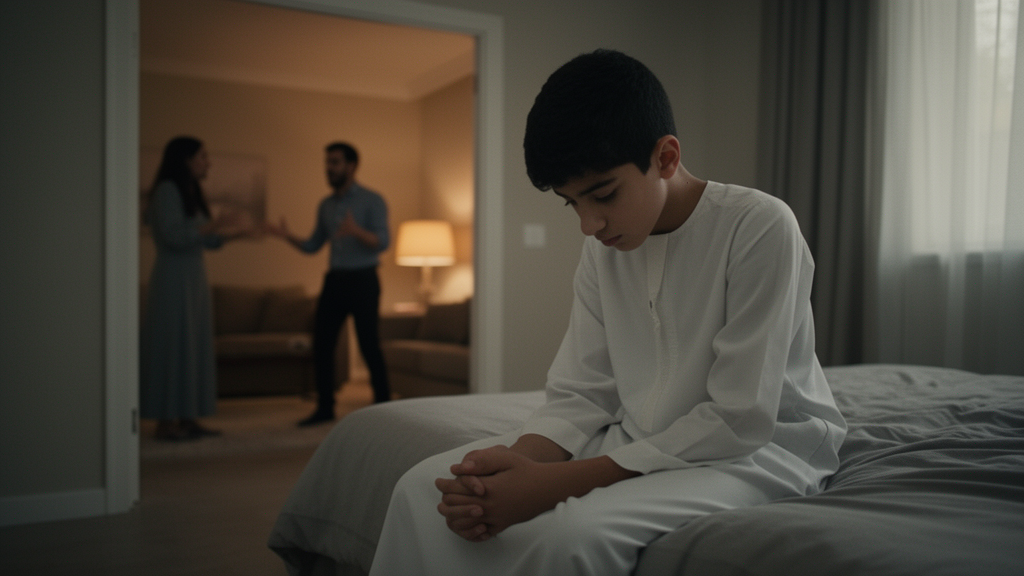
Nearly half of secondary school students in Bisha Province, Saudi Arabia, scored in the elevated range on a screening composite of depressive symptoms and general psychosocial distress, and the strongest statistical drivers of that elevated score were not grades, smartphones, or social media, but two deeply human stressors: conflict within the family and exposure to emotional or physical violence. That is the central finding of a school-based mixed-methods study published in Frontiers in Child and Adolescent Psychiatry, which surveyed 425 students aged roughly 15 to 18 and interviewed 42 teachers across eight public secondary schools during the 2024–2025 academic year. The research team, led by Ibrahim Awad Eljack Ibrahim of the University of Bisha’s Department of Family and Community Medicine, argues that the results point toward modifiable targets for intervention in a region where adolescent mental health data remain scarce.
The quantitative core of the study was a 17-item self-report composite covering emotional suppression and avoidance, somatic complaints such as headaches and stomach pain, aggression and irritability, impulsive or risk-taking behavior, feeling unsupported, and difficulty controlling emotions. Each item was rated on an eight-point scale from 0, meaning not at all, to 7, meaning always, giving a theoretical total range of 0 to 119; observed scores in the analytical sample spanned 0 to 84, with a mean of 25.7 and a standard deviation of 19.1. The composite showed good internal consistency, with a Cronbach’s alpha of 0.838 and corrected item-total correlations ranging from 0.254 to 0.654. Using the study’s binary contrast, 47.1 percent of students fell at or above a score of 25, the threshold separating the lower half of the observed distribution from the remainder.
A crucial caveat runs through the entire paper: the composite and its empirical score bands, which the authors label low, moderate, high, and extreme, are sample-specific descriptive categories rather than validated diagnostic thresholds. The instrument does not directly assess both DSM-5 core symptoms of persistent low mood and anhedonia, nor sleep, appetite, or suicidal ideation, and it does not closely reproduce established screening tools such as the PHQ-9 or CES-D. The authors are explicit that the 47.1 percent figure represents an elevated-composite-score proportion, not the prevalence of clinical depressive disorder. The findings should be read as relative psychosocial and depressive-symptom risk, a distinction that matters enormously for how the results are reported and applied.
To identify which stressors independently predicted an elevated score, the team ran a multivariable binary logistic regression with six psychosocial exposures: bullying, sexual harassment, emotional or physical violence, loss of a loved one, family conflict, and dissatisfaction with physical appearance. After correcting for multiple comparisons using the Benjamini–Hochberg procedure, two predictors remained robust. Family conflict carried an adjusted odds ratio of 5.47, with a 95 percent confidence interval of 2.52 to 11.89, and emotional or physical violence carried an adjusted odds ratio of 3.40, with a confidence interval of 1.76 to 6.56; both had corrected p-values below 0.001. Bullying showed a positive but uncorrected association, with an adjusted odds ratio of 1.68, that did not survive correction and is therefore interpreted as suggestive only. Variance inflation factors between 1.20 and 1.80 indicated no problematic collinearity among the predictors.
Gender-stratified analyses sharpened the picture. Among male students, family conflict remained significant after correction, with an adjusted odds ratio of 5.63 and a corrected p-value of 0.018, while bullying and violence met the uncorrected threshold but did not survive it. Among female students, both family conflict, with an adjusted odds ratio of 7.30, and emotional or physical violence, with an adjusted odds ratio of 5.45, remained significant after correction, each with a corrected p-value of 0.005. Sexual harassment among female students produced a large point estimate of 10.56 but an extremely wide confidence interval spanning 1.12 to 99.88, and it did not survive correction, so the authors treat it as hypothesis-generating rather than confirmed. These patterns align with international evidence, including a recent meta-analysis linking parent-adolescent conflict to depressive mood and a systematic review of 165 studies finding the strongest causal evidence connecting bullying victimization to depression, anxiety, and suicidal ideation.
Bivariate analyses added further texture. Health-related conditions, reported by 29.6 percent of students, current smoking, reported by 5.6 percent, and a family history of mental illness or depression, reported by 7.8 percent, were each associated with higher score bands after correction. Students living apart from their families also showed significantly different score-band distributions than those living with them. Notably, gender and grade level showed no corrected differences, a null pattern the authors caution should not be generalized, since other adolescent studies have documented gender differences in depression trajectories.
One of the study’s most striking null results concerns academic performance. Despite extensive literature linking depressive symptoms to educational strain, the composite score showed no significant correlation with cumulative grade point average, with a Spearman’s rho of −0.031 and a p-value of 0.519, and median CGPA values did not differ across the four score bands. The qualitative data offer a compelling interpretation. Teachers consistently described distressed students as experiencing marked declines in motivation and classroom participation before any measurable change in formal grades occurred. One teacher explained that depression makes the student give up and reduces their motivation to learn, creating a feeling that no matter how much effort they put in, they will not understand. Mathematics, science, and English were identified as the subjects most affected, alongside extracurricular activities such as school radio, competitions, and physical education. The authors suggest that engagement and motivation may be more sensitive early indicators of depression’s academic impact than cumulative grades, which can be temporarily preserved through parental pressure or exam-focused remedial support.
The teacher interviews, analyzed thematically by three independent coders, revealed five interconnected themes: behavioral and emotional indicators, impact on academic engagement, effects on the broader classroom environment, barriers to identification and support, and recommended interventions. Teachers described withdrawal, isolation, sleeping in class, poor attention, emotional instability, and neglect of personal appearance as the most recognizable signs. One teacher offered a vivid account of emotional contagion, noting that if an active student comes in, everyone becomes active with him, but if a student comes in with depression, everyone is affected, and you feel the whole class is depressed. The near-universal absence of formal mental health training emerged as a defining finding, with teachers reporting no psychological expertise or special training courses enabling them to identify students suffering from depression. Large class sizes compounded the problem, and parental denial was the most consistently cited obstacle, with teachers describing families who refused to acknowledge their child’s condition for fear of social consequences, capturing a cultural dimension in which many still believe such cases should remain hidden.
The authors are careful about the limits of their design. The cross-sectional nature of the study precludes causal inference, and the relationships are plausibly bidirectional: family conflict may exacerbate depressive symptoms, but adolescents experiencing distress may become more withdrawn, irritable, or emotionally reactive in ways that increase friction at home, and socially withdrawn students may become more vulnerable to victimization. Reliance on self-reported data introduces possible recall and social-desirability bias, particularly for sensitive exposures. The study was conducted in a single province, limiting generalizability to major metropolitan settings such as Riyadh and Jeddah, and electronic administration through WhatsApp groups may have underrepresented students without reliable smartphone access. No clinical diagnostic interviews were conducted, and the qualitative teacher sample was voluntary and non-probability-based.
Despite these limitations, the findings carry clear policy weight. The authors call for validated, age-appropriate mental health screening integrated into routine school health programs, accompanied by clear consent, referral, and safeguarding pathways, alongside teacher training in mental health first aid and symptom recognition. They recommend placing a trained psychologist within each school, structured family engagement programs, and evidence-based anti-bullying and violence-prevention strategies. Family-centered destigmatization is highlighted as essential given the parental denial reported by teachers. These recommendations align with the World Health Organization and UNESCO Health-Promoting Schools framework and with Saudi Arabia’s Vision 2030 emphasis on health, education, and quality of life. Left unaddressed, clinically significant adolescent depression carries risks extending well beyond short-term academic disengagement, including substance misuse, impaired social and occupational functioning, suicidal behavior, and persistence of depressive illness into adulthood. The Bisha study suggests that the most powerful levers for change may lie not in the classroom but in the home, where conflict and violence quietly shape the emotional lives of the adolescents who walk through the school door each morning.
Subject of Research: Adolescent mental health
Article Title: Prevalence and psychosocial correlates of depressive symptom risk among secondary school students in Saudi Arabia: a mixed-methods study
Article References: Ibrahim, I. A. E., Alshahrani, A. M., Alhalafi, A. H., Elhassan, K. E. H., Jibo, A. M., Nandi, P., Alshahrani, A. M., Alghamdy, A. A., Alhersh, A. S., Al-Qahtani, A. M., Alasmari, A. M., Alhelal, A. H., Al-Qahtani, H. A. F., Alshahrani, H. S., & Alhersh, R. M. (2026). Prevalence and psychosocial correlates of depressive symptom risk among secondary school students in Saudi Arabia: a mixed-methods study. Frontiers in Child and Adolescent Psychiatry, 5, Article 1926540. https://doi.org/10.3389/frcha.2026.1926540
Image Credits: AI Generated
DOI: 10.3389/frcha.2026.1926540
Keywords: adolescent depression, Saudi Arabia, family conflict, school mental health, mixed-methods study, psychosocial stressors, teacher training, bullying, Prevalence, psychosocial, correlates, depressive
Cite Scienmag News
Glenn Wilkins. (October 17, 2026). Family Conflict and Violence Drive Depressive Distress in Saudi Teens. Scienmag. https://scienmag.com/family-conflict-and-violence-drive-depressive-distress-in-saudi-teens/
Glenn Wilkins. "Family Conflict and Violence Drive Depressive Distress in Saudi Teens." Scienmag, 17 October 2026, https://scienmag.com/family-conflict-and-violence-drive-depressive-distress-in-saudi-teens/. Accessed 17 October 2026.
Glenn Wilkins. "Family Conflict and Violence Drive Depressive Distress in Saudi Teens." Scienmag. October 17, 2026. https://scienmag.com/family-conflict-and-violence-drive-depressive-distress-in-saudi-teens/


