


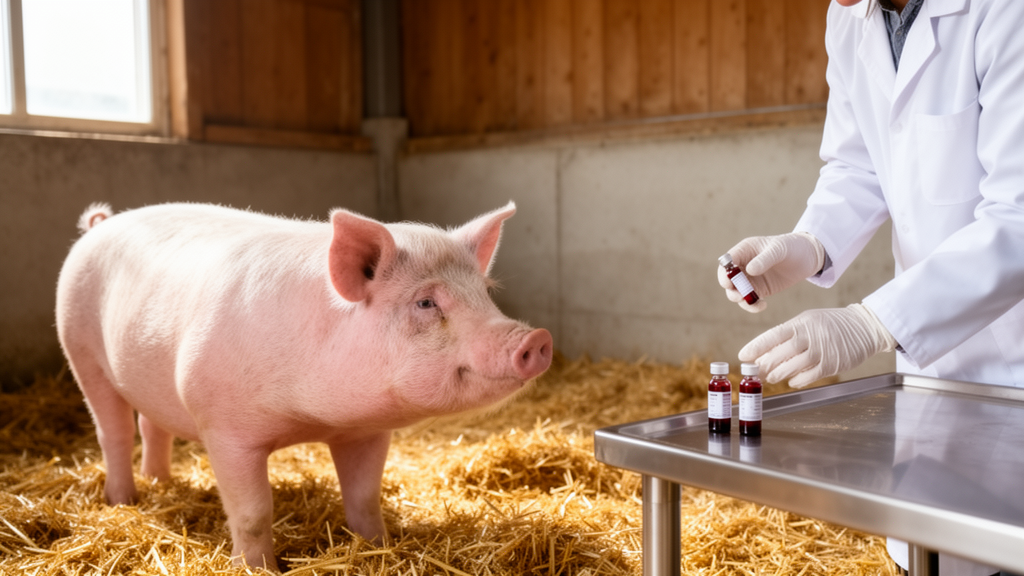
European pigs, even on the most modern intensive farms, remain widely infected with gastrointestinal parasites and enteric protists, according to a new systematic review published in Frontiers in Parasitology. A research team from the University of Life Sciences “King Mihai I” in Timisoara, Romania, led by Alesia Cioacă and Diana Hoffman, synthesized sixteen years of European evidence on the parasites that inhabit the guts of Sus scrofa domesticus, the domestic pig. Their conclusion is striking: despite decades of progress in production efficiency and animal health, parasitic infections remain endemic across the continent, shaped less by geography than by farm management, host age, and, crucially, the diagnostic methods used to detect them.
The review screened 1,655 records from PubMed, Web of Science, and ScienceDirect, covering publications from January 2010 to January 2026. After duplicate removal and rigorous title, abstract, and full-text screening, 28 studies conducted across 21 European countries made the final cut. Sample sizes ranged from 48 to 3,938 animals, drawn from intensive indoor units, outdoor systems, free-range and organic farms, and extensive household holdings. The team followed PRISMA 2020 reporting guidelines, structured the evidence around a PICO framework, and appraised methodological quality with the Joanna Briggs Institute checklist. Fifteen studies scored as high quality and twelve as moderate; none were rated low.
Among helminths, three nematodes dominated the European picture: the large roundworm Ascaris suum, the whipworm Trichuris suis, and the nodular worm Oesophagostomum spp. Ascaris suum is transmitted when pigs swallow embryonated eggs from contaminated environments, and its migrating larvae can scar the liver and lungs while intestinal infections erode growth performance. Trichuris suis, which colonizes the caecum and colon, can trigger inflammation, diarrhoea, and anaemia at high burdens. Oesophagostomum dentatum and O. quadrispinulatum, strongyles whose larvae develop within the intestinal mucosa, provoke inflammatory nodules in the large intestine. None of these pig-adapted species are regarded as major zoonotic agents, though their full relevance to human infection remains incompletely characterized.
The prevalence data revealed dramatic variation. On two free-range farms in Romania, Ascaris suum infected 63.1 percent of fattening pigs and 34.1 percent of sows, while Trichuris suis reached 39 percent in fatteners. In Serbia, nearly half of pigs from individual keepers carried the roundworm. By contrast, on intensive farrow-to-finish farms in Greece, Ascaris prevalence was just 3.7 percent, and on conventional Swiss farms a mere 0.8 percent. Age emerged as a consistent pattern for Oesophagostomum: on Swedish indoor farms, prevalence climbed from 4 percent in post-weaning piglets to 40 percent in dry sows, and in Poland it reached 51.8 percent in sows overall, detected on 68.6 percent of the 70 farms investigated.
Management practices showed statistical associations with helminth infections in some populations. On German alternative farms with outdoor access, pasture access was linked to higher odds of infection with Ascaris suum and strongyles, while deep-litter and free-range systems raised the odds for strongyles and whipworm compared with shallow-litter housing. On intensive Italian fattening farms, larger farm size and all-in/all-out production were associated with lower nematode risk. Yet these associations were not universal: a Danish study of modern sow farms found no link between farm-level roundworm prevalence and housing system, farm size, or contact with faecal material. The authors caution that no single production system carries a uniform level of risk.
Molecular tools uncovered diversity invisible to conventional microscopy. Using ITS-2 nemabiome metabarcoding on German outdoor-reared pigs, researchers found Oesophagostomum dentatum accounting for 93.9 percent of the strongyle community, O. quadrispinulatum for 5.9 percent, and Globocephalus urosubulatus for 0.1 percent — the first record of this hookworm species in domestic pigs in Europe. These figures describe the relative composition of the nematode community rather than individual-level prevalence, a technical distinction that matters when interpreting the data.
Coccidia told a different story. Cystoisospora suis, the agent of neonatal piglet cystoisosporosis, damages the small-intestinal epithelium of suckling piglets, causing malabsorption and diarrhoea. Farm-level prevalence on conventional units ranged from 42.9 percent in Germany to 83.3 percent in Spain, with litter-level values spanning 11.5 to 78.2 percent. Where age categories were analysed separately, younger animals consistently carried the highest burdens: on Swedish indoor farms, prevalence fell from 20 percent in post-weaning piglets to 0.3 percent in fatteners, with the parasite absent from sows. Eimeria spp., by contrast, showed no consistent age pattern, flourishing in some free-range and outdoor populations while remaining low in others.
The enteric protists carried the greatest public-health weight. Balantioides coli, a ciliate for which pigs are the principal reservoir hosts, has well-documented zoonotic relevance, with human infection linked to exposure to porcine faecal material. Detection varied wildly by method: on Italian intensive farms, sedimentation found the parasite in 95.9 percent of a comparative subset, FLOTAC with zinc sulphate in 85.7 percent, but FLOTAC with sodium chloride in only 8.9 percent. Cryptosporidium spp. showed a similar method effect — in Denmark, metabarcoding detected the protists in 35 percent of pigs while real-time PCR found them in 92 percent of the same population. Molecular typing repeatedly identified Cryptosporidium suis and Cry. scrofarum, with the zoonotically relevant Cry. parvum reported in fewer investigations, including a single Czech isolate assigned to gp60 subtype IIaA16G1R1b.
Blastocystis sp. revealed rich subtype diversity, with ST5 dominating in pigs from Serbia, Slovakia, and Denmark, where ST1, ST3, ST5, and ST15 co-circulated in the same population, often as mixed infections. Entamoeba polecki ST1 and ST3, both reported in humans, were detected by metabarcoding in 75 percent of a Danish pig population. Giardia duodenalis appeared in only two Danish studies, with Assemblage E — typically animal-associated — dominating, though Assemblage A, of zoonotic relevance, was also found. The microsporidian Enterocytozoon bieneusi, genotyped through the ribosomal ITS region, occurred in 92 percent of a tested Danish subset and 22.6 percent of extensively raised Iberian pigs, harbouring genotypes including EbpA, which has also been reported in humans.
The authors stress that finding the same species, subtype, or genotype in pigs and humans does not by itself demonstrate direct zoonotic transmission; establishing shared cycles requires comparative molecular investigations across host species supported by epidemiological data. Their synthesis nonetheless underlines the One Health imperative: pigs sit at a critical interface between animals, people, and the environment, capable of contaminating soil, water, and food chains. The review also flags uneven geographical coverage and substantial methodological heterogeneity — 13 studies used only conventional diagnostics, 4 only molecular approaches, and 11 combined both — as key limitations. The team calls for surveillance built on well-defined sampling strategies, comparable diagnostic methods, and molecular characterisation where relevant, so that the true parasite landscape of European pig production can finally be mapped with confidence.
Subject of Research: A systematic review of gastrointestinal parasites in Sus scrofa domesticus from Europe (2010 – 2026)
Article Title: A systematic review of gastrointestinal parasites in Sus scrofa domesticus from Europe (2010 – 2026)
Article References: Cioacă, A., Hoffman, D., Dreghiciu, I. C., Florea, T., Imre, M., Plesko, A., Oprescu, M., Oprescu, I., Dărăbuş, G., & Ilie, M. S. (2026). A systematic review of gastrointestinal parasites in Sus scrofa domesticus from Europe (2010 – 2026). Frontiers in Parasitology, 5, Article 1950643. https://doi.org/10.3389/fpara.2026.1950643
Image Credits: AI Generated
DOI: 10.3389/fpara.2026.1950643
Keywords: domestic pig, gastrointestinal parasites, Ascaris suum, Cryptosporidium, Balantioides coli, Blastocystis, Cystoisospora suis, zoonotic, One Health, systematic review, Europe, veterinary epidemiology
Cite Scienmag News
Kristina Jarvis. (October 17, 2026). Europe’s Pigs Carry a Hidden Parasite Load, Landmark Review Finds. Scienmag. https://scienmag.com/europes-pigs-carry-a-hidden-parasite-load-landmark-review-finds/
Kristina Jarvis. "Europe’s Pigs Carry a Hidden Parasite Load, Landmark Review Finds." Scienmag, 17 October 2026, https://scienmag.com/europes-pigs-carry-a-hidden-parasite-load-landmark-review-finds/. Accessed 17 October 2026.
Kristina Jarvis. "Europe’s Pigs Carry a Hidden Parasite Load, Landmark Review Finds." Scienmag. October 17, 2026. https://scienmag.com/europes-pigs-carry-a-hidden-parasite-load-landmark-review-finds/


