


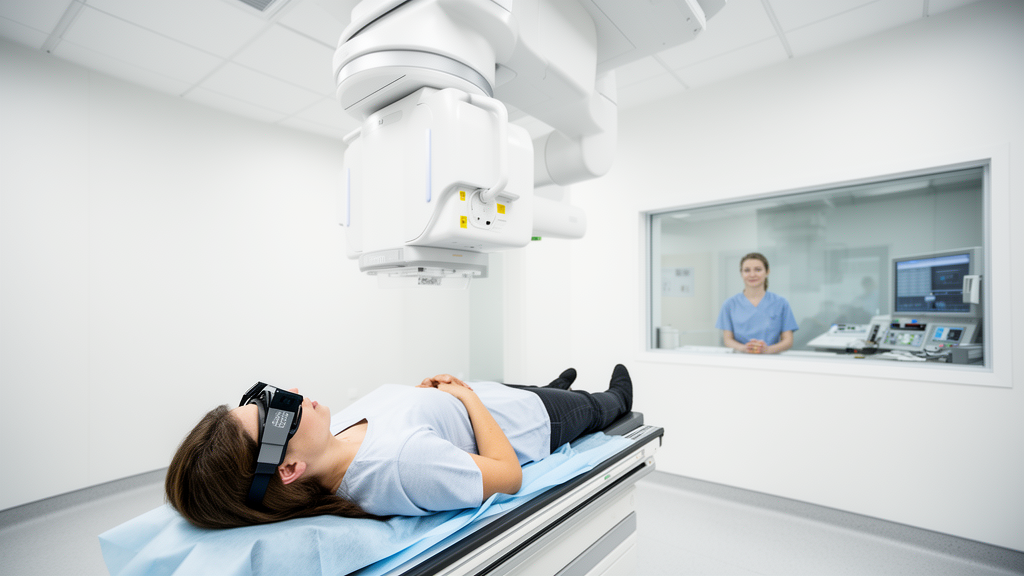
For patients receiving radiotherapy for breast cancer or lymphoma, protecting the heart has become a central concern of modern treatment planning. Deep-inspiratory breath-hold, widely known as DIBH, is the technique most departments rely on to keep radiation away from cardiac tissue. Yet the method carries an inherent trade-off: asking patients to repeatedly take a deep breath and hold it while a linear accelerator delivers dose takes longer than treating them while they breathe freely. A research team in India wondered whether a relatively simple piece of consumer-style technology, three-dimensional goggles displaying a live respiratory waveform, could shave minutes off these longer sessions. The answer, according to a randomized trial published in the journal Oncoscience, is that the goggles offered no significant time savings at all.
The study, led by first author Naseera Syeda of Tata Memorial Hospital with corresponding author Tabassum Wadasadawala of the Advanced Centre for Treatment, Research and Education in Cancer, enrolled 94 patients scheduled for DIBH radiotherapy, primarily for breast cancer, with a smaller subset treated for lymphoma. Participants were randomly assigned to one of two guidance approaches. Fifty-one patients received the standard audio-only coaching that most centers use, while 43 wore 3D goggles that combined the usual verbal instructions with real-time visual feedback showing their breathing pattern as a waveform. The trial was not blinded, which the authors acknowledge, but the primary endpoint, overall treatment time, was measured objectively using recorded breath-hold waveforms from an infrared camera system.
The technology behind the trial deserves a closer look, because it illustrates how DIBH is actually monitored in clinical practice. An infrared camera mounted on the CT and treatment couches tracked a surrogate marker box fitted with six metallic reflectors placed on the patient’s chest wall. Before simulation, a frame was used to calibrate a respiratory threshold, and during treatment the software displayed a live waveform of each breath. Radiation delivery was gated so that the beam switched on only when the chest wall position fell within the predefined threshold. The same waveform records allowed the researchers to calculate every phase of the session: setup, imaging, beam-on time, the number of breath-holds, and any interruptions. The goggles themselves displayed this respiratory signal to the patient in three dimensions, on the theory that seeing the breath-hold target might help patients achieve it faster and more consistently.
Every participant in the trial, regardless of assignment, underwent the same structured preparation. One to two weeks before simulation, patients received dedicated DIBH training, practiced with spirometers, and were encouraged to perform daily breathing exercises at home. Trained radiotherapy technologists monitored their progress through practice records and regular follow-up. This uniform coaching is a critical detail, because it meant the goggles were being tested as an addition to, not a substitute for, thorough breathing instruction. The researchers measured overall treatment time as the primary outcome, alongside setup time, imaging duration, radiation beam-on time, breath-hold counts, treatment interruptions, and positioning reproducibility.
The results were unambiguous on the main question. Patients guided by audio alone averaged 22.4 minutes of overall treatment time, while those wearing goggles averaged 23.4 minutes, a difference that was not statistically significant (p = 0.205). Nor did the goggles improve any of the secondary measures: beam-on time, imaging duration, breath-hold counts, and interruptions were all comparable between groups, and patient positioning was equally reproducible with or without the visual display. When the researchers broke the analysis down by session number, comparing the first session, the first three sessions, and subsequent sessions, no significant differences emerged at any point in the treatment course.
There was one measure where the goggles actively hurt efficiency. Setup time was significantly longer when the equipment was used, rising from a median of 6.5 minutes with standard guidance to 7.3 minutes with goggles (p = 0.005). The researchers attributed this partly to the manual setup and connections the goggle system required. In a busy radiotherapy department treating dozens of patients daily, even a few added minutes of setup per patient can compound into meaningful scheduling pressure, which is precisely the problem visual feedback was supposed to relieve.
Perhaps the most practically important finding of the trial had nothing to do with the goggles. Across the entire study population, treatment efficiency improved markedly with repetition. Average treatment time fell significantly from 25.6 minutes during the first three sessions to 21.5 minutes thereafter (p = 0.001). Familiarity with the DIBH routine, it appears, is itself a powerful driver of speed. Patients who practice the breath-hold pattern at home and repeat it session after session simply get better at it, regardless of whether they can see their breathing waveform on a screen.
The researchers also examined which patient characteristics were associated with treatment duration. In univariate analysis, gender was the only significant factor, with shorter treatment times observed among men. However, only eight male patients participated in the trial, a sample far too small to support firm conclusions about why this difference appeared. The authors flag this finding as exploratory and limited in interpretation.
The results diverge from some earlier, smaller studies that reported improvements with audio-visual guidance during DIBH. The authors suggest that structured pre-treatment coaching may explain why the goggles provided no measurable additional benefit in this trial: when patients have already been thoroughly trained, the visual display adds little. The manual setup demanded by the specific goggle system may also have eroded whatever efficiency the technology could offer. As the authors put it, the findings suggest that structured pre-treatment coaching alone may be sufficient to achieve efficient DIBH delivery in routine clinical practice, without the need for additional audiovisual augmentation.
The trial has limitations that temper how broadly its conclusions apply. Patients unable to perform DIBH were not evaluated, so the study cannot say whether goggles might improve compliance for the subset of patients who struggle with the technique. The equipment required manual setup, meaning more streamlined or battery-operated systems might yield different results. Patient satisfaction and compliance outcomes were not included in the present report and are intended for separate publication. Most importantly, the trial focused on treatment efficiency rather than comparing radiation doses to the heart or long-term clinical outcomes, so it cannot establish whether visual feedback influences cardiac protection or treatment effectiveness. Further studies involving different feedback systems and patient populations may help identify individuals who could genuinely benefit from additional visual guidance. For now, the message for high-volume or resource-limited centers is a reassuring one: careful breathing training, patient preparation, and session-by-session familiarity appear sufficient to deliver efficient cardiac-sparing radiotherapy, without adding equipment, complexity, or cost to the treatment couch.
Subject of Research: Oncology
Article Title: 3D goggles offer no significant time savings during breath-hold radiotherapy
Article References: 3D goggles offer no significant time savings during breath-hold radiotherapy. Original publication (Bibliographic details unavailable.)
Image Credits: AI Generated
DOI: Not provided
Keywords: radiotherapy, breast cancer, deep-inspiratory breath-hold, 3D goggles, audio-visual feedback, cardiac sparing, goggles, offer, significant, time, savings, during
Cite Scienmag News
Nathaniel Bowman. (October 17, 2026). 3D Goggles Fail to Shorten Breath-Hold Radiotherapy Sessions in Randomized Trial. Scienmag. https://scienmag.com/3d-goggles-fail-to-shorten-breath-hold-radiotherapy-sessions-in-randomized-trial/
Nathaniel Bowman. "3D Goggles Fail to Shorten Breath-Hold Radiotherapy Sessions in Randomized Trial." Scienmag, 17 October 2026, https://scienmag.com/3d-goggles-fail-to-shorten-breath-hold-radiotherapy-sessions-in-randomized-trial/. Accessed 17 October 2026.
Nathaniel Bowman. "3D Goggles Fail to Shorten Breath-Hold Radiotherapy Sessions in Randomized Trial." Scienmag. October 17, 2026. https://scienmag.com/3d-goggles-fail-to-shorten-breath-hold-radiotherapy-sessions-in-randomized-trial/


