


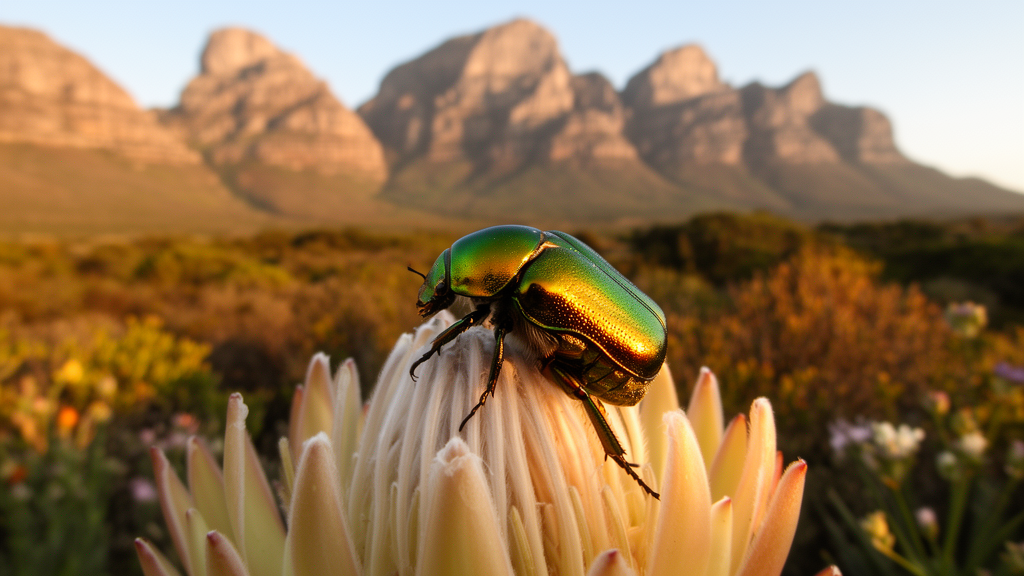
A genus of flower chafer beetles so obscure that only three species were recognized for more than two centuries has turned out to be one of the most striking examples of localized evolution in southern Africa. A comprehensive revision published in African Invertebrates has re-examined museum specimens and newly collected material of Stegopterus, a scarab beetle genus endemic to South Africa’s Western Cape Province, and concluded that the genus contains at least fifteen species rather than the four previously accepted. Eleven of these are described as new to science, and one historical species has been relegated to uncertain taxonomic status.
The revision, carried out by Enrico Ricchiardi and Renzo Perissinotto, drew on historical specimens held in major European and South African institutions, including the Natural History Museum in London, the Muséum National d’Histoire Naturelle in Paris, the Muséum d’Histoire Naturelle in Geneva, and the Iziko South African Museum in Cape Town, together with private collections and recent field material. The genus Stegopterus was originally erected in 1840 by Burmeister and Schaum to accommodate three South African species: S. vittatus, described by Fabricius in 1775, S. suturalis, described by Gory and Percheron in 1833, and S. septus, described by the two authors themselves. A fourth species, S. obesus, was added by Burmeister in 1842 on the basis of a single female from Port Natal, now Durban, but the type specimen cannot be traced and its reported locality lies far outside the known range of the genus. The authors of the new revision therefore treat S. obesus as incertae sedis, meaning its placement remains unresolved.
What makes the finding remarkable is the extraordinary geographic compression of the radiation. Every confirmed species of Stegopterus is confined to the region bounded by the South and West coasts of the Western Cape and the Cape Fold Mountains, a belt of fynbos vegetation and marginal Karoo habitat. Not a single confirmed record extends into the neighbouring Eastern Cape Province, and searches in KwaZulu-Natal have yielded no evidence that the genus ever reached that region. This pattern mirrors the biogeography of numerous other insect lineages tied to the Cape Floristic Region, one of the principal centres of endemism on the African continent, dominated by the Fynbos Biome.
The Cape Floristic Region is, by global standards, a botanical phenomenon of the first order. More than 9,000 vascular plant species crowd into an area of roughly 91,000 square kilometres, with just over 68 percent of them found nowhere else on Earth. Under the broader concept of a Greater Cape Floristic Region, which adds renosterveld, thicket, succulent karoo and pockets of afrotemperate forest, plant richness climbs above 11,000 species with endemism approaching 78 percent. The insect fauna follows a similar logic of concentrated, largely endemic clades. The region hosts more than 85 percent of the South African monkey beetle fauna, over 500 species and roughly half of the world’s total, and comparable stories have been documented in flightless keratin beetles, Colophon stag beetles, jewel beetles, and the cetoniid genera Trichostetha and Odontorrhina. Stegopterus now joins this roster as a genus whose entire known diversity unfolds within a single provincial corner of the continent.
Taxonomically, the revision rests on a careful dissection of morphological characters. The authors subdivided the fourteen verified species into two species groups on the basis of a shared derived trait, or synapomorphy: the shape of the male mesotibia. In the vittatus group, comprising nine species, the mesotibia is strongly bent ventrally with a widened apex, whereas in the septus group, with five species, it is only weakly curved and the apex is not strongly modified. This same ventral bending of the mesotibia has historically been used to erect new genera within the Trichiini, but within Stegopterus it serves to partition the genus into two coherent lineages rather than to justify splitting it further.
Distinguishing individual species required a broader suite of characters, since the male genitalia, though informative, are conservative across the genus. The authors emphasize that paramere shape should always be assessed alongside other features rather than in isolation. Chief among these are the shape of the clypeus, the frontal plate of the head, whose anterior corners and lateral margins vary subtly but consistently between species; the presence and form of a broad intrahumeral black band on the elytra; the shape of the male mesotibia; and the length of the antennal club relative to the clypeus. The antennal footstalk, which allows the beetle to flex its club in various directions for sensory purposes, is rarely perfectly straight, complicating precise length measurements, so the authors relied on the club-to-clypeus ratio as a more stable metric.
Among the new species, several stand out for their restricted and often surprising distributions. Stegopterus agulhas, known from a single locality within Agulhas National Park near the southernmost tip of the African continent, was found feeding on flowers of Berzelia, Leucadendron and Leucospermum. S. cochraneae, named in honour of Margie Cochrane, a former curator at the Iziko South African Museum, is a high-altitude dweller across the Hawekwaberge and Dutoitsberge ranges between Paarl, Franschhoek and Worcester. S. endroedyi, named for the Hungarian entomologist Sebastian Endrödy-Younga who collected the type series, occupies the easternmost limit of the genus in the Groot Swartberg above Oudtshoorn, and had in fact been recognized by Arthur Evans in the 1980s but never formally described. S. kromrivieri is a typical Cederberg inhabitant, while S. pallidulus, with its pale fulvous elytra, is confined to the Klein Swartberg range above Ladismith. S. rotundiceps, distinguished by semicircular clypeal margins and antennal clubs roughly twice the length of the clypeus, hails from the western lower slopes of the Cederberg between Leipoldtville and Clanwilliam.
The revision also required careful nomenclatural housekeeping. Lectotypes were designated for three historical names: S. septus, based on a male in the Melly Collection in Geneva labelled as a Schaum type; Trichius suturalis Gory and Percheron, 1833, now S. suturalis; and Cetonia vittata Fabricius, 1775, now S. vittatus. The lectotype designations stabilize the application of these names, which had rested on type series of uncertain composition. In the case of S. vittata, the sole candidate specimen in the Natural History Museum in London is so extensively glued that examining its genitalia would be risky, and both antennae are missing, making definitive identification impossible; the Geneva lectotype instead anchors the name. Péringuey’s 1907 revision, which had introduced the erroneous S. natalensis, later reassigned to the genus Eriopeltastes, remains valid in its generic description even though its species-level decisions required correction.
The biogeographic picture that emerges is one of climatically driven allopatric speciation. The Cape Fold Mountains comprise a double range of eastern mountains parallel to the Indian Ocean coast and a single western range running parallel to the Atlantic coast. These ranges trap moisture moving inland from the oceans, producing wet southern slopes and arid northern plains. During the Miocene, a gradual increase in aridity and temperature would have rendered low-lying areas inhospitable, forcing populations to retreat to higher altitudes near the various mountain summits, where isolation promoted divergence. The Colophon stag beetles, which are flightless and confined to these same ranges, illustrate the same dynamic. Stegopterus differs in one important respect: its species are all capable of flight and have maintained representatives in the low-lying areas, yet the genus has still radiated into a comparable number of narrow endemics.
Conservation prospects are currently favourable for most of the genus, as the majority of species are high-altitude dwellers falling within the Cape Floral Region Protected Areas, a UNESCO World Heritage Site. However, ongoing land-use transformation in the mid- and lowland areas of the Western Cape, particularly in the Cape Winelands District and regions under deciduous fruit cultivation, may threaten some of the newly described species, including S. paardebergi from the isolated Perdeberg peak between Paarl and Malmesbury, S. kromrivieri from the Cederberg, and S. hexrivieri from the Hex River area above Worcester. Females remain unknown for ten of the fourteen verified species, and basic biology and ecology are documented for only a handful, underscoring how much remains to be learned about a lineage that has been hiding in plain sight for nearly 250 years.
Subject of Research: Taxonomic revision and radiation of the Western Cape endemic flower chafer beetle genus Stegopterus
Article Title: Revision of the Western Cape endemic genus Stegopterus Burmeister & Schaum, 1840 ( Coleoptera , Scarabaeidae , Cetoniinae , Trichiini )
Article References: Ricchiardi, E., Perissinotto, R., & Strümpher, W. (2025). Revision of the Western Cape endemic genus Stegopterus Burmeister & Schaum, 1840 (Coleoptera, Scarabaeidae, Cetoniinae, Trichiini). African Invertebrates, 66(1), 151-191. https://doi.org/10.3897/afrinvertebr.66.140593
Image Credits: AI Generated
DOI: 10.3897/afrinvertebr.66.140593
Keywords: Stegopterus, Scarabaeidae, Cetoniinae, Trichiini, Western Cape, Fynbos, Cape Floristic Region, new species, taxonomy, Cape Fold Mountains, beetles, South Africa
Cite Scienmag News
Gavin Prescott. (October 17, 2026). Hidden beetle radiation: eleven new flower chafer species revealed in South Africa’s Cape mountains. Scienmag. https://scienmag.com/hidden-beetle-radiation-eleven-new-flower-chafer-species-revealed-in-south-africas-cape-mountains/
Gavin Prescott. "Hidden beetle radiation: eleven new flower chafer species revealed in South Africa’s Cape mountains." Scienmag, 17 October 2026, https://scienmag.com/hidden-beetle-radiation-eleven-new-flower-chafer-species-revealed-in-south-africas-cape-mountains/. Accessed 17 October 2026.
Gavin Prescott. "Hidden beetle radiation: eleven new flower chafer species revealed in South Africa’s Cape mountains." Scienmag. October 17, 2026. https://scienmag.com/hidden-beetle-radiation-eleven-new-flower-chafer-species-revealed-in-south-africas-cape-mountains/


