


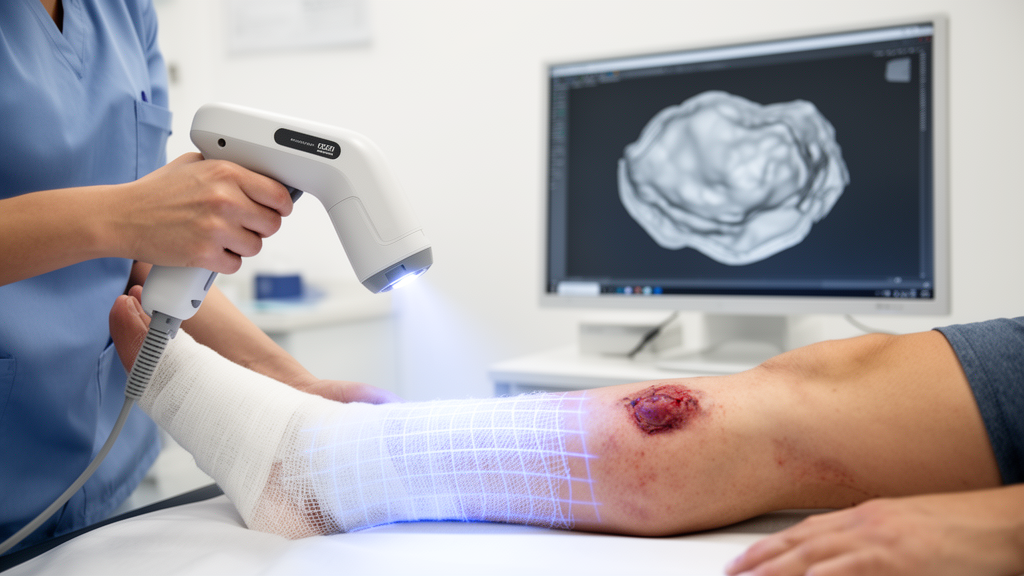
When a wound refuses to heal, clinicians often have little more than a ruler and a cotton swab to judge whether treatment is working. That familiar bedside ritual, long accepted as good enough, may soon give way to something far more rigorous. Salam Daher, an associate professor of informatics at the New Jersey Institute of Technology, has developed and patented a digital system that scans wounds in three dimensions and tracks their healing with a precision that manual techniques cannot match. The U.S. patent was granted on September 29, capping a multi-year effort that also earned a Best Innovation Award at the International Meeting for Simulation in Healthcare in 2025.
The problem Daher set out to solve is deceptively simple to state and notoriously hard to fix. Wound healing is a dynamic process that unfolds across the entire three-dimensional landscape of damaged tissue, yet most clinical assessments capture only a two-dimensional snapshot. Surface contours and wound boundaries do offer clues about the pace of recovery, but measurements taken at the surface can overlook changes in the wound’s deeper layers. Worse, different healthcare providers often select different reference points when measuring a wound’s width and length, producing conflicting data about whether the same wound is shrinking or growing.
“It’s a challenge to measure wounds,” Daher says. “First, it’s hard to measure the thickness of a wound. Second, there are multiple standards for measuring wounds, so different people would measure the same wound differently.” Her response was to move the entire measuring process into the digital realm. Using her method, a skin anomaly is first scanned and then reconstructed as a virtual three-dimensional model. Software then computes the wound’s length, width and depth — quantities that conventional analysis already attempts — and goes a step further by evaluating the wound’s perimeter, surface area and volume. Because those variables are calculated from a consistent digital model each time, clinicians can observe how they change over time as wounds heal or deteriorate, with far less of the noise introduced by human technique.
“Right now, most healthcare providers use a ruler and a Q-tip to measure your wound,” Daher says, noting that such tools are inherently less precise than digital measurements. Photography, the other common monitoring shortcut, carries its own distortions. Images can be warped by the lens or skewed by the camera’s position and angle, so a photograph that suggests improvement may simply reflect a better shooting angle. And when different providers mark different points along a wound’s margins for linear measurements, the resulting inconsistencies can create what Daher calls a false sense of whether the wound is increasing or decreasing in size.
What distinguishes the patented system from earlier digital attempts is its use of the wound’s full topography. Rather than reducing the injury to a few linear dimensions, the method maps the overall shape of the healing tissue, including every contour, peak and valley at all depths. “What’s special about this is we’re using all of the ‘ups and downs’ of that wound,” Daher explains. “You see more changes in the middle than you see at the edges. So, it could give us a faster indication of how the wound is healing or not.” Because the center of a wound typically changes more dramatically than its edges during healing, volume-based and topographic measurements can flag improvement — or deterioration — sooner than edge-to-edge rulers ever could. She presented the underlying research at the IEEE International Conference on Healthcare Informatics in Minneapolis in June.
Validation was a deliberate, staged process. The researchers first tested the method by scanning soft physical models representing skin anomalies at different stages of healing. But those early phantoms were fabricated by hand and did not originate as digital files, leaving open the question of whether the system’s measurements were accurate across every wound stage. Daher went back to the drawing board and created digital files from scratch, then 3D-printed six models depicting pressure ulcers as they progressively healed. The final component was software that used an algorithm to measure and compare the wounds against one another, closing the loop between physical ground truth and digital computation.
Daher’s collaborators at the University of Central Florida then recruited healthcare providers to put the system through a head-to-head trial. The clinicians measured wound progression first by hand, then using the software. The results, published in the IEEE Open Journal of Instrumentation and Measurement in 2025, confirmed the scientists’ prediction that the software provided more accurate measurements. Just as important for real-world adoption, the providers trusted the system. “We also found that the healthcare providers trusted the system, so the system can measure things manually or semi-automatically,” Daher says. In manual mode, the user traces the wound contours and selects measuring points while the software handles the computation. In automatic mode, users simply define which parts of the contours are wound and which are not, and the algorithm selects the measuring points on its own.
The automation work continued with collaborators at the Catholic University of America, producing a paper presented at the 2025 IEEE International Conference on Data Mining Workshops, where the system also won the conference’s Outstanding Demo Award. Together, the sequence of publications and awards traces a complete arc from concept to validated instrument: a scanning protocol, a set of 3D-printed ground-truth phantoms, a measurement algorithm, a comparative clinical trial and, finally, an automated mode that reduces the operator’s role to little more than outlining the wound boundary.
Earning the patent itself was a separate kind of trial. Although this was not Daher’s first patent, it was her first submission as lead inventor, and she discovered that inventiveness is only one ingredient in the process. Careful record-keeping and time management from start to finish are equally essential, especially once a patent has been filed and the inventor must explain to lawyers and a patent examiner how a new system differs from other patented technologies. The timing creates its own tension: the writing and defense of the patent often happen while the work has not yet appeared in a peer-reviewed journal or conference proceedings, and inventors typically delay publication in the early stages so that their own papers do not invalidate the patent claims. “You’re trying to defend something that doesn’t exist,” she says.
The defense turned out to be unusually swift. “I responded to the examiner and he retracted all of his rejections after my first response,” Daher recalls. Unsure what would come next, she asked a colleague, who told her the only remaining task was to celebrate. “I didn’t know that usually it takes more back-and-forth, with some claims not surviving the process,” she adds. “I’m happy that the hard work paid off.” The patent now stands as formal recognition of a system that could change how clinicians everywhere answer a basic question — is this wound getting better? — by replacing rulers, swabs and guesswork with a complete three-dimensional record of healing, measured the same way every time.
Subject of Research: 3D wound analysis system patented by NJIT informatics researcher Salam Daher
Article Title: More than skin deep: New system for wound analysis earns patent for NJIT researcher
Article References: More than skin deep: New system for wound analysis earns patent for NJIT researcher. Original publication (Bibliographic details unavailable.)
Image Credits: AI Generated
DOI: Not provided
Keywords: wound healing, 3D scanning, digital health, patent, medical informatics, pressure ulcers, than, skin, deep, system, wound, analysis
Cite Scienmag News
Denise Maddox. (October 17, 2026). Patented 3D Wound Tracking System Promises Faster, More Precise Healing Measurements. Scienmag. https://scienmag.com/patented-3d-wound-tracking-system-promises-faster-more-precise-healing-measurements/
Denise Maddox. "Patented 3D Wound Tracking System Promises Faster, More Precise Healing Measurements." Scienmag, 17 October 2026, https://scienmag.com/patented-3d-wound-tracking-system-promises-faster-more-precise-healing-measurements/. Accessed 17 October 2026.
Denise Maddox. "Patented 3D Wound Tracking System Promises Faster, More Precise Healing Measurements." Scienmag. October 17, 2026. https://scienmag.com/patented-3d-wound-tracking-system-promises-faster-more-precise-healing-measurements/


