


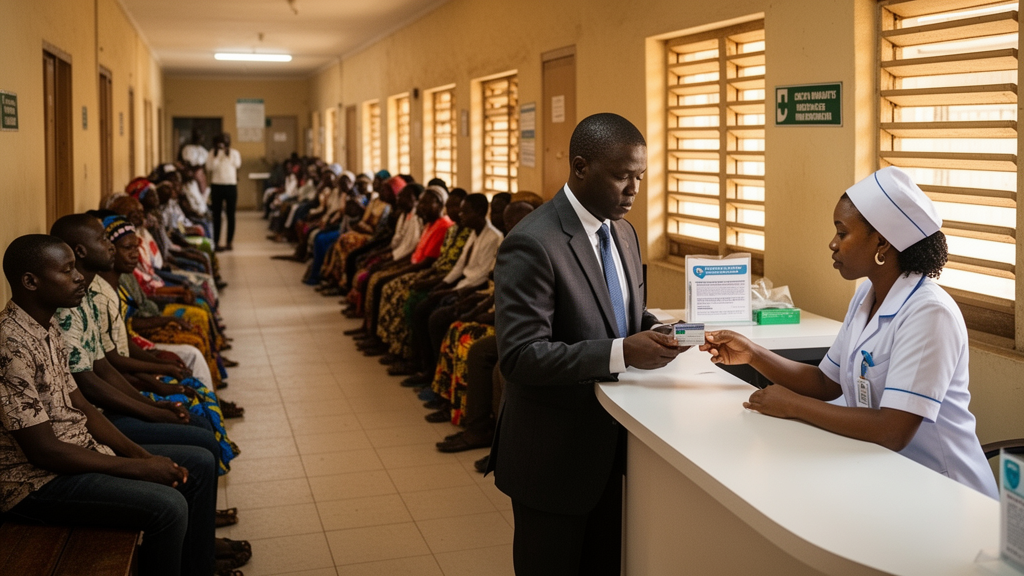
When Nigeria launched its National Health Insurance Scheme in 1999, the promise was bold: universal health coverage for all citizens by 2015. A decade past that deadline, a new systematic review published in Frontiers in Health Services reveals a scheme that genuinely improves access to care and shields families from financial ruin — but only for a small, privileged slice of the population. The review, led by Rolle Remi Ahuru of Federal University Otuoke and Ngozi Alison Okenya of Dennis Osadebay University, synthesised twelve primary studies to answer a deceptively simple question: does health insurance in Nigeria actually work?
The answer, according to the evidence, is a qualified yes. Using PRISMA 2020 guidelines, the researchers searched PubMed, Web of Science, and Google Scholar for studies published between 2015 and 2024. The initial sweep identified 495 records. After removing duplicates, screening titles and abstracts, and assessing 66 full-text papers for eligibility, only twelve studies survived the rigorous selection process. Each was critically appraised using the Joanna Briggs Institute checklist for analytical cross-sectional studies, and all twelve scored between six and eight out of eight — a rating the authors classified as good quality.
Because the included studies measured such different outcomes — healthcare utilisation, enrolment rates, out-of-pocket spending — a quantitative meta-analysis was impossible. Instead, the team employed a thematic narrative synthesis, coding findings iteratively into descriptive and analytical themes. The results converge on three central conclusions: health insurance increases healthcare uptake, reduces dependence on out-of-pocket payments, and yet remains so low and so unequal that its benefits reach only a fraction of those who need them most.
The strongest evidence on utilisation came from nationally representative analyses of the Nigeria Demographic and Health Survey. One study of 8,006 women of reproductive age, using binary logistic regression, found a statistically significant positive association between insurance enrolment and the use of antenatal care, skilled birth attendants, and postnatal care. A second analysis of 6,761 women found that insured women were more likely to deliver in health facilities than their uninsured counterparts. The NDHS itself, covering 41,668 households, reported higher uptake of maternal healthcare services and child immunisation among women with insurance coverage. Smaller facility-based studies in Osun, Ogun, and Lagos states reinforced the pattern, showing higher immunisation coverage, greater willingness to seek care, and increased uptake of preventive services among enrollees.
On financial protection, the numbers are striking. The Nigerian Health Watch report found that insured individuals spent an average of ₦11,142 per year out of pocket, compared with ₦24,345 among the uninsured — a difference of more than half. The NDHS similarly reported substantially lower out-of-pocket expenditure for maternal and reproductive healthcare among insured women. Facility-based studies in Ondo and Ogun states confirmed that enrollees were less likely to experience financial hardship, while uninsured households devoted a larger proportion of their income to healthcare. Taken together, the evidence suggests that insurance functions as a genuine financial safety net, reducing the risk of catastrophic health expenditure that pushes millions of Nigerians into poverty each year.
Yet the review’s most sobering finding concerns who actually gets covered. Enrolment remains abysmally low, and the disparities are stark. According to the NDHS, insurance coverage among urban residents stands at 23.9 per cent — roughly twice the 11.8 per cent recorded among rural residents. Enrolment is concentrated among wealthier households, more educated individuals, and populations in Southern Nigeria, leaving Northern regions, informal sector workers, and the rural poor largely excluded. Only four African countries — Rwanda at 79 per cent, Ghana at 58 per cent, Gabon at 41 per cent, and Burundi at 22 per cent — have achieved insurance coverage of 20 per cent or more of their populations, out of 36 sub-Saharan African countries assessed in 2022.
The authors interpret these patterns through Andersen’s Healthcare Utilisation Model, which frames healthcare use as a function of predisposing, enabling, and need-based factors. Education emerged as a major determinant of enrolment: higher health literacy improves awareness of insurance benefits, strengthens the ability to navigate registration procedures, and increases trust in formal healthcare systems. Uneducated individuals, by contrast, may perceive premium payments as immediate financial burdens rather than future protection, particularly in contexts of widespread economic insecurity. Geographical disparities reflect deeper structural inequalities — Southern Nigeria records higher literacy rates, greater formal-sector employment, and better healthcare infrastructure than the North, meaning higher enrolment in the South cannot be understood simply as individual preference.
The review also acknowledges its own methodological constraints. The cross-sectional nature of most included studies limits causal inference, as reverse causality and residual confounding may still be present. Several studies relied on simple binary yes-or-no measures of insurance enrolment, oversimplifying a complex construct that ignores duration of coverage, benefit package differences, and continuity of enrolment. Recall bias may distort self-reported expenditure figures, and facility-based samples drawn from urban areas likely overrepresent frequent healthcare users. Most studies also clustered in the South-Western region, limiting national generalisability.
The policy implications are urgent. The authors call for full implementation of the Vulnerable Group Fund under the National Health Insurance Authority Act of 2022, which aims to target over 83 million vulnerable and indigent Nigerians — approximately 38 per cent of the population — who cannot afford premiums. They also recommend strengthening primary healthcare centres, boosting government health expenditure through broadened tax revenue, and scaling up community-based health insurance programmes in the informal sector, where more than 90 per cent of Nigerians work. Countries that have succeeded, such as Rwanda and Ghana, broadened community-based schemes into the informal sector and subsidised premiums for the poor.
As the 2030 terminal year for the Sustainable Development Goals draws near, Nigeria’s universal health coverage service index stands at a mere 38 per cent — far below the global average of 68 per cent. The review’s verdict is clear: health insurance in Nigeria works, reducing out-of-pocket spending and increasing healthcare uptake among those enrolled. But a scheme that covers only the educated, the wealthy, the urban, and the Southern is not universal coverage — it is a mirror of the very inequalities it was designed to erase. Genuine universality, the authors argue, requires equitable financing, targeted subsidies, premium waivers, and a fundamental commitment to reaching the 83 million Nigerians the system has left behind.
Subject of Research: Systematic literature review and narrative synthesis of the effectiveness of health insurance in improving access to healthcare and providing financial protection in Nigeria
Article Title: Systematic literature review and narrative synthesis of the effectiveness of health insurance in improving access to healthcare and providing financial protection in Nigeria
Article References: Ahuru, R. R., & Okenya, N. A. (2026). Systematic literature review and narrative synthesis of the effectiveness of health insurance in improving access to healthcare and providing financial protection in Nigeria. Frontiers in Health Services, 6, Article 1946888. https://doi.org/10.3389/frhs.2026.1946888
Image Credits: AI Generated
DOI: 10.3389/frhs.2026.1946888
Keywords: Systematic, literature, review, narrative, synthesis, effectiveness, health, insurance, improving, access, healthcare, providing
Cite Scienmag News
Ophelia Keating. (October 17, 2026). Health Insurance Works in Nigeria — But Only for Those Who Can Afford It. Scienmag. https://scienmag.com/health-insurance-works-in-nigeria-but-only-for-those-who-can-afford-it/
Ophelia Keating. "Health Insurance Works in Nigeria — But Only for Those Who Can Afford It." Scienmag, 17 October 2026, https://scienmag.com/health-insurance-works-in-nigeria-but-only-for-those-who-can-afford-it/. Accessed 17 October 2026.
Ophelia Keating. "Health Insurance Works in Nigeria — But Only for Those Who Can Afford It." Scienmag. October 17, 2026. https://scienmag.com/health-insurance-works-in-nigeria-but-only-for-those-who-can-afford-it/


