


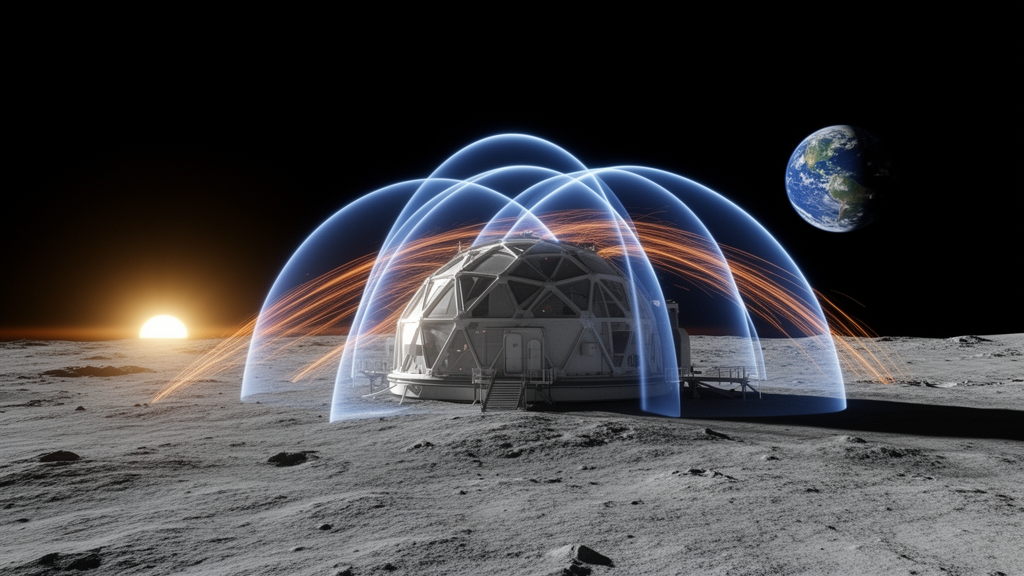
When the first crews settle permanently on the Moon or Mars, they will trade Earth’s protective cocoon for one of the most hostile radiation environments in the solar system. Earth’s global magnetosphere and thick atmosphere deflect and absorb the constant barrage of solar energetic particles, coronal mass ejections, and galactic cosmic rays that would otherwise rain down unchecked. The Moon and Mars have neither. A new perspective article published in Frontiers in Space Technologies by Onyinye G. Nwankwo of the University of Michigan and Joseph N. Pelton of the International Space University argues that as programs like Artemis and private sector initiatives move sustainable habitats from concept to reality, radiation protection must shift from a supplementary concern to a foundational design principle for off-world infrastructure.
The threats are varied and unforgiving. Solar energetic particle events are sudden, high-flux emissions of protons and heavy ions accelerated by solar flares and coronal mass ejection-driven shocks, reaching energies above 1 GeV and capable of acute radiation exposure. Coronal mass ejections are massive eruptions of solar plasma and magnetic field that can trigger intense radiation storms and induce currents capable of disrupting power systems. Galactic cosmic rays, originating outside the solar system, are exceptionally penetrating nuclei that form a persistent background modulated by the solar cycle, contributing to long-term risks such as cancer, neurocognitive decline, and cardiovascular disease. For infrastructure, penetrating particles and induced currents can produce single event upsets, latchup, and burnout in avionics and life support electronics, accelerate degradation of solar arrays and batteries, drive surface charging and arcing, and raise error rates in communication and navigation links during severe storms.
Historical storms offer sobering analogs. The 2003 Halloween storms disabled satellites and disrupted aviation even on Earth, behind the planet’s magnetic shield. A similar event striking the unshielded surfaces of the Moon or Mars could severely damage infrastructure. Published estimates of Carrington-class event frequency vary, but are commonly framed as return periods on the order of a century, with a non-negligible decadal probability. Moderate storms capable of stressing modern systems, such as those in March 1989 and October 2003, occur more frequently. For crews caught outside during a large solar energetic particle event, doses can approach thresholds for acute radiation syndrome, which is why NASA’s career effective dose framework and design reference requirements motivate storm shelters with large dose reduction factors and extravehicular activity scheduling based on dose rates.
The first of three complementary mitigation strategies examined in the article is localized artificial magnetic shielding, an attempt to reproduce on small scales the protective role of Earth’s magnetosphere. The concept of mini-magnetospheres was originally proposed for spacecraft en route to Mars but has since been adapted for surface applications, with superconducting coils deployed around habitats, communication nodes, or power systems to create protective envelopes. In principle, field strength could be adjusted during storms, offering adaptive protection, but operational feasibility depends on control stability, power availability, and verified performance under realistic plasma conditions.
The physics is illustrated by a simple test particle calculation for a single surface coil. A circular coil with a radius of 5 meters carrying 300,000 ampere-turns, oriented with its axis vertical, produces a field exceeding 450 nanotesla near the coil that decreases radially outward. Within a reference contour where the field is about 300 nanotesla, the gyro radii of 20 MeV protons become comparable to or smaller than the shielded region, so incoming particles are bent around the habitat volume rather than penetrating it. The authors stress that this is strictly a scaling illustration: plasma compression can reduce the effective standoff distance, induced currents can distort the field topology, reconnection can open access pathways that bypass the nominal barrier, and instability-driven fluctuations can erode shielding effectiveness. Credible assessment requires coupled plasma modeling and, ultimately, in situ validation.
The dominant challenge is not the magnetic field magnitude itself but the integrated system burden. Achieving measurable deflection at standoff distances relevant to surface assets generally implies local coil fields in the millitesla range, achievable in principle with high temperature superconducting materials operated under cryogenic conditions. But even a compact shield spanning a few meters can drive power demands in the tens of kilowatts range once cryogenic heat lift, thermal control, quench protection, fault-tolerant current management, and reliability margins are included. For early lunar or Martian bases, that sustained demand competes directly with life support, communications, mobility, and in situ resource utilization operations. Development remains at the proof-of-concept stage, with laboratory analog studies validating basic mini-magnetosphere principles but no system tested in situ. Transitioning to planetary deployment will require precursor missions and orbital testbeds to verify long-term stability, power and thermal demands, autonomous control, and safe fallback behavior under forecast failure.
The second strategy, regolith-based and subsurface shielding, is far more immediately feasible. Both lunar and Martian regolith are silicate-rich materials whose density and porosity influence shielding performance. Monte Carlo studies using GEANT4 and HZETRN indicate that regolith on the order of one meter can reduce solar energetic particle doses by more than 95 percent for many event spectra, while multiple meters are often needed to substantially reduce galactic cosmic ray exposure. Once emplaced, passive shielding provides continuous, intrinsically fail-safe protection with minimal operational overhead, aligning with in situ resource utilization principles. Practical deployment modes include berming against habitat sidewalls, partially buried modules with engineered retaining structures, panels or blocks fabricated from sintered regolith, and siting within naturally shielded terrain such as pits or lava tubes.
Yet regolith shielding cannot be treated as a radiation-only add-on. Meter-class coverage introduces substantial structural loads from overburden that must be carried by the pressure vessel and supporting frames, changing failure modes and inspection requirements. Excavation, transport, placement, and compaction of large material volumes are nontrivial for early missions, alongside dust control and equipment maintenance in abrasive regolith. Slope stability and berm geometry constrain achievable cover without collapse, and long-term settlement or creep can introduce uneven loading that drives cracking, joint leakage, or misalignment of interfaces. Repeated thermal cycling can alter regolith mechanical behavior and degrade liners or retaining structures over time. The authors frame regolith shielding as a coupled radiation plus civil and structural engineering problem rather than an independent attenuation calculation.
The third tier is predictive modeling and operational planning, which the authors argue is equally critical because physical shielding alone cannot ensure safety when warning times are short. For large coronal mass ejections, typical warning times from coronagraph and in situ measurements are on the order of one to three days before impact at one astronomical unit, while solar energetic particle events can develop on timescales of tens of minutes after an eruptive flare. Lunar operations can rely heavily on Earth-based observations, using multi-day CME lead times to prepare habitats and tens-of-minutes SEP lead times to halt extravehicular activity and move crews into shielded zones. Mars is harder: solar wind conditions can differ significantly from those at Earth because of heliolongitude separation and changing magnetic connectivity, so localized heliospheric models and off-axis monitors are needed to estimate impact times and particle fluxes at the planet.
Effective protection demands a combination of forecasting and autonomy. Onboard instruments capable of detecting rising particle fluxes, charging conditions, and ionospheric disturbance can trigger preprogrammed responses when thresholds are exceeded. If nowcast total electron content in a region rises by a factor of two to three above a quiet baseline, operators might switch navigation and communication to more resilient frequencies or redundant links; if monitoring indicates enhanced electric fields or rapid charging, power systems can be reconfigured, nonessential electronics powered down, and crew activity restricted to shielded volumes. For Mars missions, autonomy is especially crucial because communication delays of several minutes make ground-directed control impractical during fast-onset events. Local control systems, possibly assisted by machine learning tools, can weigh risks, mission priorities, and system redundancy in real time and execute playbooks validated in advance. Mission timelines can also integrate probabilistic forecasts to schedule extravehicular activities and critical robotic operations preferentially during intervals of low expected activity, with continuity planning calling for redundant communication channels, hardened data links, and fault-tolerant software.
Because space weather forecasts are uncertain and can fail, the authors insist that protection strategies be evaluated under late-warning and missed-event cases, with habitats remaining acceptably safe through intrinsic shielding and sheltering even when active systems are unavailable. Any operational concept that uses warning products to change configuration, enter shelters, or energize active protection must remain safe under forecast failure, including late warnings, missed events, and nonevents. Data-driven approaches can provide useful skill in forecasting the likelihood of solar energetic particle occurrence, but they typically provide probabilities rather than deterministic, site-specific early warning of exact timing and magnitude for safety-critical decisions.
The article also confronts the policy and governance dimensions. Updated standards are needed to define acceptable risk thresholds, minimum shielding performance, and required access to emergency shelters, and the authors note the inconsistency between biological limits and engineering specifications across organizations such as NASA, ESA, the International Commission on Radiological Protection, CNSA, and UNCOPUOS. Governance must specify who decides, how compliance is verified, and how responsibility is assigned when something goes wrong, especially in mixed public-private and multinational operations. Key operational questions include who has authority to declare a radiation-protective posture or terminate extravehicular activity, what dosimetry and auditing are required, how alerts are shared across partners in standardized formats, how independent operators at the same surface location ensure compatible shelter access and mutual aid, and how accountability is assigned after failures. International collaboration is essential because a single solar storm can affect assets belonging to multiple nations and private actors; organizations such as the International Space Environment Service and UNCOPUOS have begun coordinating terrestrial forecasts, but no binding framework yet governs deep space missions.
The authors also draw a sharp line between localized mitigation and planetary-scale magnetic shielding concepts, such as proposals for an artificial magnetospheric interaction at Mars L1 that would reduce atmospheric loss and alter long-term radiation exposure. The physics, infrastructure, and energy scales are not continuous: generating and sustaining a global-scale magnetic configuration requires space-based platforms, long-duration power generation, large-scale plasma interaction control, and system reliability over years to decades. No in situ demonstrations exist, and coupled plasma dynamics, control stability, and failure modes remain major open questions. Progress in superconducting materials or localized operations does not imply a smooth scaling path from meters to planetary radii. Near-term mission safety should be planned around localized, validated protection measures, while planetary-scale shielding, if pursued, should be treated as a separate research program with distinct technical hurdles, governance requirements, and validation needs.
Looking ahead, the authors identify research directions that merit prioritization: technological prototyping of habitat-scale magnetic shielding systems under lunar and Martian analog conditions to clarify power and performance requirements, more granular modeling of regolith behavior under sustained radiation and thermal stress to improve structural integrity, and development of fully autonomous decision-support algorithms that integrate space weather forecasts with mission timelines. Policy frameworks must evolve to address the complexities of mixed government-private operations and ensure equitable access to space weather alerts and risk mitigation infrastructure, including minimum protection standards, cross-agency collaboration in emergency scenarios, and liability guidelines for radiation-related failures. As humanity transitions from short-term exploratory missions to long-duration planetary habitation, the message is clear: radiation protection must become a central design principle, not an afterthought, for off-world habitats and the critical systems that sustain them.
Subject of Research: Space Technologies
Article Title: Protective magnetic shielding systems for deep space habitats: safeguarding humans and infrastructure from space weather hazards
Article References: Nwankwo, O. G., & Pelton, J. N. (2026). Protective magnetic shielding systems for deep space habitats: safeguarding humans and infrastructure from space weather hazards. Frontiers in Space Technologies, 7, Article 1715603. https://doi.org/10.3389/frspt.2026.1715603
Image Credits: AI Generated
DOI: 10.3389/frspt.2026.1715603
Keywords: space weather, magnetic shielding, lunar habitats, Mars missions, radiation protection, regolith, solar storms, Artemis, Protective, magnetic, shielding, systems
Cite Scienmag News
Denise Maddox. (October 17, 2026). Mini-Magnetospheres and Moon Dirt: The Race to Shield Deep Space Habitats From Deadly Solar Storms. Scienmag. https://scienmag.com/mini-magnetospheres-and-moon-dirt-the-race-to-shield-deep-space-habitats-from-deadly-solar-storms/
Denise Maddox. "Mini-Magnetospheres and Moon Dirt: The Race to Shield Deep Space Habitats From Deadly Solar Storms." Scienmag, 17 October 2026, https://scienmag.com/mini-magnetospheres-and-moon-dirt-the-race-to-shield-deep-space-habitats-from-deadly-solar-storms/. Accessed 17 October 2026.
Denise Maddox. "Mini-Magnetospheres and Moon Dirt: The Race to Shield Deep Space Habitats From Deadly Solar Storms." Scienmag. October 17, 2026. https://scienmag.com/mini-magnetospheres-and-moon-dirt-the-race-to-shield-deep-space-habitats-from-deadly-solar-storms/


