


…
…
The distinction between reactive and anticipatory control sits at the heart of why the hybrid decoding approach matters. Mechanical triggers embedded in footplates or joint-angle thresholds can only register a gait transition after the body has already committed to it, which means the exoskeleton always lags slightly behind the wearer’s nervous system. By the time a heel switch closes or a hip angle crosses a preset boundary, the muscular contraction driving the movement has been underway for tens or even hundreds of milliseconds. A decoder that reads both cortical preparation signals and peripheral muscle activation can, in principle, close part of that gap, because the brain begins organizing a movement before the muscles visibly execute it. The BiLSTM architecture used in this study is well suited to this problem for a related reason: bidirectional long short-term memory networks process sequences in both forward and backward directions during training, allowing them to learn temporal context that spans the moments before and after a candidate transition event. This temporal context awareness helps the model distinguish a genuine intention-related transition from noise or from routine oscillations within a stable gait phase, which is precisely the discrimination problem that plagues single-threshold triggering schemes.
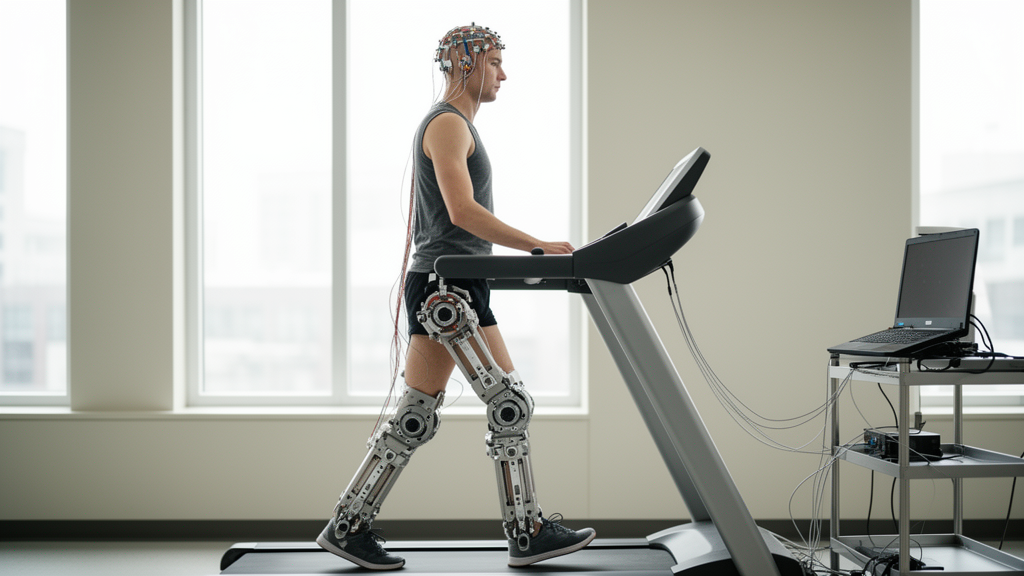
The choice of six lower-limb muscles for bilateral EMG recording reflects the functional anatomy of gait transitions. Muscles such as the tibialis anterior, gastrocnemius, rectus femoris, biceps femoris, and related flexors and extensors around the hip, knee, and ankle each contribute distinct activation patterns during initiation, weight shifting, and swing phases. Recording twelve channels bilaterally gives the decoder a rich picture of the neuromuscular coordination pattern, because gait transitions involve asymmetric, sequenced activation across limbs rather than a uniform burst. The addition of hip and knee kinematics provides a third stream of information that anchors the neural and muscular signals to the actual biomechanical state of the joints, which helps the model learn the characteristic relationships between what the cortex plans, what the muscles execute, and how the limbs actually move. Pretraining on data from forty-five healthy volunteers gave the network a broad foundation of these relationships before it was deployed on the seven naive test participants, an approach that reduces the calibration burden on each new user, a practical consideration of real importance for clinical deployment where lengthy per-patient training sessions are a barrier to adoption.
The magnitude of the latency difference deserves careful interpretation. A reduction from roughly 0.33 seconds under EMG-only control to about 0.28 or 0.29 seconds under hybrid control may appear modest when stated in isolation, but in the context of a walking gait cycle, which typically lasts about one second, a saving of forty to fifty milliseconds represents a meaningful fraction of the swing phase. During that window, the position of the limb changes substantially, and assistance delivered even slightly earlier can better coincide with the wearer’s own momentum rather than working against it. The reported Cohen’s d of approximately 0.88 indicates that this difference was not only statistically detectable but large by conventional standards, meaning the improvement was consistent across trials rather than driven by a few outliers. Consistency matters greatly in assistive robotics, because a control system that is fast on average but erratic from step to step can feel unpredictable to the wearer and undermine trust in the device.
The asymmetry between left-side and right-side performance, with classification accuracy of 91.3 percent for left transitions and 86.6 percent for right transitions, is a detail worth noting even though the authors do not dwell on it. Hemispheric differences in cortical representation, hand and foot dominance, and subtle asymmetries in electrode contact or muscle anatomy can all contribute to such disparities. In clinical populations, such as stroke survivors with unilateral brain injury, asymmetries in decoding accuracy between the affected and unaffected sides are likely to be far more pronounced than in healthy volunteers, which makes understanding and compensating for lateral differences an important direction for future work. The fact that latency was nearly identical on both sides suggests that the timing advantage of hybrid fusion is robust even when classification confidence differs, hinting that the latency benefit arises from the fusion architecture itself rather than from side-specific signal quality.
The composition of the triggering latency budget illuminates where future engineering gains might be found. The authors define latency as the sum of the sliding-window observation delay, feature extraction time, BiLSTM inference time, and communication delay between the decoder and the exoskeleton controller. Each of these components imposes different constraints. The observation window must be long enough to capture the temporal signatures of a transition, creating an inherent trade-off between detection accuracy and delay, since a longer window sees more context but waits longer before committing to a decision. Feature extraction and inference times depend on computational hardware and can be optimized through model compression, quantization, or deployment on embedded processors. Communication delay depends on the bus or wireless link connecting the decoding computer to the exoskeleton controller and can often be reduced through tighter integration. Understanding this decomposition matters because it shows that the reported latencies are not a fixed property of the decoding method but the product of an entire processing pipeline, and improvements in any stage translate directly into faster assistance.
The usability findings, though secondary to the decoding results, carry practical weight for translation. Donning and doffing times are a frequently underestimated barrier to exoskeleton adoption, particularly in rehabilitation settings where therapists must fit devices on patients with limited mobility multiple times per session. A system requiring sixteen EEG electrodes and twelve EMG channels necessarily involves substantial setup, and the reported acceptable donning times suggest that the electrode arrangement was manageable in practice. The QUEST 2.0 instrument, an established satisfaction questionnaire for assistive technology, covers dimensions such as sound, comfort, weight, ease of use, safety, and effectiveness, and a mean score of 32 out of 40 indicates generally favorable user appraisal across these dimensions. High satisfaction scores in naive users are encouraging, though it should be remembered that healthy volunteers walking on a controlled course experience fewer of the frustrations, fatigue, and environmental challenges that real-world users with motor impairment would encounter.
The physiological rationale for combining EEG with EMG extends beyond simple complementarity of timing. Sensorimotor rhythms in the alpha and beta bands over motor cortical areas undergo characteristic desynchronization during movement preparation and execution, a phenomenon long documented in upper-limb studies and increasingly confirmed for locomotion. Beta-band activity in particular appears to serve multiple roles during walking, including aspects of motor execution, postural regulation, and the processing of proprioceptive feedback from the moving limbs. Because these cortical signatures precede or accompany the earliest phases of movement organization, they carry information about intention that peripheral EMG cannot provide, since EMG becomes detectable only once spinal motor neurons recruit the muscle fibers. Conversely, EMG offers high signal-to-noise ratio and tight coupling to biomechanical events, making it a reliable confirmation signal. The fusion of the two modalities therefore creates a system in which cortical signals can flag an upcoming transition early while muscular signals verify and refine the detection, a division of labor that the BiLSTM can learn to weight appropriately.
The acknowledged limitations frame the appropriate interpretation of these results. Seven participants is a small sample, and all were healthy and naive to the device, meaning that the reported accuracies and latencies represent a favorable scenario. Patient populations present challenges that healthy volunteers do not: spasticity alters EMG patterns, lesions disrupt cortical rhythm generation, medications affect neuromuscular signaling, and pain or fear of falling modifies gait in ways that no pretrained model anticipates. Artifact validation is a second concern, because walking generates head movement, electrode motion relative to scalp, and cardiac and ocular contamination that can masquerade as neural signals. The authors’ explicit identification of these issues, along with generalizability and the need for ergonomic optimization, reflects appropriate scientific caution. The path forward they outline, moving toward patient studies and refining the physical interface, is the standard and necessary route by which proof-of-concept demonstrations in healthy volunteers mature into clinically meaningful assistive technology, and the present results provide a quantitative benchmark, roughly ninety percent accuracy and sub-third-of-a-second latency, against which those future patient-facing systems can be measured.
Subject of Research: Neuroscience / Neurorehabilitation
Article Title: Hybrid EEG–EMG intention decoding for real-time triggering of a lower-limb exoskeleton
Article References: Wang, K., Li, W., Ding, D., Wang, L., Sun, Y., Zhao, H., & Gong, W. (2026). Hybrid EEG–EMG intention decoding for real-time triggering of a lower-limb exoskeleton. Frontiers in Neurorobotics, 20, Article 1914651. https://doi.org/10.3389/fnbot.2026.1914651
Image Credits: AI Generated
DOI: 10.3389/fnbot.2026.1914651
Keywords: exoskeleton, EEG, EMG, brain-computer interface, BiLSTM, gait intention decoding, neurorobotics, rehabilitation robotics, Hybrid, intention, decoding, real-time
Cite Scienmag News
Cassandra Pierce. (October 17, 2026). Mind and Muscle Together: Hybrid Brain–Body Signals Drive a Walking Exoskeleton in Real Time. Scienmag. https://scienmag.com/mind-and-muscle-together-hybrid-brain-body-signals-drive-a-walking-exoskeleton-in-real-time/
Cassandra Pierce. "Mind and Muscle Together: Hybrid Brain–Body Signals Drive a Walking Exoskeleton in Real Time." Scienmag, 17 October 2026, https://scienmag.com/mind-and-muscle-together-hybrid-brain-body-signals-drive-a-walking-exoskeleton-in-real-time/. Accessed 17 October 2026.
Cassandra Pierce. "Mind and Muscle Together: Hybrid Brain–Body Signals Drive a Walking Exoskeleton in Real Time." Scienmag. October 17, 2026. https://scienmag.com/mind-and-muscle-together-hybrid-brain-body-signals-drive-a-walking-exoskeleton-in-real-time/


