


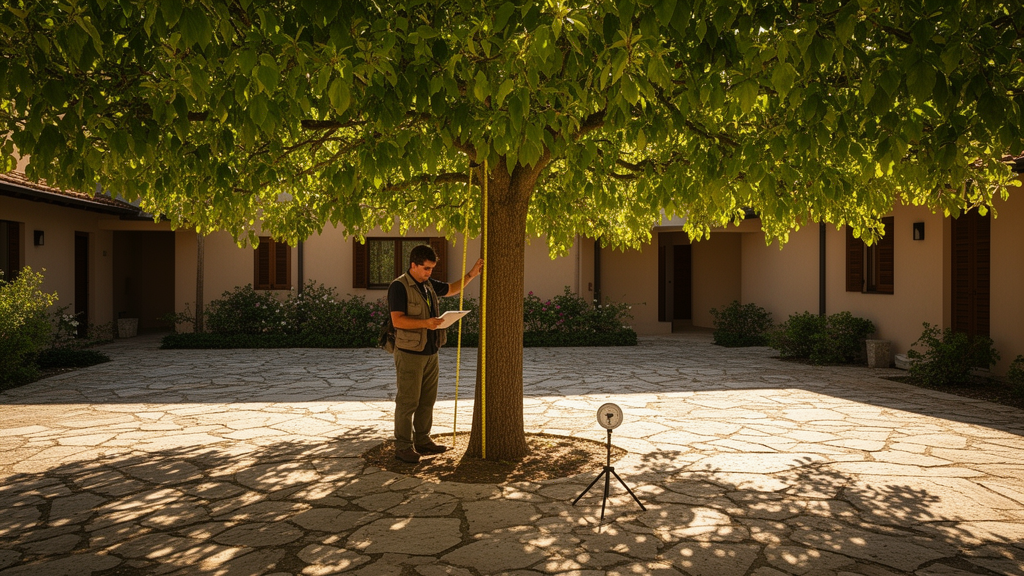
In the searing heat of Aswan, Egypt, where summer air temperatures regularly climb above 40 degrees Celsius, the courtyards of the Egyptian Japanese School serve as more than just passageways between classrooms. They are outdoor classrooms, playgrounds, and social hubs where students spend significant portions of their day. But under the relentless desert sun, these spaces can quickly become sources of thermal stress rather than environments for learning and recreation. A new study published in Frontiers in Built Environment has developed a sophisticated decision-making framework to determine which tree species, when planted in these courtyards, offers the best combination of cooling power, consistency throughout the day, and resilience to changing courtyard orientations.
Researchers from the University of Hail, Imam Mohammad Ibn Saud Islamic University, Dar Al-Hekma University, and Aswan University tackled a problem that has long frustrated urban designers and landscape architects in hot-arid regions: while urban vegetation is widely recognized as a passive cooling strategy, its actual performance depends on a complex interplay between the tree’s physical characteristics and the surrounding built environment. A tree that provides exceptional shade in one courtyard orientation may perform far less effectively in another. A species that delivers dramatic peak-hour cooling may not maintain that benefit throughout the school day. Conventional assessments that rely on a single thermal variable, such as air temperature reduction, simply cannot capture this multidimensional nature of vegetation performance.
To address this gap, the research team developed what they call a Multi-Criteria Thermal Performance Framework, or MCTPF. The framework integrates high-resolution microclimatic simulations using ENVI-met software with physiological equivalent temperature, or PET, calculations to evaluate vegetation performance across three complementary dimensions. The first dimension, quantified through the Tree Cooling Efficiency Index, measures the magnitude of integrated thermal improvement relative to a non-vegetated baseline. The second, captured by the Thermal Resilience Index, assesses whether a vegetation scenario reduces temporal variability in thermal conditions throughout the assessment period. The third, expressed through the Orientation Sensitivity Index, quantifies how much cooling effectiveness changes when the same vegetation configuration is evaluated under contrasting courtyard orientations. These three indices are subsequently integrated through a Composite Thermal Performance Index after normalization to a common performance scale.
The study focused on two semi-enclosed courtyards at the Egyptian Japanese School, each with an identical footprint of 200 square meters but with critically different orientations. The primary courtyard opens toward the east, while the secondary faces west. This asymmetrical configuration creates fundamentally different patterns of solar radiation absorption and wind interaction throughout the school day, establishing diverse thermal microenvironments within the same building complex. The researchers established a non-vegetated baseline scenario for each courtyard and then modeled three alternative vegetation scenarios by introducing individual tree species: Cassia leptophylla, commonly known as the gold medallion tree; Ficus nitida, or the Indian laurel; and Cassia nodosa, the pink shower tree. Each species was represented in the ENVI-met model using its actual morphological characteristics, including tree height, canopy diameter, leaf area index, and canopy porosity, rather than imposing an artificial standardized geometry.
The simulation results revealed substantial differences among the modeled vegetation configurations and between the two courtyard orientations. Ficus nitida consistently produced the greatest cooling response across all three thermal variables. In the east-facing courtyard, this species reduced air temperature by approximately 5.02 percent, mean radiant temperature by 37.88 percent, and PET by 25.39 percent relative to the baseline. In the west-facing courtyard, the corresponding improvements were 4.57 percent, 25.48 percent, and 15.35 percent respectively. The substantially larger reductions in mean radiant temperature compared to air temperature demonstrate that the principal cooling contribution of these tree scenarios was associated with modification of the radiative environment through shading and interception of solar radiation rather than with large reductions in ambient air temperature.
However, the story became considerably more nuanced when the researchers evaluated performance across all three dimensions simultaneously. While Ficus nitida achieved the highest Tree Cooling Efficiency Index values in both courtyards, with scores of 0.251 in the east-facing courtyard and 0.162 in the west-facing courtyard, it also exhibited the greatest sensitivity to courtyard orientation, with an Orientation Sensitivity Index of 0.428. In contrast, Cassia leptophylla demonstrated the greatest orientation robustness, with the lowest OSI value of 0.272, despite producing the lowest cooling efficiency among the three species. Cassia nodosa occupied an intermediate position, combining moderate cooling performance with the highest Thermal Resilience Index in the east-facing courtyard, indicating superior temporal stabilization of thermal conditions under that orientation.
The Composite Thermal Performance Index revealed clear trade-offs among cooling magnitude, temporal stability, and orientation robustness. Ficus nitida in the east-facing courtyard achieved the highest overall CTPI value of 74.75, reflecting its dominant cooling efficiency and near-maximum temporal resilience. However, its high orientation sensitivity resulted in the lowest orientation-robustness score, which limited its composite performance under the less favorable west-facing courtyard condition, where its CTPI dropped to just 21.06. Conversely, Cassia leptophylla, despite its lower cooling efficiency, achieved the highest CTPI in the west-facing courtyard at 25.00, benefiting substantially from its superior orientation robustness. The ranking of vegetation configurations changed between the two courtyard orientations, confirming that the same tree species can exhibit fundamentally different integrated thermal performance depending on its spatial context.
The researchers conducted a sensitivity analysis to examine whether alternative weighting structures would alter the comparative ranking. Under the baseline structure, which assigned the greatest weight to cooling efficiency, Ficus nitida in the east-facing courtyard remained the preferred alternative. However, when orientation robustness received substantial importance, Cassia leptophylla became the preferred configuration. This finding demonstrates that the framework does not impose a universally optimal vegetation choice but rather provides a transparent mechanism for adapting tree-selection decisions to different thermal-design priorities while preserving the spatial influence of courtyard orientation.
Model validation showed strong agreement between simulated and measured air temperature patterns, with a coefficient of determination of 0.996 and a mean absolute error of 1.505 degrees Celsius. Relative humidity demonstrated even stronger agreement, with a coefficient of determination of 0.9998. However, the researchers acknowledge that the validation was based on baseline measurements at a single location over one 24-hour period and did not directly validate vegetation-induced thermal responses. Mean radiant temperature, wind conditions, PET, and the magnitude of vegetation cooling were not independently validated against field measurements, meaning the findings should be interpreted primarily as comparative simulation-based evidence rather than fully validated predictions of absolute thermal conditions.
The implications of this research extend well beyond a single school in Aswan. As cities across the Middle East, North Africa, and other hot-arid regions grapple with intensifying urban heat, the framework offers a transparent and reproducible pathway from microclimatic simulation to climate-responsive design selection. Rather than asking simply which tree provides the greatest temperature reduction, designers can now evaluate vegetation strategies according to clearly defined priorities: whether maximum cooling efficiency matters most, whether temporal stability throughout the occupancy period is the primary concern, or whether robustness across different spatial orientations should dominate the decision. The framework makes these trade-offs explicit, allowing vegetation selection to respond to specific courtyard conditions and design objectives rather than relying on single-variable comparisons that may mask critical performance differences. The researchers emphasize that future studies should validate vegetation-induced thermal effects through field measurements across broader environmental contexts, examine multiple seasons and climatic regions, and incorporate age-specific physiological parameters to better represent the children and adolescents who constitute the primary users of educational courtyards.
Subject of Research: Tree selection, courtyard form, and outdoor microclimatic comfort in hot-arid educational spaces: a multi-criteria decision framework
Article Title: Tree selection, courtyard form, and outdoor microclimatic comfort in hot-arid educational spaces: a multi-criteria decision framework
Article References: Aldersoni, A., Abdallah, A. S. H., Abdelhafez, M. H. H., Elkhayat, K., Gomaa, M. M., & Ragab, A. (2026). Tree selection, courtyard form, and outdoor microclimatic comfort in hot-arid educational spaces: a multi-criteria decision framework. Frontiers in Built Environment, 12, Article 1956270. https://doi.org/10.3389/fbuil.2026.1956270
Image Credits: AI Generated
DOI: 10.3389/fbuil.2026.1956270
Keywords: ENVI-met, PET, TCEI, TRI, OSI, CTPI, courtyard orientation, hot-arid climate, school courtyards, tree selection, thermal comfort, urban vegetation
Cite Scienmag News
Violet Maxwell. (October 17, 2026). The Best Courtyard Tree Depends on More Than Cooling Power, Study Finds. Scienmag. https://scienmag.com/the-best-courtyard-tree-depends-on-more-than-cooling-power-study-finds/
Violet Maxwell. "The Best Courtyard Tree Depends on More Than Cooling Power, Study Finds." Scienmag, 17 October 2026, https://scienmag.com/the-best-courtyard-tree-depends-on-more-than-cooling-power-study-finds/. Accessed 17 October 2026.
Violet Maxwell. "The Best Courtyard Tree Depends on More Than Cooling Power, Study Finds." Scienmag. October 17, 2026. https://scienmag.com/the-best-courtyard-tree-depends-on-more-than-cooling-power-study-finds/


