


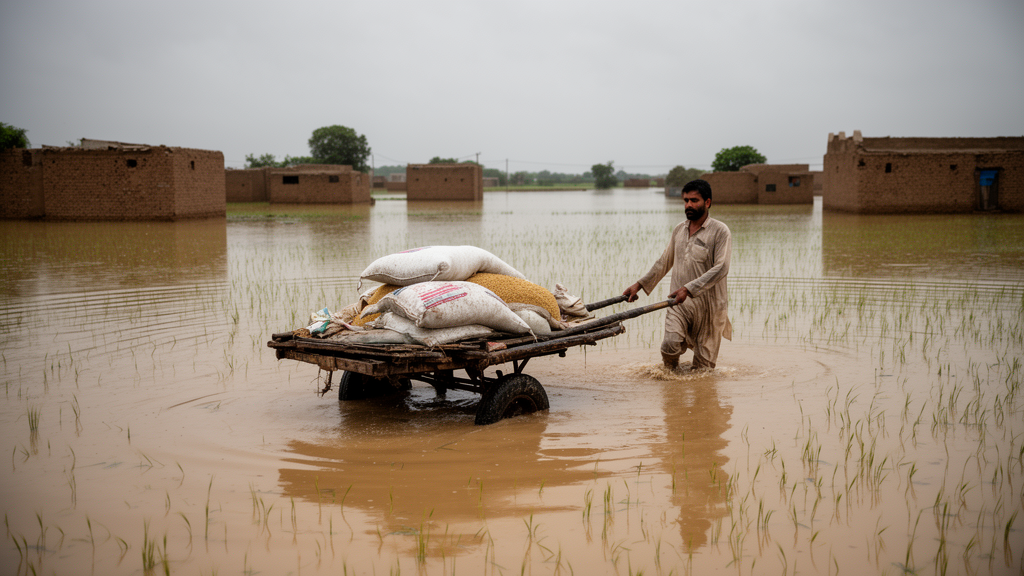
On the fertile alluvial plains of District Narowal in Punjab, Pakistan, the rice–wheat rotation that anchors national food security is being quietly dismantled by a combination of climatic and economic pressures. A new household-level study, published in Frontiers in Environmental Economics, has quantified just how vulnerable the district’s farming families are to multi-hazard climate variability, and the results reveal a stark picture of exposure, sensitivity and constrained adaptation across one of the country’s most climate-sensitive agricultural zones.
The research team, led by Laila Shahzad of the Sustainable Development Study Center at Government College University, Lahore, surveyed 300 rice–wheat farming households across two tehsils of District Narowal using door-to-door questionnaires and focus group discussions conducted between December 2022 and March 2023. The district, which covers 4,623 square kilometres and is home to roughly 1.7 million people, 85 percent of whom live in rural areas, was deliberately selected because it is classified as highly vulnerable under Pakistan’s National Monsoon Contingency Plan. Major floods in 2010, 2012 and 2022 inundated more than 65 villages and large areas of cropland, particularly affecting rice and livestock systems, while droughts, pest outbreaks, waterlogging and soil degradation create a persistent multi-hazard risk environment.
Methodologically, the study is notable for integrating the Intergovernmental Panel on Climate Change vulnerability framework—exposure, sensitivity and adaptive capacity—within a Climate Vulnerability Index (CVI) model, combined with the Analytic Hierarchy Process (AHP) for weighting adaptive capacity indicators. Farmers rated 13 climate-related risks on a four-point Likert scale, producing a Climate Change Risk Perception Score that was standardized into an index scaled from 0 to 100. Adaptive capacity was evaluated across five capital assets drawn from the Sustainable Livelihood Framework: natural, physical, financial, human and social. Pairwise comparison matrices were normalized and consistency verified using the Consistency Ratio, with values of 0.09 for Narowal and 0.05 for Shakargarh confirming acceptable expert judgement. Historical temperature and rainfall records for 2002 to 2021 from the Pakistan Meteorological Department were analysed with simple linear regression to validate farmers’ perceptions against measured trends.
The headline finding is a pronounced spatial gradient in vulnerability. The IPCC-CVI was calculated as 0.26 for Tehsil Narowal and 0.91 for Tehsil Shakargarh, with the index ranging from −1, least vulnerable, to +1, most vulnerable. Tehsil Narowal recorded higher exposure, with an index of 0.83 compared with 0.62 in Shakargarh, driven primarily by flood intensity, which ranked highest in both tehsils with standardized risk perception values of 95.48 and 94.01 respectively. Erratic rainfall and temperature fluctuations followed closely behind. Both tehsils demonstrated moderate to high sensitivity, with indices of 0.76 and 0.71, reflecting impacts on fertilizer availability, soil fertility, drinking water scarcity and access to basic health services. Adaptive capacity remained relatively low in both areas, at 0.48 in Narowal and 0.36 in Shakargarh, reinforcing the overall vulnerability pattern and making Tehsil Narowal slightly more vulnerable overall despite Shakargarh’s proximity to the Ravi River.
The meteorological data corroborate farmers’ lived experience. Regression analysis revealed a declining trend in mean maximum annual temperature alongside an increasing trend in mean minimum temperature, with the highest mean maximum of 30.42 degrees Celsius recorded in 2009 and the highest mean minimum of 26.03 degrees Celsius in 2018. Rainfall showed a significant increasing trend, with extreme events of 133 millimetres in 2003, 116 millimetres in 2013 and 110 millimetres in 2014 contributing to severe floods that damaged crops and livestock. Farmers reported erratic rainfall and rising temperatures particularly during the Kharif season from May to October, when monthly maximum temperatures ranged between 31 and 38 degrees Celsius, disrupting rice–wheat cropping cycles and reducing productivity.
Beyond direct climatic impacts, the study documents how biological hazards compound risk. Farmers reported increased pest attacks, locust swarms and persistent weeds despite pesticide use, alongside livestock disease outbreaks such as lumpy skin disease that reduce household income and food security. These pressures have intensified chemical use, degrading soil and water quality while raising production costs and health risks. Financial vulnerability is compounded by the near-total absence of crop insurance, with 87.9 percent of respondents in Narowal and 91.3 percent in Shakargarh reporting no coverage, limited access to formal credit, and reliance on exploitative informal lending systems. Land tenure insecurity further constrains adaptation, as smallholders without ownership rights have limited access to government support and reduced incentives to invest in long-term resilience measures.
Socio-economic and demographic factors emerged as key determinants of vulnerability and adaptation. Age, farming experience, landholding size and ownership rights all shaped household responses, with older farmers tending to rely on traditional practices and resource-intensive irrigation that increase environmental stress. Education levels were low, with 37.1 percent of respondents in Narowal and 43.8 percent in Shakargarh having only primary education, while roughly 29 percent were illiterate, constraining awareness of climate risks and preparedness for extreme events. Gender dynamics further shape vulnerability: while farming is predominantly male-led, with 90.7 percent of household heads in Narowal and 82.5 percent in Shakargarh being male, women contribute through off-farm activities such as handicrafts and home gardening, yet mechanization and sociocultural barriers limit their participation in modern agricultural practices and technology adoption.
Farmers exhibit moderate adaptation through crop diversification and altered sowing dates. The survey revealed that 40 percent of farmers in Narowal and 48.8 percent in Shakargarh moderately changed their sowing calendars, while 52.8 and 41.9 percent had high capacity to adjust crop calendars. Fertilizer and pesticide adjustments were common, with 43.6 and 50.6 percent of respondents reporting moderate changes to maintain soil fertility. Switching from traditional cereals to cash crops was moderately practiced by 50 and 42.5 percent of farmers to manage financial risks, while a significant proportion, 50.7 and 43.8 percent, left land fallow for one or more cycles to restore soil organic matter and moisture. However, most farmers did not adopt climate-tolerant crop varieties, showing low adaptive capacity at 48.6 and 50.8 percent, and tree planting remained limited in Narowal.
The study’s implications are urgent and policy-relevant. The authors call for mainstreaming climate resilience into agricultural development projects and provincial policies, expanding access to finance through crop insurance schemes and affordable credit, and linking the economic trade-offs inherent in rice–wheat systems to actionable responses such as crop diversification, improved irrigation efficiency, climate-smart agriculture and land restoration approaches including Land Degradation Neutrality. Investments in infrastructure, including efficient irrigation systems, improved market access and reliable early warning services, are deemed essential to strengthening system-wide resilience, alongside targeted capacity-building initiatives and gender-inclusive approaches that empower women and broaden participation in climate-smart practices.
Comparative evidence from other regions reinforces the patterns observed in Narowal. Smallholder farmers in Tanzania adopt strategies such as crop diversification, early sowing and drought-tolerant varieties, closely paralleling behaviours observed among rice–wheat farmers in Punjab, while studies from Ethiopia identify crop diversification, planting date adjustments and livestock management as key determinants of adaptation. These similarities highlight the broader relevance of localized adaptation strategies across diverse agro-ecological contexts and support the evidence from Narowal that adaptive capacity is shaped by both environmental pressures and socio-economic conditions. With agriculture contributing 24 percent to Pakistan’s gross domestic product and providing 37.4 percent of employment, and with 65 to 70 percent of the population depending on agriculture for income, the findings underscore that safeguarding rural livelihoods in districts like Narowal is not merely a local concern but a matter of national economic stability under increasing water stress and climate uncertainty.
Subject of Research: Climate Vulnerability and Economic Impacts on Rural Livelihoods in Narowal, Punjab
Article Title: Understanding climate vulnerability and economic impacts on rural livelihoods: lessons from Narowal, Punjab
Article References: Shahzad, L., Saleem, M., Sharif, F., Shedayi, A. A., Hayyat, M. U., Farhan, M., & Dogar, M. (2026). Understanding climate vulnerability and economic impacts on rural livelihoods: lessons from Narowal, Punjab. Frontiers in Environmental Economics, 5, Article 1781478. https://doi.org/10.3389/frevc.2026.1781478
Image Credits: AI Generated
DOI: 10.3389/frevc.2026.1781478
Keywords: climate vulnerability, Pakistan, Punjab, rice-wheat farming, adaptation strategies, multi-hazard, socio-economic determinants, rural livelihoods, Understanding, climate, vulnerability, economic
Cite Scienmag News
Alan Morgan. (October 17, 2026). Floods, Pests and Poverty: How Climate Vulnerability Is Reshaping Rural Livelihoods in Punjab. Scienmag. https://scienmag.com/floods-pests-and-poverty-how-climate-vulnerability-is-reshaping-rural-livelihoods-in-punjab/
Alan Morgan. "Floods, Pests and Poverty: How Climate Vulnerability Is Reshaping Rural Livelihoods in Punjab." Scienmag, 17 October 2026, https://scienmag.com/floods-pests-and-poverty-how-climate-vulnerability-is-reshaping-rural-livelihoods-in-punjab/. Accessed 17 October 2026.
Alan Morgan. "Floods, Pests and Poverty: How Climate Vulnerability Is Reshaping Rural Livelihoods in Punjab." Scienmag. October 17, 2026. https://scienmag.com/floods-pests-and-poverty-how-climate-vulnerability-is-reshaping-rural-livelihoods-in-punjab/


