


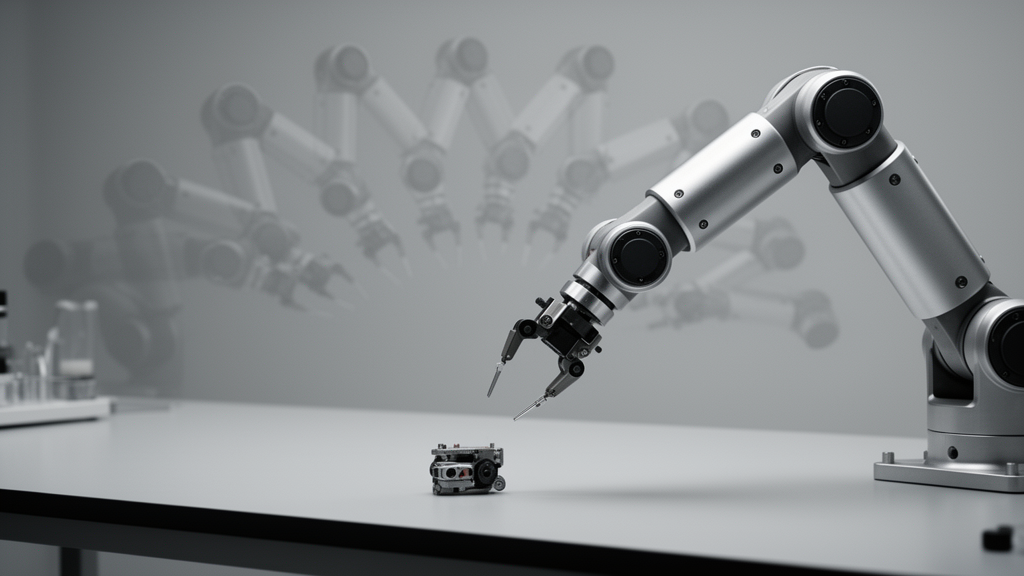
Robot arms have a hidden mathematical problem that most people never think about: for a seven-joint robotic manipulator, there is not one correct answer to where the joints should be, but infinitely many. A research team at Lviv Polytechnic National University in Ukraine has now tackled this issue with a generative artificial intelligence approach that treats inverse kinematics not as a search for a single joint configuration, but as the generation of an entire family of admissible solutions. Their method, called DiffusionIK, combines conditional diffusion models with differentiable forward kinematics to produce up to 50 diverse joint configurations for a single target pose, achieving 99.80 percent success on unseen poses and 98.40 percent near singularities.
The work, published in Frontiers in Artificial Intelligence, addresses one of the most fundamental problems in robotics. Inverse kinematics is the task of determining the joint angles of a manipulator so that its end-effector reaches a specified position and orientation in space. For a standard six-degree-of-freedom arm, the problem has a finite number of solutions. But for a redundant seven-degree-of-freedom manipulator, the same end-effector pose corresponds to a continuous one-dimensional manifold of admissible joint configurations, known as the self-motion manifold. Classical numerical solvers such as damped least squares and the Levenberg-Marquardt algorithm of the Orocos KDL library return only one configuration, and they do so depending on the initial approximation and regularization parameters.
Machine learning approaches have tried to approximate the mapping from end-effector pose to joint angles using neural networks, but most retain a regression-based formulation. The model is trained to predict a single joint vector for a given pose, which fundamentally limits its usefulness for redundant manipulators. When the true solution distribution is multimodal, minimizing the mean squared error leads to averaging across different modes, producing a joint vector that may not belong to the set of kinematically admissible configurations at all. The Ukrainian team, led by Lesia Hentosh with Yaroslav Hladun and Ivan Tsmots, recognized that redundant inverse kinematics requires a distributional formulation rather than a pointwise approximation.
Generative models offer a natural framework for such a formulation, and one of the closest prior approaches is IKFlow, which uses normalizing flows to generate diverse inverse kinematics solutions. But normalizing flows require invertible transformations, which restricts the network architecture and complicates the use of arbitrary residual blocks, normalization layers, and nonlinear transformations. Diffusion models offer a different generative paradigm. They learn to progressively recover data from a noisy state without requiring an explicit invertible mapping between distributions. The team adapted this paradigm to the joint configuration space of a seven-degree-of-freedom xArm manipulator.
The DiffusionIK method operates in three stages. First, a conditional diffusion model with a Residual Multi-Layer Perceptron denoiser generates a set of initial joint configurations in a normalized space. The model is trained using procedurally generated training pairs obtained from the forward kinematics of the manipulator, removing any dependence on a classical inverse kinematics solver. Second, classifier-free guidance strengthens the consistency of the generated configurations with the target end-effector pose, reducing the pre-refinement position residual from 56.3 millimeters to 16.9 millimeters. Third, Denoising Diffusion Implicit Models sampling reduces the number of generation steps, and a differentiable forward-kinematics refinement stage then reduces the task-space residual for each candidate configuration.
The refinement stage proved to be the most critical component of the entire scheme. Without it, the diffusion model produces structured candidates, but the success rate under strict thresholds of 1 millimeter and 1 degree remains limited. After 50 gradient-refinement steps, the success rate increases to 97.20 percent. After 200 steps, it reaches 99.40 percent. After 500 steps, all evaluated target poses have at least one generated configuration satisfying both thresholds. Crucially, the mean joint-space variability remains 9.77 radians throughout refinement, indicating that the method does not collapse the set of candidates into a single configuration but locally corrects each sample toward the solution manifold while preserving diversity.
In a unified benchmark against damped least squares, KDL, direct regression, and a normalizing-flow baseline, DiffusionIK with refinement achieved 99.80 percent success on 500 unseen poses with 95 percent confidence intervals of 98.9 to 100.0. The same refinement applied to the regression and normalizing-flow baselines yields only 97.40 and 13.80 percent respectively, confirming that the generative stage, and not refinement alone, is decisive. The normalizing-flow baseline, trained with 4.4 million parameters for 300,000 steps on the same procedurally generated data, produced candidates with a median position error of 157 millimeters even after refinement, because candidates starting in the wrong basin of attraction of the task-space residual cannot be recovered by local gradient descent.
Robustness near kinematic singularities was evaluated on a second set of 500 poses selected for having the lowest Yoshikawa manipulability index from a 40-fold pool of reachable poses. Near singularities, the iterative numerical solvers pay either time or reliability: damped least squares retains 99.00 percent success but its median query time grows to 243 milliseconds, while the KDL solver keeps sub-millisecond latency but drops to 91.60 percent. DiffusionIK with refinement retains 98.40 percent success at an essentially unchanged 19 milliseconds per pose, with a median position error of 1.7 millimeters. The fraction of individually converged candidates decreases from 63.5 to 32.3 percent, indicating that ill-conditioning slows individual refinements, while the redundancy of 50 candidates per pose preserves the per-pose success rate.
The computational analysis shows that most of the time is spent on gradient refinement. Denoising Diffusion Implicit Models sampling with 50 steps forms 50 candidates in approximately 100 milliseconds, while refinement with 200 steps requires approximately 1,200 milliseconds on an NVIDIA RTX 4090. The complete generation and refinement scheme takes approximately 1,300 milliseconds for one target pose. The method can operate in several regimes: generative sampling alone provides structured candidates in about 100 milliseconds for initialization of subsequent motion planning, reduced refinement with 50 steps achieves 97.20 percent success in about 300 milliseconds, and full refinement with 200 steps provides 99.40 percent success in about 1,300 milliseconds.
The practical value of the proposed method lies in obtaining not one but a set of diverse kinematically admissible solutions for a single target pose. Such configurations can be used for subsequent selection of a manipulator posture with regard to joint limits, singular configurations, self-collisions, obstacles in the workspace, and requirements imposed by the next motion. The team notes that the current implementation does not include collision checking with the environment or self-collision constraints, and validation on a physical manipulator is needed to account for calibration errors, sensing uncertainty, and actuator-level deviations. Further research should focus on integrating collision constraints into the generation and refinement process, reducing the number of refinement steps, and applying progressive distillation to accelerate diffusion sampling.
Subject of Research: Conditional diffusion-based inverse kinematics for redundant 7-DOF manipulators with differentiable refinement
Article Title: Conditional diffusion-based inverse kinematics for redundant 7-DOF manipulators with differentiable refinement
Article References: Hentosh, L., Hladun, Y., & Tsmots, I. (2026). Conditional diffusion-based inverse kinematics for redundant 7-DOF manipulators with differentiable refinement. Frontiers in Artificial Intelligence, 9, Article 1884749. https://doi.org/10.3389/frai.2026.1884749
Image Credits: AI Generated
DOI: 10.3389/frai.2026.1884749
Keywords: Conditional, diffusion-based, inverse, kinematics, redundant, manipulators, differentiable, refinement, scientific research
Cite Scienmag News
Denise Maddox. (October 17, 2026). Diffusion AI Solves Robot Arm Kinematics With 50 Solutions Per Pose. Scienmag. https://scienmag.com/diffusion-ai-solves-robot-arm-kinematics-with-50-solutions-per-pose/
Denise Maddox. "Diffusion AI Solves Robot Arm Kinematics With 50 Solutions Per Pose." Scienmag, 17 October 2026, https://scienmag.com/diffusion-ai-solves-robot-arm-kinematics-with-50-solutions-per-pose/. Accessed 17 October 2026.
Denise Maddox. "Diffusion AI Solves Robot Arm Kinematics With 50 Solutions Per Pose." Scienmag. October 17, 2026. https://scienmag.com/diffusion-ai-solves-robot-arm-kinematics-with-50-solutions-per-pose/


