


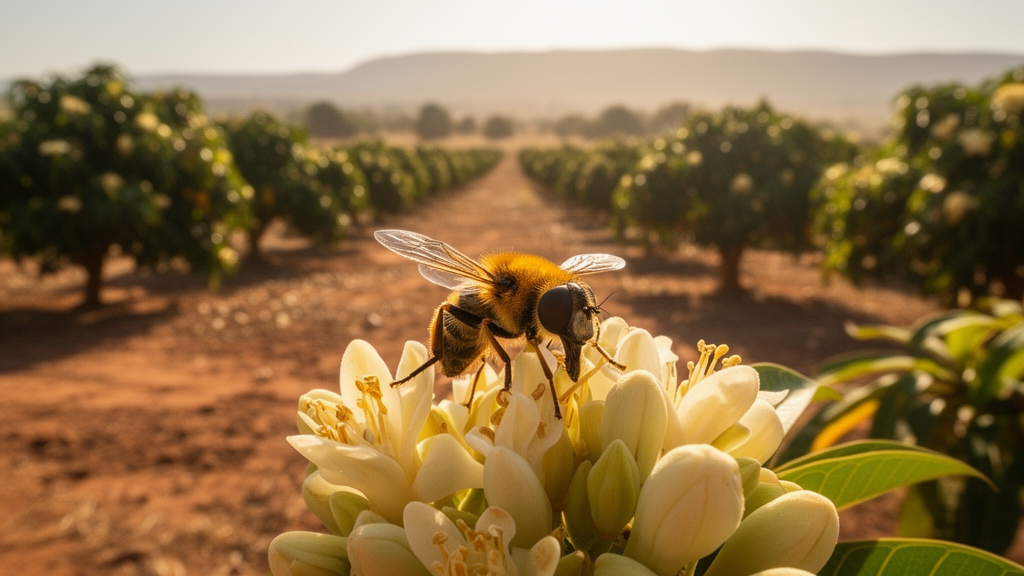
South Africa’s mango orchards hum with insect visitors every flowering season, but a new study warns that many of the insects doing the real pollination work could lose their climatic habitat in the coming decades. Researchers have combined species distribution models with a quantitative measure of pollination performance to map how climate change may reshape not just where pollinators live, but how much pollination they can actually deliver. The findings, published in Frontiers of Biogeography, suggest that both pollinator species richness and pollination provision are likely to decline across the country’s core mango-growing regions under two climate scenarios.
The study’s central innovation lies in treating pollinators as what they truly are: a functionally diverse cast rather than interchangeable parts. Traditional species distribution models, or SDMs, predict where species can survive based on occurrence records and climate data, but most assume every pollinator contributes equally to pollination. That assumption overlooks the enormous variation in body size, tongue length and behaviour that determines whether an insect actually deposits pollen on a flower’s reproductive organs. In a generalist, mass-flowering crop like mango, which attracts swarms of visitors that are not specialised for pollinating it, the distinction between a legitimate pollinator and a mere nectar thief can be the difference between fruit and failure.
To close this gap, the researchers calculated Pollen Deposition Effectiveness, or PDE, for each visiting species. The metric multiplies three components: visitation frequency, the percentage of visits involving contact with the flower’s reproductive organs, and single-visit pollen deposition. The result is an estimate of the number of pollen grains a species deposits per minute. When the team replaced the binary presences of SDM outputs with each species’ PDE value and summed the values of co-occurring species, they produced maps of potential pollination provision rather than simple species counts. This framework can reveal cases where species numbers remain stable but the total functional capacity of a community quietly erodes, as effective pollinators are replaced by less capable ones.
The case study focused on mango pollinators in Limpopo, Mpumalanga and KwaZulu-Natal, the provinces where South African mango production is concentrated. Limpopo alone accounts for 74 percent of the country’s planted mango hectares. The stakes are considerable: mango processing and support industries employed 13,650 people in 2019, production has been valued at over US$25 million annually, and more than 95 percent of the crop is consumed within the country. These figures exclude mango sold by smallholder farmers in informal markets and grown for personal consumption, a segment that relies heavily on wild pollinators and includes some of South Africa’s most food-insecure populations.
Compiling visitor records from global literature and the Global Biodiversity Information Facility, the team identified 61 insect species that visit mango flowers in South Africa. After applying the PDE framework, only 38 qualified as pollinators, belonging exclusively to the orders Diptera and Hymenoptera, that is, flies, bees and wasps. Butterflies and moths were excluded because their long proboscises and elevated posture allow them to feed on mango nectar without touching the flower’s reproductive organs, transferring no pollen. Beetles lacked pollen deposition data, and true bugs lacked data for all components. The finding underscores how misleading visitor lists can be when they fail to distinguish legitimate pollinators from freeloaders.
The most effective pollinators turned out to be surprisingly small. Blow flies of the family Calliphoridae, the stingless bee Liotrigona bottegoi, the syrphid fly Ornidia obesa and the housefly Musca domestica recorded the highest PDE values. The pattern fits expectations from flower morphology: mango nectar is accessible to insects of all tongue lengths, but body size and proboscis length together dictate whether an insect contacts the tiny flower’s reproductive organs. Small, short-tongued insects carrying pollen on their thoraces are ideally positioned. Notably, all bees except Liotrigona bottegoi, Megachile semiflava and the honeybee were assigned average effectiveness values from honeybees and stingless bees, meaning the true performance of small Ceratina and Braunsapis bees, which are 3 to 6 millimetres long, may rival that of the blow flies.
Projecting climatically suitable habitat to 2061–2080 under the intermediate RCP4.5 and high-emissions RCP8.5 scenarios, the models predicted substantial losses. Across all pollinators, average suitable habitat declined by 66,663 square kilometres under RCP4.5 and 73,608 square kilometres under RCP8.5, representing roughly 42 and 43 percent of total habitat respectively. Diptera fared worst, with fly species overwhelmingly predicted to lose ground, while some bees gained suitable area in Mpumalanga and KwaZulu-Natal. Among the most effective pollinators, Lucilia sericata and several Chrysomya blow fly species and Braunsapis bees lost the most climatic habitat in total area, ranging from about 102,000 to 373,000 square kilometres each under RCP4.5. Only the small bee Ceratina nyassensis showed substantial gains.
Species composition is also set to shift dramatically. Sørensen’s dissimilarity analysis revealed that most of the study region will experience substantial turnover, with pollinators currently found in South Africa likely pushed polewards by a changing climate. In Limpopo and north-eastern Mpumalanga, the nestedness component dominated, indicating species loss without replacement, the most concerning pattern for pollination continuity. Yet the study also delivered an unexpectedly reassuring result: the spatial patterns of PDE-weighted pollination provision closely resembled those of raw species richness, indicating high functional redundancy. With 32 of 38 pollinators contributing moderate and roughly equivalent levels of pollen deposition, no single keystone species dominates, and turnover is unlikely to trigger an immediate collapse of pollination services where replacement occurs.
That redundancy, however, is not infinite. The researchers caution that their models estimate climatically suitable area, not realised habitat, and exclude land use, phenology and seasonal mismatches between pollinator activity and mango flowering. Mass-flowering crops require high pollinator visits within a short window, so shifts in the timing of peak pollinator populations could significantly affect fruit set even where species persist. Data gaps also loom large: visit effectiveness values were missing for entire families, forcing reliance on taxonomic averages, and flight range and nesting specialisation data are scarce for most mango pollinators. Managed honeybees, often deployed to supplement pollination, may be poorly attracted to mango flowers and can even reduce fruit set under some conditions, complicating any assumption that managed colonies can replace wild pollinators.
The implications reach well beyond ecology. Declining pollinator richness is expected to reduce mango yields, and smallholder farmers, unable to afford managed pollinators, are likely to be hit hardest. Comparable research in Tanzania found that changes in pollinator habitats reduced crop revenue by as much as 29 percent for smallholders growing pollinator-dependent crops. Shifting mango seasons could also cut sale prices by 30 to 40 percent by missing the Christmas and New Year demand peak. The authors emphasise that their primary aim is methodological, offering a proof of concept rather than definitive forecasts, but the framework points to clear conservation priorities: protecting over-performing species such as calliphorid flies and small native bees, reducing pesticide use, establishing low-cost flower patches and weed refuges in orchards, and filling the data gaps that currently obscure which insects South Africa’s mango crop truly depends on.
Subject of Research: Integrating pollinator effectiveness into species distribution models to assess climate change impacts on mango pollination in South Africa
Article Title: Biogeography of pollination under climate change: integrating pollinator effectiveness into species distribution models for mango in South Africa
Article References: Sánchez, M. P., & Pearson, R. (2026). Biogeography of pollination under climate change: integrating pollinator effectiveness into species distribution models for mango in South Africa. Frontiers of Biogeography, 19, Article e180771. https://doi.org/10.21425/fob.19.180771
Image Credits: AI Generated
Keywords: pollination, climate change, species distribution models, mango, South Africa, pollen deposition effectiveness, functional redundancy, food security, wild pollinators, conservation, Biogeography, under
Cite Scienmag News
Sloane Callahan. (October 17, 2026). Climate change could shrink habitat for South Africa’s most effective mango pollinators. Scienmag. https://scienmag.com/climate-change-could-shrink-habitat-for-south-africas-most-effective-mango-pollinators/
Sloane Callahan. "Climate change could shrink habitat for South Africa’s most effective mango pollinators." Scienmag, 17 October 2026, https://scienmag.com/climate-change-could-shrink-habitat-for-south-africas-most-effective-mango-pollinators/. Accessed 17 October 2026.
Sloane Callahan. "Climate change could shrink habitat for South Africa’s most effective mango pollinators." Scienmag. October 17, 2026. https://scienmag.com/climate-change-could-shrink-habitat-for-south-africas-most-effective-mango-pollinators/


