


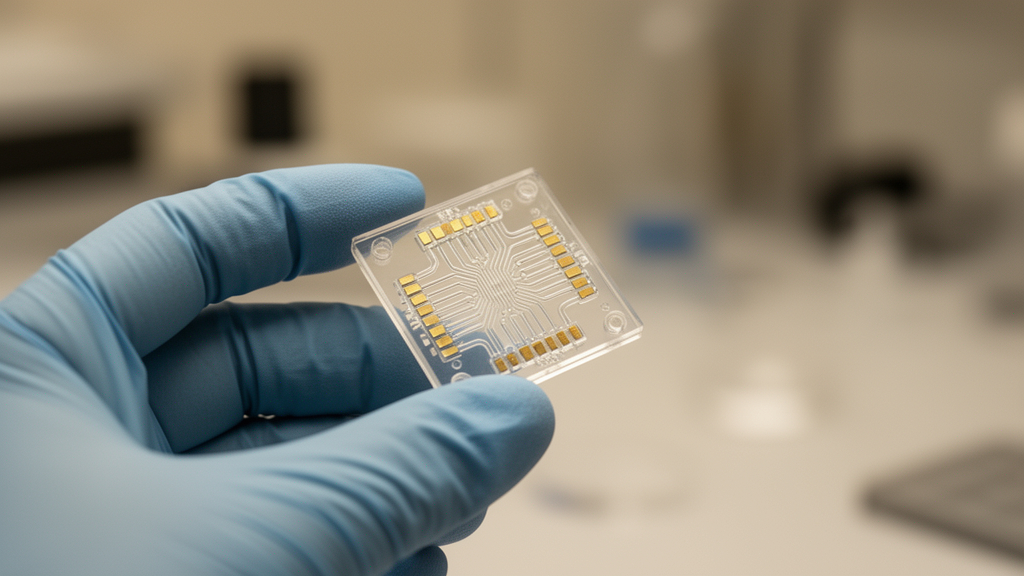
Dopamine is one of the most consequential molecules in the brain. It shapes reward learning, motivation, movement control and cognition, and its dysregulation is implicated in Parkinson’s disease, addiction and schizophrenia-spectrum conditions. Yet measuring it in living systems has always been an awkward compromise. Dopamine is released in brief, spatially localized bursts, and it coexists with a crowd of electroactive interferents and structurally related catecholamines that can fool a sensor. Conventional electrochemical tools, such as carbon-fiber microelectrodes paired with fast-scan cyclic voltammetry or amperometry, offer superb temporal resolution, but they are typically limited to single-site measurements, demand labor-intensive fabrication, and are vulnerable to noise and parasitic effects picked up along long interconnects. A new study published in Frontiers in Nanotechnology tackles these weaknesses at their root by putting an entire three-electrode electrochemical cell, together with the circuits that both build and read the sensor, onto a single CMOS microchip.
The work, led by Minghao Li of Fudan University together with Aishath N. Naeem and Sara S. Ghoreishizadeh of Imperial College London, builds on a decade of interest in CMOS-integrated biosensors. The same chip technology that powers image sensors and DNA sequencers can be adapted to chemistry: CMOS image sensors array photodiodes to capture light, while DNA analysers use arrays of ion-sensitive field-effect transistors to read genetic material. But those platforms do not involve direct charge exchange between the sensor and the surrounding electrolyte. Electrochemical dopamine detection is different. It relies on oxidation and reduction reactions at an electrode surface, requiring direct charge transfer between the sensor and the fluid, followed by sensitive electronics to measure the tiny faradaic currents that result. Those currents are proportional to the concentration of the target molecule, following the Randles–Ševčík relationship that governs voltammetric peak currents.
A standard amperometric sensor needs three electrodes. The working electrode hosts the redox reaction; the counter electrode completes the electrical circuit; and the reference electrode provides a stable potential against which the working electrode’s voltage is controlled. Previous CMOS-integrated dopamine sensors have generally integrated only the working electrode on the chip, leaving the reference and counter electrodes dangling off-chip. That dependency breaks the scalability that makes CMOS attractive in the first place, complicates miniaturization, and makes accurate measurements across large sensor arrays harder. There is a second, subtler obstacle. The top metal layer exposed in a standard CMOS process is nearly pure aluminum, which is unsuitable for electrochemical sensing. Gold is favored for its conductivity and biocompatibility, but it is deliberately excluded from standard CMOS fabs to prevent contamination of the manufacturing line. Adding it means post-processing, traditionally with clean-room lithography or a benchtop electrochemical workstation.
The new platform addresses both problems simultaneously. The team designed and fabricated their chip, which they call DevoSens, in a standard 180-nanometer CMOS process at TSMC, with six metal layers and an aluminum top layer. The entire chip measures just 1.7 by 1.7 millimeters and draws a mere 0.21 milliwatts from a 1.8-volt supply. At its heart sits a 4-by-4 array of exposed metal pads, each 66 by 66 micrometers, that serve as the bases for the microelectrodes. A single additional pad forms the reference electrode, and four pads, electrically connected to give a larger total area that suppresses polarization, form the counter electrode. A 16-to-4 multiplexer built from NMOS-only switches routes whichever microelectrode is selected to either the readout circuitry or the electrodeposition circuits, a choice that also keeps input leakage below 0.1 nanoamps.
The post-processing chemistry is deliberately simple, scalable and low-cost, avoiding clean-room lithography altogether. It begins with cleaning in acetone and isopropanol, then a mild etch in sodium hydroxide to strip the native aluminum oxide. A double zincation step activates the aluminum surface, after which the chip is immersed in an electroless nickel plating bath at 85 degrees Celsius for 25 minutes. Finally, an electroless gold layer is deposited by displacement reaction in a gold plating solution at 90 degrees Celsius. This Al/zinc/nickel/gold stack gives every microelectrode a biocompatible gold surface without any photolithography. One electrode is then further developed into a silver/silver chloride pseudo-reference electrode: silver is electrodeposited onto the gold using pulsed current, and chlorination is achieved by a 60-second immersion in iron(III) chloride. Energy-dispersive X-ray spectroscopy confirmed the surface composition, showing silver rising to 85.2 percent after plating and chlorine appearing at 12.3 percent after chlorination, the signature of Ag/AgCl formation.
What makes this demonstration stand out is that the electrodeposition itself was run by circuits on the same chip, replacing the benchtop potentiostat that would normally control such processes. A current reference generator based on a modified beta-multiplier architecture produces nanoamp-level currents with transistors operating mostly in the subthreshold region, keeping power consumption down to a few microwatts. For the gold electroplating, the team selected a current reference multiplier output of 312 nanoamps, gated it with an external 100-hertz clock at a 20 percent duty cycle, and thereby achieved the optimized average current density of 1.5 milliamperes per square centimeter in pulsed galvanostatic mode. Pulsed deposition is known to yield smoother, harder and more uniform films than direct current. Atomic force microscopy showed that the on-chip method actually outperformed the benchtop instrument in repeatability: the standard deviation of deposited layer thickness at 900 seconds was 0.083 micrometers on-chip versus 0.188 micrometers with the external workstation, indicating better control under prolonged deposition.
The quality of the resulting gold surface matters enormously for downstream biosensing. Cyclic voltammetry in sulfuric acid revealed two distinct oxidation peaks corresponding to crystalline gold facets, suggesting a polycrystalline surface with Au(100), Au(110) and Au(111) orientations. Crystalline gold is more suitable than amorphous gold for attaching recognition elements such as antibodies and aptamers, and for nonenzymatic electrochemical sensing. Stability testing showed that freshly prepared gold microelectrodes sustained an average of roughly 23 consecutive cyclic voltammograms in phosphate-buffered saline before signs of instability, with peak-current variation held within 5.2 percent during the stable window. The on-chip Ag/AgCl reference electrode, measured against a commercial Ag/AgCl electrode in 1-molar potassium chloride, drifted at only 1.6 millivolts per hour after an initial three-hour settling period over 22 hours of testing, sufficiently stable for the timescales of these experiments.
The payoff came in dopamine measurements using only the chip’s own electrodes and electronics. The on-chip waveform generator, a direct digital synthesizer built around an 8-bit counter and a resistor-ladder digital-to-analog converter, produced a triangular voltage sweeping from 0.4 to 1.2 volts at 100 millivolts per second. A switched-capacitor transimpedance amplifier integrated the bidirectional sensing current, followed by a programmable-gain amplifier with correlated double sampling to suppress flicker noise and offset. The dominant oxidation peak appeared consistently at about 0.27 volts, attributed to the two-electron oxidation of dopamine to dopamine-o-quinone. Peak currents rose linearly with concentration across the tested 100 to 400 micromolar range with a coefficient of determination of 0.994, yielding a sensitivity of 12.35 milliamperes per millimolar per square centimeter and a calculated detection limit of 4.9 micromolar. Crucially, the calibration curve closely matched that of a conventional configuration using off-chip reference and counter electrodes, demonstrating that full integration sacrifices no analytical performance.
The team also probed selectivity, a perennial headache for amperometry since fixed-potential measurements cannot inherently distinguish dopamine from other electroactive species. Ascorbic acid, whose oxidation potential sits uncomfortably close to dopamine’s, produced a sensitivity roughly 47.5-fold lower than dopamine’s on these gold microelectrodes. The detection floor is currently limited by electrode-interface noise, possible dopamine adsorption or fouling, the absence of a dedicated surface-modification layer for enrichment, and the readout circuit’s input-referred noise of 1.5 nanoamps rms, equivalent to about 2.8 micromolars of dopamine. The authors point to nano-structuring of the working electrode, catalytic coatings or selective membranes, and quieter readout electronics as routes to lower concentrations.
The broader implications reach well beyond dopamine. Prior CMOS platforms have already shown what monolithic integration can deliver: a 1024-pixel electrochemical imager capturing dopamine diffusion at 40,000 frames per second, single-cell arrays recording thousands of vesicular release events from 76 cells in 42 seconds, and hybrid CMOS-graphene systems reaching theoretical detection limits of 6 nanomolars. But nearly all relied on external electrodes or external fabrication equipment. By monolithically integrating the working, counter and reference electrodes alongside the electrodeposition and readout circuits, this work delivers a self-contained sensing platform with improved autonomy, reduced sample volume, minimal parasitic wiring and noise pickup, and genuine potential for low-cost mass production. The same architecture could be extended to other neurochemicals or metabolic analytes simply by modifying the working-electrode surface, opening a path toward compact, scalable and even implantable chemical sensing.
Subject of Research: Fully integrated three-electrode CMOS electrochemical platform for amperometric dopamine sensing
Article Title: A 3-electrode electrochemical cell on CMOS and application for amperometric measurement of dopamine
Article References: Li, M., Naeem, A. N., & Ghoreishizadeh, S. S. (2026). A 3-electrode electrochemical cell on CMOS and application for amperometric measurement of dopamine. Frontiers in Nanotechnology, 8, Article 1888883. https://doi.org/10.3389/fnano.2026.1888883
Image Credits: AI Generated
DOI: 10.3389/fnano.2026.1888883
Keywords: CMOS, dopamine, electrochemical sensor, amperometry, microelectrode array, Ag/AgCl reference electrode, gold electroplating, electrodeposition, biosensor, neurotransmitter detection, switched-capacitor readout, 180 nm process
Cite Scienmag News
Cassandra Pierce. (October 17, 2026). Full electrochemical lab on a single chip brings self-contained dopamine sensing closer. Scienmag. https://scienmag.com/full-electrochemical-lab-on-a-single-chip-brings-self-contained-dopamine-sensing-closer/
Cassandra Pierce. "Full electrochemical lab on a single chip brings self-contained dopamine sensing closer." Scienmag, 17 October 2026, https://scienmag.com/full-electrochemical-lab-on-a-single-chip-brings-self-contained-dopamine-sensing-closer/. Accessed 17 October 2026.
Cassandra Pierce. "Full electrochemical lab on a single chip brings self-contained dopamine sensing closer." Scienmag. October 17, 2026. https://scienmag.com/full-electrochemical-lab-on-a-single-chip-brings-self-contained-dopamine-sensing-closer/


