


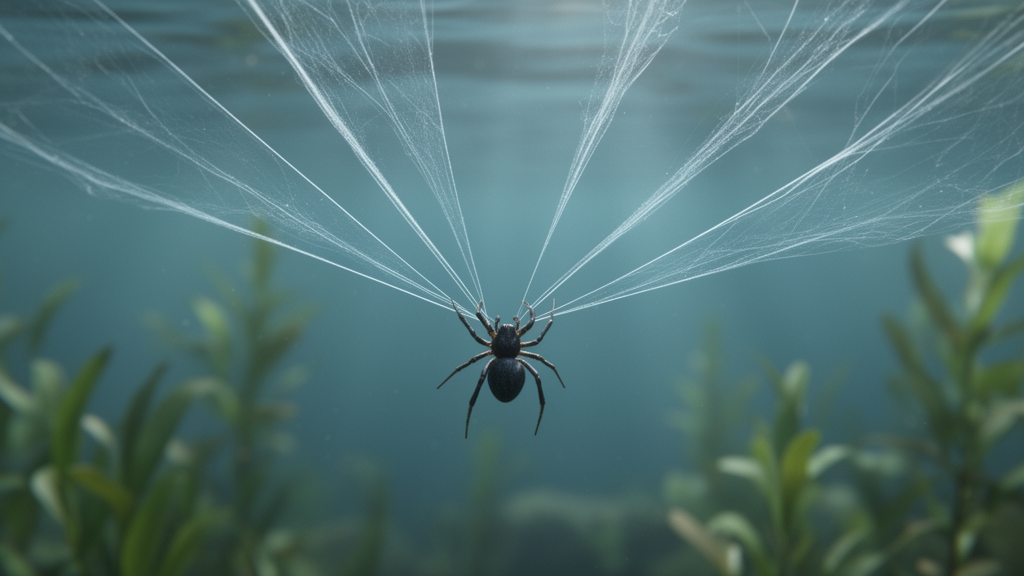
The diving bell spider Argyroneta aquatica is the only spider known to spend its entire life underwater, spinning silk beneath the surface to build its famous air-filled diving bell, its egg cocoon, and capturing webs. Yet the fine internal architecture of its underwater silk has remained largely unexplored. A new study published in Frontiers in Arachnid Science has now peered inside these threads at nanometer resolution, revealing a far more complex silk toolkit than anyone had documented before—and uncovering surprising parallels with silk produced by mites that branched off from spiders hundreds of millions of years ago.
Andrey B. Shatrov and Elena V. Soldatenko of the Zoological Institute of the Russian Academy of Sciences in St. Petersburg captured a single adult female water spider in the Panika River in Russia’s Volgograd province in June 2023 and kept her in a small laboratory vial. Because the container lacked sticks or plant stems, the spider never built a diving bell or egg cocoon. Instead, she periodically produced capturing webs that stretched across the entire width of the vial—webs the researchers could then harvest and analyze. The team examined the threads with light microscopy, scanning electron microscopy (SEM), transmission electron microscopy (TEM), and atomic force microscopy (AFM), a combination rarely applied to spider silk and almost never to silk from mites.
The results were striking. Based on diameter and internal organization, the water spider’s silk fell into five distinct thread types, labeled a through e, freely interlaced in the bundles the researchers collected. All types shared basic properties: they were infinitely long, unbranched, round in cross-section, uniform in width along their entire course, and only rarely ruptured. But beyond that common ground, each type told its own structural story.
The a-type threads, mostly straight and up to 1,000 nanometers in diameter, proved the most architecturally elaborate. Under TEM, each consisted of a fibrillary wall—up to three nearly identical layers separated by narrow clear spaces—enveloping an electron-dense, vacuolated core. Fine fibers sometimes rose vertically from the wall’s outer surface, a feature the authors suggest may contribute to adhesion. Remarkably, the core could occasionally be absent altogether, and in some specimens the wall itself was lost, leaving only the core substance wrapped in a slightly wrinkled double membrane. These threads most likely correspond to dragline silk, the structural backbone spiders use for support and safety lines.
The b-, c-, and d-type threads were organized in a nearly identical, much simpler fashion: fine granular, electron-light material enveloped by a fine membrane, with tightly packed longitudinal fibrils faintly visible inside. Their diameters ranged from a maximum of about 500 nanometers in the b-type, down to roughly 120 nanometers in the c-type, to around 50 nanometers in the d-type. These threads were more convoluted and far more numerous than the a-type, and they tended to cluster in groups, with thin c-type threads sometimes running tightly alongside thicker b- or a-type fibers. The researchers interpret these fine threads as piriform silk—the attachment silk spiders use to anchor their webs to surfaces—supported by an amorphous organic film in the samples that likely represents piriform adhesive cement.
The rarest and largest threads, the e-type, measured an impressive 3.5 to 4.5 micrometers across and displayed a layered membranous wall surrounding a uniformly dense core. Their scarcity and bulk suggest a general constructive role, comparable to the thick dragline threads of orb-weaving spiders such as Nephila, whose microfibrillar walls cross at angles and can slide along one another. Unlike the a-type, the e-type surface bore no loosely packed vertical fibers.
To put the water spider’s silk in evolutionary context, the team compared it with silk from two very different mites. The water mites Limnochares aquatica and Limnesia maculata, which produce silk from dermal glands—an acquisition their freshwater ancestors evolved roughly 235 million years ago—spin threads of only one type, closely matching the a-type threads of the water spider, though larger at 1 to 3 micrometers in diameter. Like the spider’s a-type threads, the mite threads feature fibrillary walls with vertically rising surface fibers, and empty threads collapse flat against substrates in SEM, resembling elastic ribbons. In contrast, the terrestrial two-spotted spider mite Tetranychus urticae, a notorious agricultural pest, produces silk of a single type that closely corresponds to the water spider’s d-type threads: uniformly round, extremely thin at 50 to 100 nanometers, and built from fine tightly packed fibers within a moderately dense matrix.
The convergence is remarkable. Water mites, spider mites, and spiders belong to distinct phylogenetic lineages of arachnids, yet their silk-producing mechanisms yield strikingly similar thread architectures. The authors conclude that the spectrum of ways arachnids can pack silk proteins into threads is limited to a small number of possible variations, so evolution has repeatedly arrived at the same solutions. Shared aquatic environments may further drive similarity in silk formation and morphology, as seen in the match between water spider and water mite threads. Meanwhile, the water spider’s d-type-like silk echoes that of an aerial mite, hinting at the breadth of its adaptations to different conditions.
The comparison also highlights what makes spider silk special. Unlike spiders, which maintain several kinds of abdominal silk glands and up to six silk types, other arthropod groups—insects, crustaceans, pseudoscorpions, and mites—typically possess only one type of silk gland serving a specific local function. Intriguingly, the silk glands themselves differ fundamentally in origin: they are abdominal in the water spider and water mites but prosomal in tetranychid mites, meaning the same thread designs emerged from anatomically unrelated organs. Even caddisfly larvae, which spin silk underwater like the diving bell spider, produce composite paired fibers embedded in glue proteins with polysaccharide components—a substantially different construction despite similar ecological demands.
The study also fills a methodological gap. While silk research has embraced sophisticated techniques ranging from X-ray diffraction to AFM tomography, TEM has been applied only sporadically to silk threads. By fixing silk bundles in glutaraldehyde and osmium tetroxide, embedding them in araldite, and cutting ultrathin sections, the researchers could resolve internal structures invisible to surface-imaging methods—including the layered walls, vacuolated cores, and membrane-wrapped core substances that distinguish the thread types. The work suggests that the nanofibers of the external wall may provide both adhesive properties and extensibility, while the internal core may contain coiled protein fibers responsible for tensile strength, though the authors note that fully characterizing these features will require more advanced approaches. For now, the diving bell spider’s underwater web stands revealed as one of nature’s most intricate silk constructions—a five-thread toolkit spun in silence beneath the water’s surface.
Subject of Research: Ultrastructure of silk threads of the water spider Argyroneta aquatica compared with silk of water mites and spider mites
Article Title: Ultrastructure of silk threads of the water spider Argyroneta aquatica (Clerck, 1757) (Araneae, Cybeidae) in comparison with that of some mites
Article References: Shatrov, A. B., & Soldatenko, E. V. (2024). Ultrastructure of silk threads of the water spider Argyroneta aquatica (Clerck, 1757) (Araneae, Cybeidae) in comparison with that of some mites. Frontiers in Arachnid Science, 3, Article 1384553. https://doi.org/10.3389/frchs.2024.1384553
Image Credits: AI Generated
DOI: 10.3389/frchs.2024.1384553
Keywords: water spider, Argyroneta aquatica, silk ultrastructure, transmission electron microscopy, water mites, spider mites, Tetranychus urticae, piriform silk, dragline silk, arachnid evolution, diving bell, nanofibrils
Cite Scienmag News
Gavin Prescott. (October 17, 2026). Underwater Spider Weaves Five Distinct Silk Threads, Electron Microscopy Reveals. Scienmag. https://scienmag.com/underwater-spider-weaves-five-distinct-silk-threads-electron-microscopy-reveals/
Gavin Prescott. "Underwater Spider Weaves Five Distinct Silk Threads, Electron Microscopy Reveals." Scienmag, 17 October 2026, https://scienmag.com/underwater-spider-weaves-five-distinct-silk-threads-electron-microscopy-reveals/. Accessed 17 October 2026.
Gavin Prescott. "Underwater Spider Weaves Five Distinct Silk Threads, Electron Microscopy Reveals." Scienmag. October 17, 2026. https://scienmag.com/underwater-spider-weaves-five-distinct-silk-threads-electron-microscopy-reveals/


