


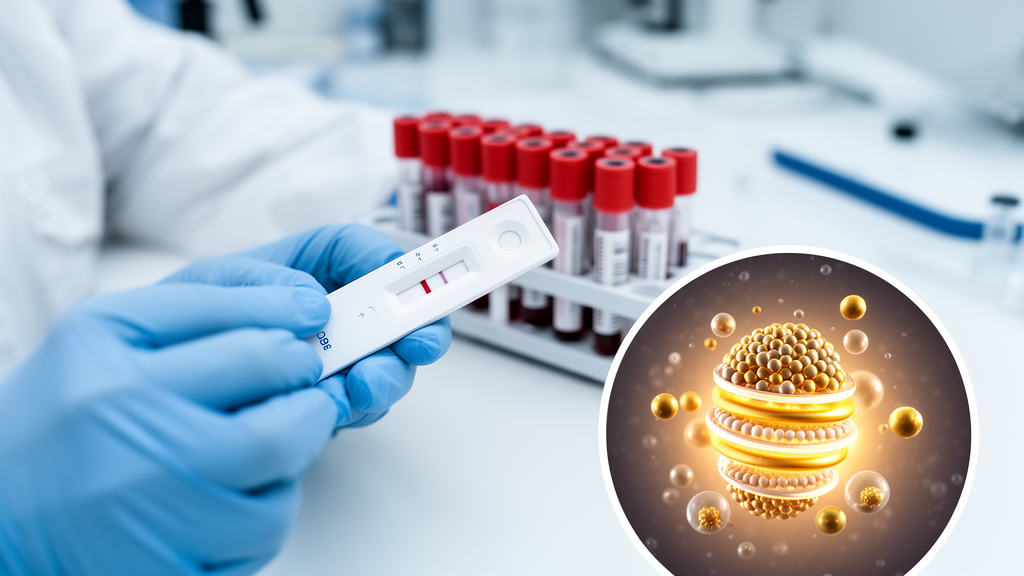
Syphilis has been curable with penicillin since 1943, yet the sexually transmitted infection continues to climb in the United States, and one of the biggest obstacles to stopping it is simply seeing it in time. Known as “the great imitator” because its symptoms mimic many other diseases and can fade without treatment while the infection quietly keeps doing damage, syphilis often escapes detection in its earliest stages, when antibody levels in the blood are at their lowest. A team led by Penn State researchers now reports a rapid diagnostic test that could change that, using a cleverly engineered nanoparticle to make faint signals visible enough for clinicians to act on during a single visit.
The new pilot device, described in a study published in ACS Sensors, integrates the two blood tests that form the backbone of the U.S. Centers for Disease Control and Prevention’s recommended diagnostic pathway into one rapid format. The first, so-called treponemal test detects antibodies against the syphilis bacterium, Treponema pallidum, antibodies that can persist in the body for decades after an infection has been treated. The second, non-treponemal test looks for separate antibodies produced in response to cellular damage caused by the disease, which indicates the stage of infection and whether a person currently needs treatment. Running both tests together reduces the chance of false-negative or false-positive results and helps physicians distinguish between a past infection, an active one, and one that has been properly treated.
“What is important about our approach is that we are not asking clinicians to abandon this well-established diagnostic pathway,” said corresponding author Dipanjan Pan, Penn State’s Dorothy Foehr Huck & J. Lloyd Huck Chair Professor in Nanomedicine. “Instead, we are trying to reproduce the same sequence of diagnostic information in a much faster and potentially point-of-care format.” The limitation of existing rapid tests, he explained, was never the ability to capture antibodies but the ability of clinicians to see the gold nanoparticles that form the visible line on a positive result. Those particles only become visible to the naked eye when enough of them accumulate, which is a serious problem when antibody concentrations are low.
One obvious fix would be to make the nanoparticles larger and therefore brighter, but that strategy runs into a physical wall. At around 60 nanometers, roughly one hundred times smaller than a red blood cell, gold particles begin clumping together or settling out of solution like sand in a river rather than flowing smoothly through the test device. The Penn State team took a different route: instead of changing the particle’s size, they changed its composition, sandwiching a layer of silver between two layers of gold.
The physics behind that choice comes down to a phenomenon called localized surface plasmon resonance. “At the nanoscale, I like to picture the electrons on the particle’s surface as the ripple of standing and sitting that happens when a stadium full of people participate in ‘the wave,'” said first author Ketan Dighe, a biomedical engineering graduate student at Penn State. “That collective motion is called localized surface plasmon resonance, and when light hits them, it’s what gives the particles their color and makes them so useful for detection.” In ordinary gold nanoparticles, this collective electron motion is what produces the familiar ruby-red color of rapid test lines rather than gold’s metallic hue.
When a particle carries multiple metallic layers, the electrons that would normally interact only with others from the same layer begin to combine features across the metallic boundaries, a process known as plasmon hybridization, which produces a much stronger optical signal. Silver has stronger optical properties than gold but degrades quickly when exposed to oxygen, so the researchers sealed it between two gold layers, keeping the particle stable while harvesting the combined optical benefits of all three layers. Pan likened the effect to a choir: “One singer can be heard, but when several singers are carefully coordinated, their voices emphasize one another and the sound becomes much more powerful,” he said. “Those three layers work together to produce a much stronger optical signal than the original gold particle alone.”
Before embedding the multilayer particles in a lateral flow reporter, the standard architecture of at-home tests such as those used for pregnancy or COVID-19, the team ran laboratory benchmark comparisons against conventional gold nanoparticles. The results were striking: six times fewer multilayer particles were needed to form a visible mark, and the particles remained visible with three times fewer target molecules in the sample. That sensitivity boded well for detecting syphilis antibodies at the low concentrations that matter most clinically. “The low-titer range, meaning the range with the lowest concentration of antibodies, is particularly challenging for detecting syphilis,” Pan said. “This range is also clinically important, occurring during early infection, later stages of syphilis or after treatment when antibody levels are declining to make sure treatment worked.”
The team then validated the approach using 36 clinical specimens spanning a range of antibody concentrations, obtained from the CDC and Boca Biolistics, a commercial biorepository. In these experiments, test line intensities increased by 19% to 46% compared with conventional gold nanoparticles, with the largest gains appearing in tests that detected antibodies at the lowest concentrations. In practical terms, that sensitivity would give healthcare professionals the information they need to determine treatment options before a patient leaves the clinic. “If I could tell a patient what infection they had during a visit, the counseling, the information I provide and the treatment would dramatically change,” said co-investigator Casey Pinto, a clinician and associate professor of public health sciences at Penn State College of Medicine.
The stakes are considerable. Nearly 4,000 babies in the United States were born with syphilis in 2024, the twelfth consecutive annual increase in congenital cases, and the CDC has reported that a lack of timely testing and adequate treatment contributed to nearly 90% of them. “Syphilis is one of those unique bacteria that can impact every single organ of the body,” Pinto said. “If we do not catch syphilis and the woman is pregnant, it could infect the child, too. The baby can be born with developmental delays, heart problems, blindness, teeth and bone malformations, skin rashes and it can even lead to death.” Two rapid syphilis tests have been approved by the U.S. Food and Drug Administration in recent years, but they detect only treponemal antibodies, and no single-step confirmatory syphilis test is currently approved for use in the United States. One such test exists in Europe, but it does not detect antibodies in the low-titer range.
The Penn State team has applied for a patent on the device and is exploring partnerships with industry as it moves toward larger validation studies, further prototype development and regulatory submission. If those steps succeed, the researchers envision a fundamental shift in how syphilis care is delivered. “We could potentially move syphilis testing from a multistep laboratory process toward a model of testing, diagnosing and treating in a single clinical visit,” Pan said. For an infection that has been curable for more than eighty years yet continues to spread largely because it goes unseen, making the invisible visible at the earliest moment may prove to be the most consequential optical enhancement of all.
Subject of Research: A multilayer gold-silver-gold nanoparticle for rapid one-step syphilis diagnostics detecting low antibody concentrations
Article Title: One-step rapid syphilis test detects infection earlier, researchers report
Article References: One-step rapid syphilis test detects infection earlier, researchers report. Original publication (Bibliographic details unavailable.)
Image Credits: AI Generated
DOI: Not provided
Keywords: syphilis, rapid diagnostic test, nanoparticles, plasmon hybridization, lateral flow assay, Treponema pallidum, point-of-care testing, congenital syphilis, ACS Sensors, Penn State, antibody detection, nanomedicine
Cite Scienmag News
Kristina Jarvis. (October 17, 2026). Layered Nanoparticles Power a Rapid One-Step Syphilis Test That Catches Infection Earlier. Scienmag. https://scienmag.com/layered-nanoparticles-power-a-rapid-one-step-syphilis-test-that-catches-infection-earlier/
Kristina Jarvis. "Layered Nanoparticles Power a Rapid One-Step Syphilis Test That Catches Infection Earlier." Scienmag, 17 October 2026, https://scienmag.com/layered-nanoparticles-power-a-rapid-one-step-syphilis-test-that-catches-infection-earlier/. Accessed 17 October 2026.
Kristina Jarvis. "Layered Nanoparticles Power a Rapid One-Step Syphilis Test That Catches Infection Earlier." Scienmag. October 17, 2026. https://scienmag.com/layered-nanoparticles-power-a-rapid-one-step-syphilis-test-that-catches-infection-earlier/


