


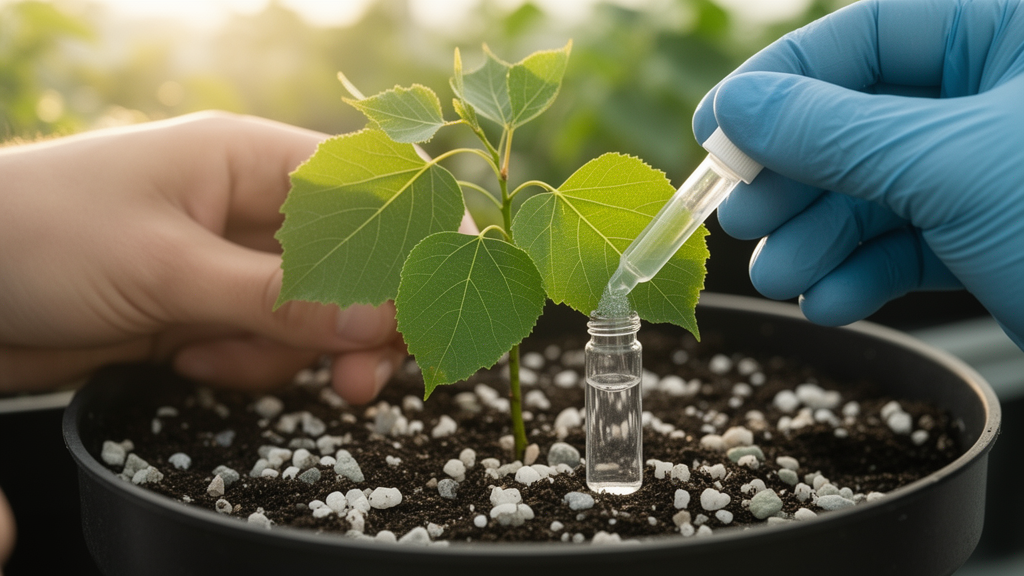
Deep in the poplar plantations of Xinmin City in China’s Liaoning Province, an invisible ecosystem is at work. Every leaf surface carries a dense film of bacteria and fungi that influences how the tree grows, how it resists disease, and how it copes with drought and cold. A new study published in Frontiers in Ecology and Evolution has now shown that this leaf-dwelling microbial world, known as the phyllosphere, is not a random assemblage of whatever drifts in on the wind. Instead, it is shaped to a remarkable degree by the chemical identity of the leaf itself, with total nitrogen and total phosphorus emerging as the master variables that determine which microbes thrive on which tree.
The research team, led by Shuang Li and Weixi Zhang of Shenyang Agricultural University and the Chinese Academy of Forestry, focused on four hybrid poplar varieties grown under identical field conditions in the same plantation. These hybrids, derived from crosses involving Populus deltoides and related species, are the backbone of China’s vast Three-North Shelter Forest System, the largest ecological engineering project on Earth, which stretches across the country’s arid northwest, north, and northeast to hold back windblown sand and protect fragile soils. Understanding what lives on the leaves of these trees, and why, has direct consequences for how such plantations are managed and how their microbial resources might one day be harnessed.
To capture the leaf-surface microbiome, the researchers employed a carefully validated extraction protocol. Leaf samples were collected from the upper canopy at heights of six to eight metres, picked from four cardinal directions on each tree using sterile gloves and high-reach shears. Back in the laboratory, ten grams of leaf tissue were placed in a sterile flask with phosphate buffer and subjected to a mild sequence of ultrasonication and shaking, a treatment strong enough to dislodge epiphytic microbes from the waxy leaf surface but gentle enough to avoid rupturing the cells themselves. The resulting suspension was filtered through a sterile nylon membrane, which was then frozen at minus eighty degrees Celsius until DNA extraction.
The genetic material was amplified using primers targeting the 16S rRNA gene for bacteria and the ITS region for fungi, and sequenced on an Illumina NovaSeq platform. After quality filtering and denoising, the team obtained amplicon sequence variants, or ASVs, which serve as precise molecular markers of individual microbial taxa. Good’s coverage values exceeded 0.9996 across all samples, confirming that the sequencing depth was more than sufficient to capture the full diversity present on the leaves.
The results revealed a striking pattern. Across all four poplar varieties, the dominant microbial groups were remarkably stable: fungi belonged overwhelmingly to the phyla Ascomycota and Basidiomycota, while bacteria were dominated by Proteobacteria and Actinobacteria. Yet beneath this conserved core, the richness and composition of the communities differed significantly from one variety to another. Cultivar Y2 harboured the highest fungal species richness, as measured by the Chao1 index, while cultivar Y4 supported the greatest bacterial richness. The Shannon diversity index, which reflects both richness and evenness, did not differ significantly among varieties for either kingdom, suggesting that variety identity primarily regulates how many microbial taxa colonise the leaf rather than how evenly they are distributed once established.
At the genus level, the specificity became even more apparent. The fungal genus Nothophoma was the most abundant across all four varieties, but its relative abundance ranged from 15.56 percent in cultivar Y3 to 41.71 percent in cultivar Y4. The bacterial genus Methylobacterium-Methylorubrum peaked at 27.18 percent in Y1 but dropped to 11.64 percent in Y3, while Curtobacterium reached 33.49 percent in Y2 yet fell to just 4.76 percent in Y3. Linear discriminant analysis effect size, or LEfSe, screening identified distinct sets of indicator taxa enriched in each variety, from Pseudomonas and Rosenbergiella in Y1 to Pantoea in Y4, painting a picture of four chemically distinct leaf habitats each selecting its own microbial suite.
What drives this sorting? The researchers measured five leaf nutrient traits: total carbon, total nitrogen, total phosphorus, soluble sugar, and starch. The four varieties differed significantly in four of the five, with cultivar Y3 consistently showing the highest levels of carbon, nitrogen, phosphorus, and starch, and cultivar Y1 the lowest nitrogen and phosphorus combined with the highest carbon-to-nitrogen ratio. Redundancy analysis, a statistical technique that quantifies how much of the variation in community composition can be explained by environmental variables, revealed that leaf nutrients explained 34.72 percent of the bacterial and 46.78 percent of the fungal community variation. Variance partitioning showed that the macronutrients carbon, nitrogen, and phosphorus independently explained 30.79 percent of bacterial and 52.73 percent of fungal variation, while the carbohydrates soluble sugar and starch contributed almost nothing on their own.
Spearman correlation analysis added mechanistic texture to these statistical patterns. Among the fungi, the genera Cryptocline, Rhodotorula, and Nigrospora showed significant positive correlations with total phosphorus, total nitrogen, and total carbon, indicating that their relative abundances rise as these macronutrients accumulate in the leaf. Cladosporium, by contrast, was significantly negatively correlated with starch, suggesting its abundance is suppressed when leaves store more of that polysaccharide. Among the bacteria, Methylobacterium-Methylorubrum and Hymenobacter declined with increasing total phosphorus, while Rosenbergiella increased with the same nutrient, being positively regulated by phosphorus, nitrogen, and carbon alike. Total phosphorus was also significantly negatively correlated with the Simpson index of bacterial diversity, implying that excessive phosphorus may reduce community evenness by favouring a small number of phosphorus-responsive dominant taxa.
The finding that nitrogen and phosphorus, rather than carbon-based compounds, are the primary bottom-up regulators of phyllosphere community assembly aligns with a broader ecological paradigm. In nutrient-limited habitats, the availability of these two elements often constrains microbial growth more tightly than carbon does, because carbon is typically abundant in leaf exudates while nitrogen and phosphorus are scarcer. Previous work across neotropical tree species and temperate forests has similarly identified leaf nitrogen and phosphorus concentrations, along with host species identity, as major drivers of phyllosphere bacterial structure. The poplar study extends this paradigm to hybrid cultivars growing side by side under identical site conditions, providing unusually clean evidence that host-mediated nutrient filtering operates at the cultivar level even when the environmental sources of microbial inoculum are shared.
The authors argue that these results confirm obvious host specificity in the phyllosphere microbiome of different poplar varieties and identify leaf nutrients as important driving factors regulating community structure. The practical implications are considerable. Because cultivar identity quantitatively reshapes the conserved core microbiome, forest managers selecting poplar varieties for afforestation are, whether they realise it or not, also selecting the microbial communities that will colonise those trees. Understanding which leaf chemical profiles favour which microbial assemblages could open the door to breeding or managing poplar stands that cultivate beneficial microbes, enhance disease resistance, and improve environmental adaptation, turning the invisible ecosystem on the leaf surface into a deliberate component of plantation design rather than an afterthought of the wind.
Subject of Research: Study on phyllosphere microbial community diversity of poplar
Article Title: Study on phyllosphere microbial community diversity of poplar
Article References: Li, S., Zhang, W., Huiyu, S., Ge, Y., Wu, S., Zhu, W., & Ding, C. (2026). Study on phyllosphere microbial community diversity of poplar. Frontiers in Ecology and Evolution, 14, Article 1963202. https://doi.org/10.3389/fevo.2026.1963202
Image Credits: AI Generated
DOI: 10.3389/fevo.2026.1963202
Keywords: phyllosphere, poplar, microbiome, high-throughput sequencing, leaf nutrients, nitrogen, phosphorus, host specificity, afforestation, shelterbelt, Proteobacteria, Ascomycota
Cite Scienmag News
Morgan Morrow. (October 17, 2026). Poplar leaf microbes follow the tree’s nitrogen and phosphorus recipe. Scienmag. https://scienmag.com/poplar-leaf-microbes-follow-the-trees-nitrogen-and-phosphorus-recipe/
Morgan Morrow. "Poplar leaf microbes follow the tree’s nitrogen and phosphorus recipe." Scienmag, 17 October 2026, https://scienmag.com/poplar-leaf-microbes-follow-the-trees-nitrogen-and-phosphorus-recipe/. Accessed 17 October 2026.
Morgan Morrow. "Poplar leaf microbes follow the tree’s nitrogen and phosphorus recipe." Scienmag. October 17, 2026. https://scienmag.com/poplar-leaf-microbes-follow-the-trees-nitrogen-and-phosphorus-recipe/


