


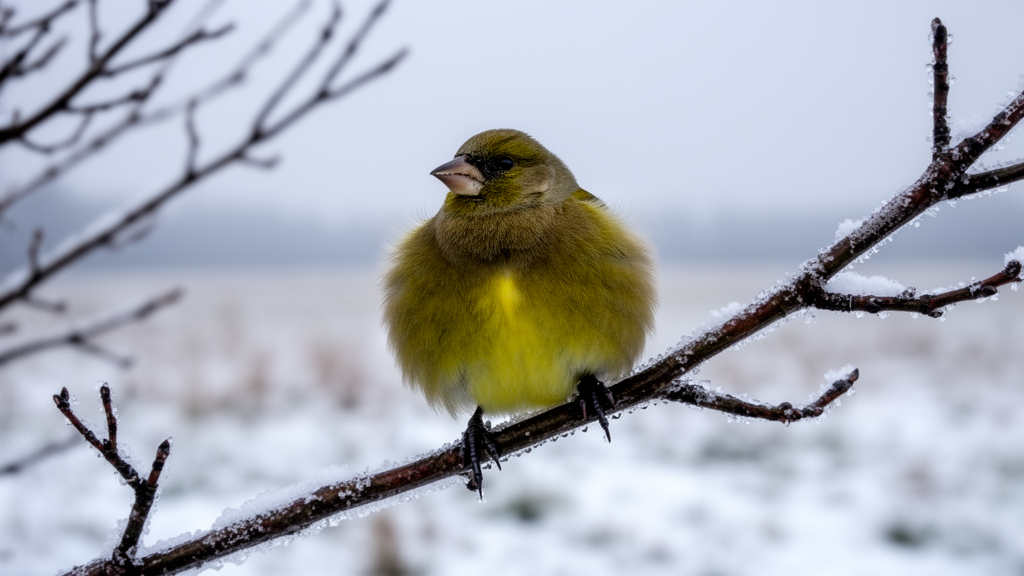
Winter is the season when small birds play a deadly balancing act with their own bodies. Every gram of stored fat improves the odds of surviving a freezing night, yet every extra gram makes a bird heavier and slower when a hawk strikes. For decades, ecologists have treated this trade-off between starvation and predation as the central rule of winter survival. Now a multi-year field study of European greenfinches in southeastern Latvia shows that an infectious disease can quietly rewrite that rulebook, changing which body-reserve strategies pay off and even eroding the survival advantages of being dominant.
The research, published in Frontiers in Bird Science, followed individually color-ringed greenfinches (Chloris chloris) across winters from 2019 to 2021 at feeding sites in the Krāslava countryside. The team, led by Indrikis A. Krams of the University of Latvia together with colleagues from Latvia, Estonia, and the United States, captured birds with mist nets, measured body mass to the nearest 0.1 gram and wing length to the nearest millimeter, and recorded each bird’s flock identity, sex, and social rank. In total, 894 marked individuals with complete data on dominance rank, body condition, flock size, epidemic status, and overwinter survival entered the final analyses, drawn from 52 flocks whose sizes ranged from just 6 to as many as 360 birds.
The study’s central methodological insight concerns how body reserves are measured. Rather than relying on raw body mass alone, the researchers calculated a body mass index by dividing mass by wing length cubed, producing a size-corrected proxy of energetic condition. The logic is subtle but important: a large bird naturally weighs more than a small one, so raw mass conflates structural size with actual reserves. The analyses revealed that this size-adjusted BMI responded far more strongly to dominance and epidemic context than total body mass did, indicating that size-corrected condition is a more sensitive indicator of the short-term energetic strategies birds deploy under disease pressure.
Dominance itself was quantified rigorously. Trained observers spent hours each day at the feeding sites recording displacement events, in which one bird supplanted another from access to food. Only these unambiguous displacements were used to build dominance hierarchies, since minor agonistic behaviors such as wing flicks are less repeatable. In small flocks of about ten birds, every individual was captured and ranked directly. In larger flocks, each marked bird was assigned a relative rank on a percentage scale, from 0 to 10 percent for the most subordinate individuals to 90 to 100 percent for consistent victors. Rank was then treated as a continuous predictor, standardized so that coefficients represent the effect of a 10 percent change in social standing.
The epidemic context emerged naturally during the third winter. In 2019 and 2020, no clinical cases of trichomonosis appeared at the feeding sites, and those winters were classified as non-epidemic. Winter 2021 was different: multiple dead birds suddenly appeared at the sites, mortality escalated over subsequent days and weeks, and oral-crop swabs examined under light microscopes repeatedly revealed motile Trichomonas gallinae trophozoites, identified by their characteristic rapid, non-directional movement and flagellated morphology, with the undulating membrane visible at higher magnification. Birds suffering from this protozoan parasite experience dysphagia, lethargy, anorexia, and dehydration, and infection typically impairs feeding, causing rapid loss of body condition.
The results on body reserves were strikingly context-dependent. Averaged across all social settings, dominance rank alone did not predict BMI. Instead, a significant interaction between rank and flock size showed that rank-related differences in body condition emerged only in particular social environments. In medium-sized flocks of 55 to 88 birds and in very large flocks of 125 to 330 individuals, higher-ranking birds maintained significantly higher BMI than subordinates. In small flocks of 10 to 38 birds, no clear rank-related differences in BMI were detected at all. The researchers interpret this through the lens of social ecology: in small flocks, hierarchies are stable and food access is predictable, so even dominant birds can meet their energetic needs without carrying bulky reserves, and selection for agility may favor lean phenotypes. In larger flocks, where competition is fiercer and feeding opportunities are less predictable, dominants appear to accrue greater reserves.
Disease then reshaped these social gradients in a flock-size-specific way. The three-way interaction between dominance rank, flock size, and epidemic status was statistically significant, and it was driven primarily by medium-sized flocks, where the positive association between rank and BMI observed in non-epidemic winters was significantly reduced during the epidemic. In the largest flocks, a similar attenuation was suggested but fell just short of conventional significance. Meanwhile, the epidemic had an overall negative effect on BMI, indicating that birds carried reduced reserves during the outbreak winter. Total body mass, by contrast, was comparatively insensitive to disease-driven change, consistent with the idea that mass integrates both fat and lean tissue and therefore reflects a more stable energetic state than the more responsive BMI.
The survival findings represent the most dramatic reversal in the study. During the trichomonosis epidemic, higher BMI was associated with a substantially increased probability of surviving until spring, with a strong positive interaction between BMI and epidemic status. Individuals entering the epidemic with greater relative adiposity retained a markedly greater likelihood of reaching spring, presumably because fat stores buffer the prolonged periods of reduced food intake that the parasite induces. Outside epidemic conditions, the pattern flipped: BMI showed a weak but statistically significant negative association with survival, exactly as mass-dependent predation models predict when the cost of carrying extra weight, through reduced escape performance, slightly outweighs its benefit under benign conditions. In other words, the same body condition that was a slight liability in ordinary winters became a powerful lifeline when disease struck.
Dominance, meanwhile, did not guarantee survival under disease pressure. Higher-ranking individuals did show higher survival probabilities on average, but once individual body condition was accounted for during the epidemic, the survival advantage of rank was substantially reduced. The authors suggest that infectious disease may act as a conditional equalizer within social groups, weakening the fitness disparity between dominant and subordinate individuals when survival depends primarily on physiological resilience rather than competitive ability. Social rank may also shape disease outcomes through immunological pathways, since prior work across taxa links dominance to altered inflammatory profiles and pathogen resistance, although immune parameters were not directly measured in this study.
An extended model that jointly considered BMI and size-independent body mass, derived as residuals from the relationship between log-transformed mass and wing length, added a further layer of physiological nuance. Individuals heavier than expected for their structural size showed higher overwinter survival overall, suggesting that total somatic reserves, potentially including metabolically accessible lean tissue such as muscle protein, contribute to winter survival more generally. Yet size-independent mass conferred no additional epidemic-specific advantage beyond that provided by BMI, implying that relative adiposity is the dominant energetic buffer during the acute phases of disease-induced anorexia. The authors propose a sequential model of reserve use: fat supports short-term tolerance to reduced intake, while lean tissue extends endurance once fat stores are exhausted. The findings also carry a caveat about predators, since Eurasian sparrowhawks can acquire the parasite from infected prey, raising the possibility that predator activity itself shifts during epidemics. As emerging pathogens become increasingly prevalent in wildlife, the study argues that the fitness value of body reserves cannot be inferred from simple main effects; it emerges only from the interaction of social structure, group size, and disease context, and predicting survival in a changing world will require integrating disease ecology into traditional frameworks of winter behavior.
Subject of Research: Disease ecology and winter survival in European greenfinches
Article Title: Disease-driven variation in body reserves links social rank, flock size, and overwinter survival in European greenfinches
Article References: Krams, I. A., Krams, R., Popovs, S., Adams, C. B., Freeberg, T. M., & Krama, T. (2026). Disease-driven variation in body reserves links social rank, flock size, and overwinter survival in European greenfinches. Frontiers in Bird Science, 5, Article 1779032. https://doi.org/10.3389/fbirs.2026.1779032
Image Credits: AI Generated
DOI: 10.3389/fbirs.2026.1779032
Keywords: greenfinches, trichomonosis, body condition, social dominance, flock size, overwinter survival, disease ecology, Latvia, Disease-driven, variation, body, reserves
Cite Scienmag News
Gavin Prescott. (October 17, 2026). When Fat Saves Lives: Disease Flips the Survival Rules for Wintering Greenfinches. Scienmag. https://scienmag.com/when-fat-saves-lives-disease-flips-the-survival-rules-for-wintering-greenfinches/
Gavin Prescott. "When Fat Saves Lives: Disease Flips the Survival Rules for Wintering Greenfinches." Scienmag, 17 October 2026, https://scienmag.com/when-fat-saves-lives-disease-flips-the-survival-rules-for-wintering-greenfinches/. Accessed 17 October 2026.
Gavin Prescott. "When Fat Saves Lives: Disease Flips the Survival Rules for Wintering Greenfinches." Scienmag. October 17, 2026. https://scienmag.com/when-fat-saves-lives-disease-flips-the-survival-rules-for-wintering-greenfinches/


