


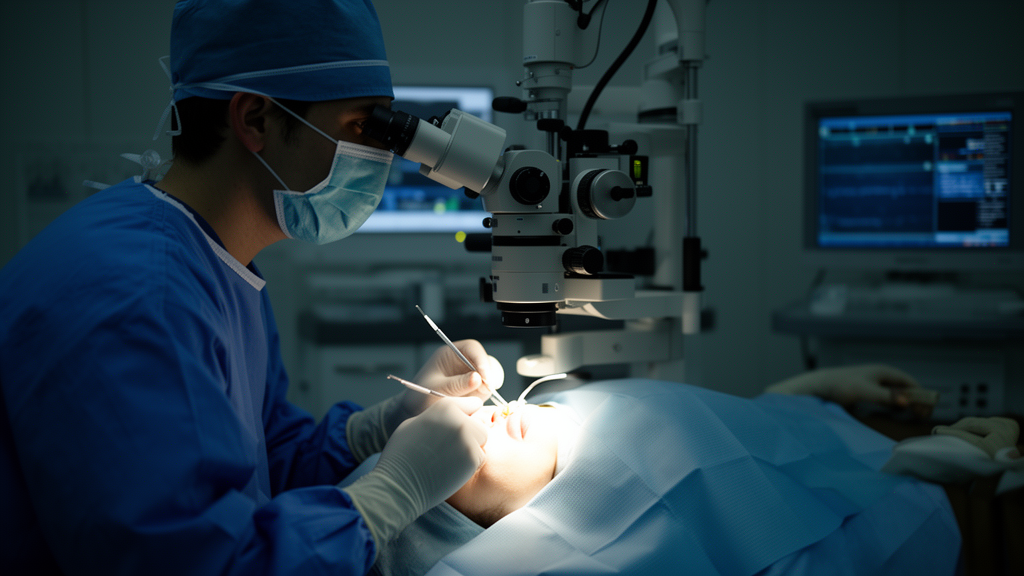
For the millions of people living with glaucoma, routine cataract surgery carries a hidden paradox. The very operation meant to restore sight can briefly starve an already vulnerable optic nerve of blood flow, because conventional phacoemulsification machines push intraocular pressure to 60–90 mmHg during the procedure—far above the physiologic range of roughly 15 mmHg. Now a small pilot study from Belgium suggests that a novel dual-pump fluidics platform may allow surgeons to operate at near-physiologic pressures without sacrificing the stability of the anterior chamber, offering an early glimpse of a gentler approach for eyes that can least afford ischemic insult.
The study, published in Frontiers in Ophthalmology by Koen Willekens of Visionair oogzorg in Geel, Antwerp, enrolled ten eyes of ten patients with glaucoma scheduled for cataract surgery between October 2024 and June 2025. All procedures were performed with the Zeiss Quatera 700 system, with the intraocular pressure target set to its minimum of 30 mmHg for every step of the operation. The cohort included eight eyes with primary open-angle glaucoma and two with primary angle-closure glaucoma, with patients averaging 71.5 years of age and most taking two or more pressure-lowering medications daily.
The primary outcome was deliberately simple: the occurrence of any intraoperative surgical complication. All ten procedures were completed without a single observed complication, an event rate of 0.0 percent. The exact 95 percent Clopper–Pearson confidence interval, however, stretched from 0.0 to 30.8 percent—a statistical reminder that ten eyes cannot rule out rare events like posterior capsule rupture, which typically occurs in 0.6 to 2.1 percent of modern cataract surgeries. The study was explicitly framed as a feasibility pilot, not powered to establish comparative safety.
What makes the Quatera 700 technically distinctive is its QUATTRO Pump, a synchronized dual-pump system that balances infusion and aspiration in real time. Conventional peristaltic or Venturi machines rely on gravity-fed bottles and must compensate for post-occlusion surge—the sudden collapse of the anterior chamber when an occlusion breaks—by raising infusion pressures well above physiologic levels. The QUATTRO Pump instead continuously calculates and adjusts fluid flow based on incision leakage, predicted occlusion breaks, and sudden changes in aspiration demand. Bench-testing data cited in the study show that the platform maintains effective intraocular pressure within roughly 2 mmHg of its programmed target, even at aspiration flow rates up to 90 cc/min, and bounds post-occlusion surge durations to a brief 282 to 408 milliseconds.
The distinction between target pressure and measured pressure is crucial. Target intraocular pressure is the digital parameter programmed into the console; measured pressure is the true dynamic hydrostatic pressure inside the patient’s anterior chamber during active surgery. In standard platforms, high fluidic demand or an occlusion break creates a large discrepancy between these two metrics, frequently producing unmeasured hypotony or surges that collapse the chamber. The Quatera’s sensor-driven pump minimizes this fidelity gap, which is why the anterior chamber remained stable even during critical moments such as phaco tip occlusion and sudden surge, with no recorded instances of shallow anterior chamber, iris prolapse, or capsular protrusion.
Beyond safety, the study tracked efficiency metrics. Mean effective phaco time—the cumulative ultrasound energy delivered—was 3.24 seconds with a standard deviation of 2.01 seconds, aided by a pre-chopping technique that obviated the need for sculpting. Mean surgical duration was 443 seconds, or roughly seven and a half minutes. Lower ultrasound energy reduces thermal injury risk, corneal endothelial cell loss, and postoperative inflammation, and prior work by Rauen and colleagues in 2024 demonstrated that maintaining pressures at or below 30 mmHg with active fluidics significantly reduced corneal trauma and endothelial cell loss compared to conventional high-pressure techniques.
Visual outcomes were encouraging. Best-corrected visual acuity improved in nine of ten eyes, with a median paired logMAR change of −0.10 from baseline to one month postoperatively, a statistically significant improvement with a p-value of 0.0137. Visual field mean deviation, a functional measure of glaucomatous damage, remained stable at one month with a mean paired shift of +0.58 dB. Mean intraocular pressure actually decreased from 18.65 to 14.79 mmHg at one month, consistent with prior reports showing modest pressure reduction following phacoemulsification, though this change did not reach statistical significance in this small sample.
Two patients experienced postoperative pressure spikes above 30 mmHg—one delayed spike of 33.4 mmHg at week one and one acute spike of 35.0 mmHg on day one—yielding a 20 percent event rate. Both resolved within 48 hours following short-term systemic acetazolamide. The study notes that transient pressure elevation on the first postoperative day is common in glaucoma patients, likely due to retained viscoelastic, inflammation, or trabecular meshwork debris, and was within a manageable range in this cohort.
Structural monitoring revealed an increase in average retinal nerve fiber layer thickness of +4.02 micrometers at one month, alongside a marked improvement in OCT signal strength from a baseline mean of 6.50 to a postoperative mean of 8.80. The study cautions that this RNFL increase likely reflects improved image acquisition after cataract removal rather than true neural tissue change, a phenomenon previously reported by Mwanza and colleagues in 2011. Cataract removal clears the optical media, allowing OCT scanners to capture cleaner images of the same tissue.
The study’s limitations are substantial and acknowledged by the author. Ten patients, a single surgeon, a single center, no masking, no control group, and a one-month follow-up window collectively restrict statistical power and generalizability. The cohort was highly selected, excluding patients with endothelial dystrophy, active uveitis, known corticosteroid responders, or functionally monophthalmic eyes. Larger randomized comparative trials are required to confirm these preliminary safety profiles and determine long-term clinical benefits in a broader glaucoma population. Still, as a proof of concept, the study demonstrates that operating at a target of 30 mmHg—the lowest setting currently available in the Quatera 700 software—is clinically feasible, and the author suggests that efficient cataract extraction at truly physiologic pressures near 15 mmHg might be possible in the future as the technology matures.
Subject of Research: A pilot feasibility case series of low-pressure cataract surgery at 30 mmHg using the Zeiss Quatera 700 in ten glaucoma patients reported no intraoperative complications and improved visual acuity.
Article Title: Prospective descriptive pilot feasibility case series of low-pressure cataract surgery with the Zeiss Quatera 700 in glaucoma patients
Article References: Willekens, K. (2026). Prospective descriptive pilot feasibility case series of low-pressure cataract surgery with the Zeiss Quatera 700 in glaucoma patients. Frontiers in Ophthalmology, 6, Article 1824059. https://doi.org/10.3389/fopht.2026.1824059
Image Credits: AI Generated
DOI: 10.3389/fopht.2026.1824059
Keywords: cataract surgery, glaucoma, intraocular pressure, Zeiss Quatera 700, QUATTRO Pump, phacoemulsification, ocular perfusion, pilot study, anterior chamber stability, effective phaco time, logMAR, optical coherence tomography
Cite Scienmag News
Ophelia Keating. (October 17, 2026). Low-Pressure Cataract Surgery Shows Early Promise for Glaucoma Patients. Scienmag. https://scienmag.com/low-pressure-cataract-surgery-shows-early-promise-for-glaucoma-patients/
Ophelia Keating. "Low-Pressure Cataract Surgery Shows Early Promise for Glaucoma Patients." Scienmag, 17 October 2026, https://scienmag.com/low-pressure-cataract-surgery-shows-early-promise-for-glaucoma-patients/. Accessed 17 October 2026.
Ophelia Keating. "Low-Pressure Cataract Surgery Shows Early Promise for Glaucoma Patients." Scienmag. October 17, 2026. https://scienmag.com/low-pressure-cataract-surgery-shows-early-promise-for-glaucoma-patients/


