


Paracetamol is the most widely used analgesic in the world, and a substantial fraction of every dose survives the human body. Roughly twenty percent of the drug is excreted as metabolites, flowing through sewage systems and into rivers, lakes, and treatment plants that were never designed to capture it. Once in the environment, the molecule can react with hypochlorite during disinfection to form significantly toxic compounds, and a growing body of research suggests it may act as an endocrine disruptor with anti-androgenic effects at every stage of human development. Conventional water and sewage treatment rarely removes it. Now a team of Brazilian researchers has combined laboratory experiments with quantum-mechanical simulations to explain, atom by atom, exactly how three-dimensional graphene materials capture this ubiquitous pollutant — and their findings point to a surprisingly simple design rule for building better water filters.
The study, published in Frontiers in Carbon, was led by Carolina F. de Matos and Mayara B. Leão of the Federal University of Pampa and the Federal University of Santa Maria, together with colleagues at the Franciscan University and the Pontifical Catholic University of Rio Grande do Sul. Their central question was deceptively basic: when a paracetamol molecule meets a graphene-based adsorbent, what kind of bond holds it there? The answer matters because adsorption is one of the cheapest water-treatment technologies available, yet most studies in the field report only how much contaminant a material removes, not why. Without a mechanistic understanding, researchers are essentially tuning materials blind.
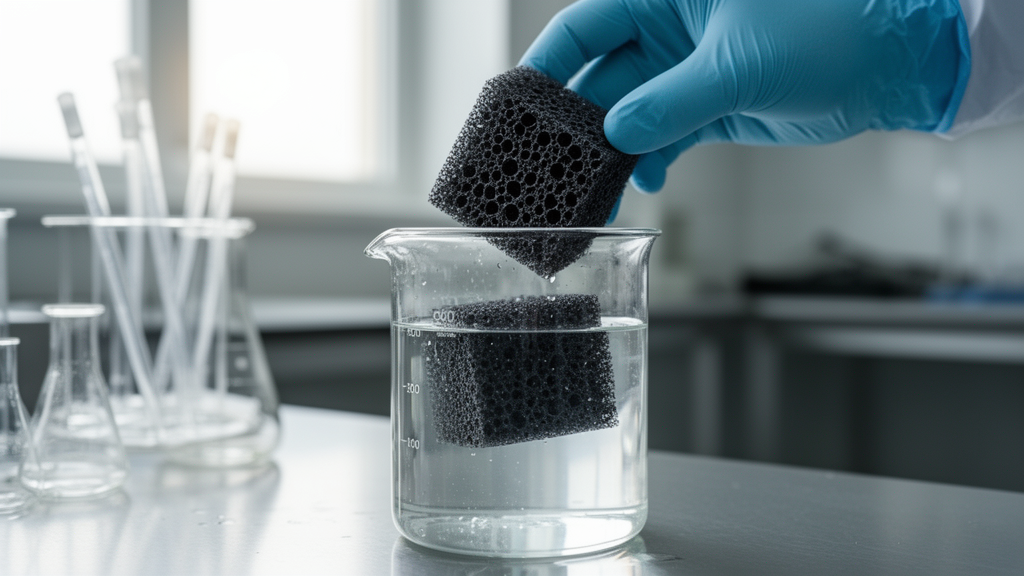
The materials at the heart of the work are three-dimensional networks of reduced graphene oxide, or 3D-rGO. Flat graphene sheets have an enormous surface area, but they suffer from a fatal flaw in water: the sheets stack back together through strong π-π and van der Waals interactions, collapsing into clumps with little accessible surface. They are also hydrophobic and easily leach into waterways as hard-to-recover fragments. The three-dimensional version solves both problems. By assembling reduced graphene oxide sheets into an interconnected porous scaffold — a monolithic hydrogel — the researchers created a material with high porosity, good mechanical properties, and a structure that resists restacking. Similar materials have already shown promise for removing dyes, oils, pesticides, metals, and drugs such as ibuprofen, diclofenac, and naproxen.
To probe how chemistry and structure jointly govern performance, the team synthesized four adsorbents from the same graphene oxide precursor. Three were three-dimensional hydrogels reduced with different concentrations of ascorbic acid — a mild, food-safe reducing agent — at 0, 5, and 25 millimoles per liter, yielding materials labeled 3D-rGO0, 3D-rGO5, and 3D-rGO25. The fourth was a two-dimensional reduced graphene oxide, 2D-rGO. The logic was elegant: more reducing agent strips away more oxygen-containing functional groups such as hydroxyl, epoxy, and carboxyl groups, while also compacting the porous structure. Scanning electron microscopy revealed the expected trend — the more ascorbic acid used, the denser and less cavernous the scaffold. Potentiometric titration quantified the chemistry: 3D-rGO0 carried 10.62 millimoles of carboxyl groups per gram, while 3D-rGO5 and 3D-rGO25 carried only 3.08 and 2.52 respectively. Surface areas ranged from 62.8 square meters per gram for the most compact material up to 172.3 for the loosest.
The adsorption experiments told a story with two distinct chapters. In the kinetic tests, where 8 milligrams of each material were suspended in 5 milliliters of a 50 milligram-per-liter paracetamol solution, speed favored the most oxidized and most porous material. 3D-rGO0 reached equilibrium in roughly five hours, with half of the adsorbable drug captured in just 15.9 minutes, while 2D-rGO needed about a day and nearly 193 minutes to reach the halfway point. But when the researchers measured total capacity — how much drug each material could hold at saturation — the ranking inverted. 3D-rGO5, the material with an intermediate reduction level, absorbed a striking 235.7 milligrams of paracetamol per gram, the highest of the four. The heavily reduced 3D-rGO25 and the flat 2D-rGO came next at 176.8 and 175.1 milligrams per gram, and the fast-acting 3D-rGO0 trailed at 157.6.
The explanation lies in a trade-off between morphology and chemistry. 3D-rGO0’s loose, granular structure gives drug molecules rapid access to its abundant oxygenated sites, so it adsorbs quickly — but its low surface area limits total capacity. 3D-rGO5 occupies a sweet spot: a cohesive three-dimensional network with large cavities, moderate compaction, and enough residual oxygen groups to bind the drug strongly. Isotherm fitting added another clue. All three 3D materials followed the Langmuir model, consistent with monolayer adsorption on a finite set of sites, while the 2D material fit the Sips model, which blends Freundlich behavior at low concentrations with Langmuir saturation at high ones. Dimensionality, it seems, shapes not just how much drug is captured but the very character of the process.
To understand what happens at the molecular scale, the team turned to density functional theory calculations using the SIESTA code. They built simplified graphene models decorated with one or two copies of three representative oxygen groups — epoxy, hydroxyl, and carboxyl — and simulated paracetamol docking onto each. The local density approximation was chosen deliberately because it handles weak, π-stacking interactions on sp2 carbon systems better than gradient-corrected functionals. Binding energies were corrected for basis set superposition error, and Mulliken population analysis quantified how much electronic charge shifted between drug and surface.
The simulations delivered a clear verdict: every configuration, without exception, was physisorption. Even the most energetically favorable cases — 1.28 electron-volts for graphene bearing two hydroxyl groups and 1.48 electron-volts for two carboxyl groups — showed binding distances and charge transfers incompatible with true chemical bonding. Total charge density isosurface analysis confirmed the point visually: no shared electron density bridges appeared between the drug and the graphene, ruling out chemisorption. Instead, the interaction is dominated by hydrogen bonding between the drug and the surface’s oxygen groups, with the strength climbing steadily as functional groups multiply. The HOMO-LUMO gap analysis reinforced the picture — the electronic structure of the combined system barely differed from that of its isolated components, exactly what one expects when molecules sit on a surface rather than react with it.
The convergence of theory and experiment is what makes this study significant. The simulations predicted that more oxygen groups mean stronger binding; the experiments showed that more oxygen groups and more accessible pores mean higher capacity. The team even observed that adding functional groups slightly deforms the graphene sheet, and that the graphene acts as an amphoteric charge donor depending on how the drug orients itself — details that only quantum calculations could reveal. Together, the two lines of evidence establish a design principle: the ideal paracetamol adsorbent is a three-dimensional graphene scaffold that is porous enough to let the drug reach its interior, yet retains a threshold density of oxygenated functional groups. Reduce too little and the structure stays loose but chemistry-starved; reduce too much and the pores collapse and the binding sites vanish.
For a world increasingly worried about pharmaceuticals in its drinking water, the implications are practical. The synthesis takes about two hours, uses ascorbic acid rather than harsh reagents, and produces a monolithic hydrogel that is easy to handle and recover — addressing the leaching problem that plagues two-dimensional nanomaterials. The researchers suggest their findings provide a solid foundation for developing more efficient and advanced water-treatment technologies, and the same experimental-theoretical framework could be extended to other emerging contaminants, from antibiotics to endocrine disruptors. The humble painkiller in the medicine cabinet may soon meet its match in a sponge made of atom-thin carbon.
Subject of Research: Paracetamol adsorption mechanisms on three-dimensional reduced graphene oxide materials for water treatment
Article Title: Unlocking the paracetamol adsorption mechanism in graphene tridimensional-based materials: an experimental-theoretical approach
Article References: de Matos, C. F., Leão, M. B., Vendrame, L. F. O., Jauris, I. M., Zanella, I., & Fagan, S. B. (2024). Unlocking the paracetamol adsorption mechanism in graphene tridimensional-based materials: an experimental-theoretical approach. Frontiers in Carbon, 3, Article 1305183. https://doi.org/10.3389/frcrb.2024.1305183
Image Credits: AI Generated
DOI: 10.3389/frcrb.2024.1305183
Keywords: graphene, paracetamol, adsorption, water treatment, reduced graphene oxide, density functional theory, physisorption, functional groups, emerging contaminants, 3D-rGO, pharmaceutical pollution, hydrogel
Cite Scienmag News
Neil Sanderson. (October 17, 2026). How 3D Graphene Sponges Pull Paracetamol Out of Water. Scienmag. https://scienmag.com/how-3d-graphene-sponges-pull-paracetamol-out-of-water/
Neil Sanderson. "How 3D Graphene Sponges Pull Paracetamol Out of Water." Scienmag, 17 October 2026, https://scienmag.com/how-3d-graphene-sponges-pull-paracetamol-out-of-water/. Accessed 17 October 2026.
Neil Sanderson. "How 3D Graphene Sponges Pull Paracetamol Out of Water." Scienmag. October 17, 2026. https://scienmag.com/how-3d-graphene-sponges-pull-paracetamol-out-of-water/


