


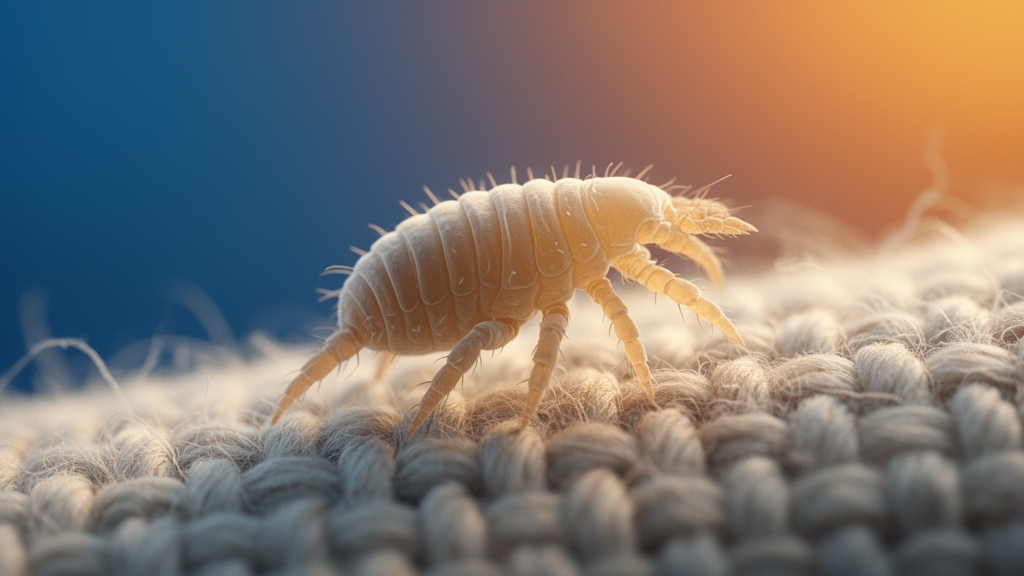
They are invisible, they live in your mattress, and they may be about to get a climate makeover. The American house dust mite, Dermatophagoides farinae, is one of the most potent allergen factories on the planet, triggering asthma, allergic rhinitis, and atopic dermatitis in an estimated 10 to 20 percent of the global population. Now a research team from Zhangzhou, China, has mapped the mite’s thermal biology in unprecedented detail, and the results read like a warning label for a warming world: the creature thrives in a surprisingly narrow temperature window, and even moderate heat stress can crash its populations.
The study, published in Frontiers in Insect Science, is one of the most comprehensive thermal biology datasets ever assembled for this medically important species. Researchers led by Zhimin Xu, Xu Zhang, Huiquan Lin, Yongwen Lin, and Haiming Cai reared mites at five constant temperatures—15, 20, 25, 30, and 35 degrees Celsius—at 75 percent relative humidity, tracking every egg, larva, protonymph, and tritonymph individually from cradle to grave. Using the age-stage, two-sex life table framework, they calculated how fast the mites developed, how many survived, and how many offspring each female produced, generating a full demographic portrait at each temperature.
The headline finding is a classic asymmetric thermal performance curve, the kind biologists see across ectothermic life. Development accelerated steadily from 15 to 30 degrees, then reversed sharply at 35 degrees. The shortest pre-adult development time was 19.14 days at 30 degrees, a blistering pace compared with 68.98 days at 15 degrees—nearly a 3.6-fold difference. But at 35 degrees, development time ballooned to 35.18 days, an 84 percent increase over the optimum, a phenomenon the authors call thermal inhibition. Above a certain point, heat stops helping and starts hurting.
Survival told the same story. Egg-to-adult survival peaked at 25 degrees with 88.6 percent of eggs successfully completing all four immature stages, but plummeted to just 35.7 percent at 35 degrees. The tritonymph stage—the final molt before adulthood—was the most heat-sensitive, with only 55.3 percent survival at the highest temperature. The authors suggest this vulnerability may reflect the elevated metabolic demands of the final molt, when energy requirements are highest and physiological stress hits hardest. At 15 degrees, prolonged development itself became a mortality driver, with cumulative deaths mounting over the long 69-day journey to adulthood.
Reproduction followed a similar unimodal pattern, but with a twist that reveals something deeper about population ecology. Total lifetime fecundity peaked at 25 degrees, with females producing an average of 85.2 eggs. Daily oviposition rate, however, was highest at 30 degrees, at 1.11 eggs per day. Female longevity was greatest at 25 degrees, reaching 125.4 days, but collapsed to 45.2 days at 35 degrees. This trade-off between total lifetime output and daily reproductive speed explains a subtle but crucial result in the life table analysis.
That result concerns the intrinsic rate of increase, or rm, the single most important number in population biology. It peaked at 30 degrees, at 0.0598 per day, even though the net reproductive rate R0—the average number of female offspring per female—was highest at 25 degrees, at 33.96. The reason is that faster development and earlier reproduction contribute more strongly to population growth rate than does total lifetime fecundity, a well-documented pattern in age-structured population ecology. In practical terms, at 30 degrees a mite population can double in just 11.59 days, which explains how infestations can reach allergenically significant densities within weeks under favorable indoor conditions.
The team also fitted the developmental rate data to the Brière-1 nonlinear model, a standard tool for estimating thermal thresholds in arthropods. The fitted parameters place the lower developmental threshold at 9.9 degrees, the optimal temperature at 30.2 degrees, and the upper thermal limit at 35.9 degrees, with a model fit of R-squared equal to 0.987. These numbers matter because they define the fundamental thermal niche of the species—the range of temperatures within which it can persist and reproduce. D. farinae, it turns out, is a thermal specialist, not a generalist.
So what does this mean for climate change? Global average temperatures are projected to rise by 1.5 to 4.5 degrees by the end of the century, and the authors argue this could reshape the geography of dust mite allergy. In cooler temperate regions where indoor temperatures currently sit below the 25 to 30 degree optimum, moderate warming of 1 to 2 degrees could boost mite population growth rates, extend seasonal activity periods, and prolong the allergen exposure season. In tropical and subtropical regions where summer indoor temperatures already approach 35 degrees, further warming could exceed the mite’s thermal tolerance and suppress populations. The result would be a shifting pattern of allergen risk: elevated exposure in temperate zones, potential reductions in the warmest regions.
The authors are careful to note the limits of their laboratory data. Constant temperatures do not capture the diurnal fluctuations of real indoor environments, and humidity was fixed at 75 percent to isolate temperature as the sole variable, even though humidity interacts with temperature to shape mite water balance—below 60 percent relative humidity, most house dust mite species cannot maintain positive water balance. Formal degree-day models, population viability analyses, and climate projection downscaling will be needed to turn these qualitative interpretations into quantitative predictions of future allergen exposure.
Still, the baseline data are now on the table, and they are sobering. House dust mites operate close to their thermal optimum under typical room temperatures, which makes them vulnerable to even moderate sustained heat stress—and equally poised to exploit any warming that pushes indoor climates toward their sweet spot. For the hundreds of millions of people sensitized to Der f 1 and Der f 2, the potent cysteine protease and lipid-binding proteins that constitute the mite’s allergenic arsenal, the message is clear: the thermal biology of a microscopic arachnid may soon determine how much allergen drifts through your bedroom. Preventive measures—hot-water washing of bedding, allergen-impermeable encasements, humidity control below 50 percent, and HEPA-filter vacuuming—remain the first line of defense, but the changing climate is rewriting the rules of engagement.
Subject of Research: A laboratory life table study of Dermatophagoides farinae across five temperatures defines the mite's narrow thermal niche and provides baseline parameters for climate change allergen risk models.
Article Title: Thermal performance curves and age-stage, two-sex life table of Dermatophagoides farinae (Acari: Pyroglyphidae): baseline data for climate change impact assessment
Article References: Xu, Z., Zhang, X., Lin, Z., Lin, H., Lin, Y., & Cai, H. (2026). Thermal performance curves and age-stage, two-sex life table of Dermatophagoides farinae (Acari: Pyroglyphidae): baseline data for climate change impact assessment. Frontiers in Insect Science, 6, Article 1913734. https://doi.org/10.3389/finsc.2026.1913734
Image Credits: AI Generated
DOI: 10.3389/finsc.2026.1913734
Keywords: house dust mites, Dermatophagoides farinae, thermal performance curve, life table, climate change, allergens, asthma, intrinsic rate of increase, temperature, ectotherms, allergic rhinitis, population ecology
Cite Scienmag News
Sloane Callahan. (October 17, 2026). House Dust Mites Have a Narrow Thermal Window, and Climate Change Is Squeezing It. Scienmag. https://scienmag.com/house-dust-mites-have-a-narrow-thermal-window-and-climate-change-is-squeezing-it/
Sloane Callahan. "House Dust Mites Have a Narrow Thermal Window, and Climate Change Is Squeezing It." Scienmag, 17 October 2026, https://scienmag.com/house-dust-mites-have-a-narrow-thermal-window-and-climate-change-is-squeezing-it/. Accessed 17 October 2026.
Sloane Callahan. "House Dust Mites Have a Narrow Thermal Window, and Climate Change Is Squeezing It." Scienmag. October 17, 2026. https://scienmag.com/house-dust-mites-have-a-narrow-thermal-window-and-climate-change-is-squeezing-it/


