


Hearing loss has become one of the most intensively studied modifiable risk factors for dementia, and the stakes could hardly be higher. Alzheimer’s disease and related dementias now affect an estimated 57 million people worldwide, and the Lancet Commission on Dementia Prevention, Intervention and Care has concluded that addressing hearing loss in midlife contributes the largest share of the total modifiable dementia risk, simply because it is so common in older adults. Yet a fundamental question has remained stubbornly unresolved: is the link between failing ears and failing minds driven by the hearing damage itself, or do the two conditions share deeper biological roots, such as genetic predisposition? A new study from researchers at Rush University in Chicago set out to disentangle these possibilities by explicitly controlling for inherited risk of both hearing loss and Alzheimer’s disease while tracking cognition over years.
The research, published in Frontiers in Audiology and Otology, drew on five longitudinal cohorts maintained by the Rush Alzheimer’s Disease Center, including the Religious Orders Study, the Memory and Aging Project, the Minority Aging Research Study, the Clinical Core, and the Latino Core. From 5,247 adults enrolled across these cohorts, the team identified 3,232 participants who had both self-reported hearing data and repeated cognitive assessments, with an average follow-up of 6.9 years. These participants, whose average age at the analytic baseline was 78 years, underwent annual testing across five cognitive domains: perceptual speed, semantic memory, episodic memory, working memory, and visuospatial ability. Nineteen individual tests, from story recall to the Stroop task, were converted into standardized scores and averaged into a single global cognition composite.
Self-reported hearing was captured with two deceptively simple questions asked during annual interviews. Participants were asked whether, with or without a hearing aid, they could usually hear and understand a person speaking in a normal voice in a quiet room, and how often they had difficulty understanding people over the telephone. Roughly one in ten participants reported trouble hearing in quiet settings, while about a third reported difficulty on the phone. After adjusting for age, sex, education, vascular disease risk, and, crucially, polygenic risk scores for both Alzheimer’s disease and hearing loss, neither self-report measure showed a statistically significant association with cognitive level or with the rate of cognitive change over follow-up. The coefficients were small and the p-values well above conventional thresholds, suggesting that what older adults say about their own hearing may not reliably map onto their cognitive trajectory.
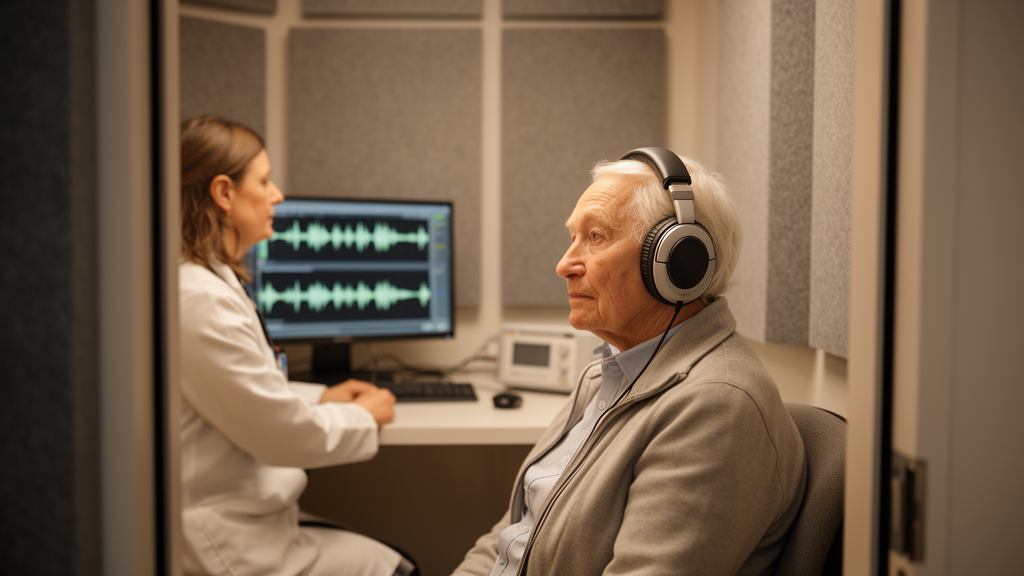
The researchers did not stop at self-report. In a subset of 113 participants, hearing was measured objectively at a single time point using four distinct assessments administered in participants’ homes with calibrated equipment. Pure-tone audiometry quantified sensitivity at speech frequencies in the better ear. The QuickSIN test measured the ability to understand sentences embedded in four-talker babble, yielding a signal-to-noise ratio loss score. Two far more demanding tasks probed central auditory processing: a spectral ripple discrimination test, in which participants detected subtle phase differences in rippled sound patterns filtered between 200 and 500 hertz, and a frequency-modulation pattern discrimination test in noise, which required detecting frequency variations in modulated sinusoids against a speech-shaped noise masker. These non-speech tasks tap the cognitive, attentional, and network-level machinery that the brain uses to parse complex auditory scenes.
The results were striking in their selectivity. Global hearing, computed as a composite of all four standardized measures, was significantly associated with global cognition at the analytic baseline, with a standardized coefficient of −0.243 after full covariate adjustment. But the hearing-by-time interaction was not significant, meaning baseline hearing did not predict how quickly cognition declined afterward. When the individual tests were examined separately, the pattern sharpened further: pure-tone audiometry and speech-in-noise ability showed no significant association with cognition at baseline or longitudinally, whereas the two complex spectral pattern discrimination tasks were significantly associated with global cognition at baseline. The spectral ripple test produced the larger effect, with a coefficient of −0.257, though the authors caution that even this effect size is considered small by conventional standards.
What makes these findings scientifically interesting is precisely what they rule out. By constructing polygenic risk scores from genome-wide association data, the team quantified each participant’s inherited susceptibility to Alzheimer’s disease, based on the International Genomics of Alzheimer’s Project, and to hearing difficulty, based on the UK Biobank. Alzheimer’s polygenic risk was itself strongly associated with lower cognitive levels, as expected, but it did not interact with time, and hearing genetic risk showed no significant association with cognition at all. The association between complex auditory discrimination and cognition persisted even after these genetic covariates were included, indicating that shared genetic vulnerability does not fully account for the hearing-cognition link observed at baseline.
The theoretical framework behind the study posits that central auditory processing tasks impose high cognitive demands that interact with pathological synaptic mechanisms, potentially accelerating neuronal degeneration. Supporting this idea, molecular biomarkers of Alzheimer’s pathology have been observed accumulating in the medial temporal lobe, a brain region thought to participate in auditory processing. Previous work has shown that dichotic tests, which assess binaural processing, are sensitive to early cognitive impairment, and that dichotic sentence identification detects memory deficits more effectively than dichotic digits in adults with mild cognitive impairment and dementia. The Rush team’s earlier cross-sectional work had already found that dynamic and static spectral-pattern discrimination contributed significantly to predictions of global cognition in community-dwelling older adults, and the present study extends that observation into a longitudinal framework.
Why, then, did self-reported hearing fail to show any association? The authors offer several plausible explanations. Self-report is known to underestimate hearing ability in older adults experiencing cognitive decline, even though it has a positive predictive value of 0.89 to 0.96 for detecting loss at the high frequencies affected first by age-related hearing damage. Coping strategies, compensatory habits, stigma, and denial related to hearing loss and ageism may all distort what participants report. It is also possible that the two questions used in this study were simply not sensitive enough to capture the difficulties older adults actually experience. The authors recommend that future studies complement subjective reports with objective measures such as the audiometric and central auditory tests deployed here.
The longitudinal null results deserve careful interpretation. With only 113 participants in the measured-hearing subset and a low conversion rate to mild cognitive impairment and Alzheimer’s disease during follow-up, the study may have lacked the statistical power to detect whether baseline auditory performance predicts the slope of cognitive decline. The authors note that the small sample size likely hindered prediction of longitudinal outcomes, and that the racially skewed composition of the subset, which over-represented Black and African American participants and under-represented Asian and other minority groups, limits generalizability. Race was therefore excluded from the measured-hearing models, and the authors urge caution in extrapolating these findings to the broader U.S. population.
Despite these limitations, the study carries a clear practical implication: complex, non-speech-dependent tests of spectral pattern discrimination may serve as accessible screening tools for cognitive ability in older adults, potentially detectable at earlier points in adulthood and possibly reflecting neural changes in the medial temporal lobe before clinical symptoms emerge. The authors emphasize that large-scale auditory and neurophysiological studies are needed to validate novel central auditory processing tests and to clarify the causal relationships among genetics, hearing loss, and cognitive decline. Approaches such as Mendelian randomization, which uses genetic variants as instruments to test causal pathways, are flagged as promising next steps. For now, the message is nuanced but compelling: the ears that matter most for detecting cognitive vulnerability may not be the ones measured by a standard audiogram, but the ones engaged when the brain must decode the intricate spectral fabric of sound itself.
Subject of Research: Association between polygenic risk for hearing loss and Alzheimer's disease, central auditory processing, and longitudinal cognitive outcomes in older adults
Article Title: Polygenic risk for hearing abilities and longitudinal cognitive outcomes in older adults
Article References: Akhtar, U. S., Tasaki, S., Yang, J., Leurgans, S. E., Shafiro, V., & Shah, R. C. (2026). Polygenic risk for hearing abilities and longitudinal cognitive outcomes in older adults. Frontiers in Audiology and Otology, 4, Article 1872446. https://doi.org/10.3389/fauot.2026.1872446
Image Credits: AI Generated
DOI: 10.3389/fauot.2026.1872446
Keywords: hearing loss, Alzheimer's disease, polygenic risk score, central auditory processing, cognitive decline, spectral ripple discrimination, pure-tone audiometry, speech-in-noise, older adults, dementia prevention, longitudinal cohort, Rush Alzheimer's Disease Center
Cite Scienmag News
Cassandra Pierce. (October 17, 2026). Genes for Hearing and Alzheimer’s Fail to Explain Why Complex Auditory Tests Track Cognition in Older Adults. Scienmag. https://scienmag.com/genes-for-hearing-and-alzheimers-fail-to-explain-why-complex-auditory-tests-track-cognition-in-older-adults/
Cassandra Pierce. "Genes for Hearing and Alzheimer’s Fail to Explain Why Complex Auditory Tests Track Cognition in Older Adults." Scienmag, 17 October 2026, https://scienmag.com/genes-for-hearing-and-alzheimers-fail-to-explain-why-complex-auditory-tests-track-cognition-in-older-adults/. Accessed 17 October 2026.
Cassandra Pierce. "Genes for Hearing and Alzheimer’s Fail to Explain Why Complex Auditory Tests Track Cognition in Older Adults." Scienmag. October 17, 2026. https://scienmag.com/genes-for-hearing-and-alzheimers-fail-to-explain-why-complex-auditory-tests-track-cognition-in-older-adults/


