


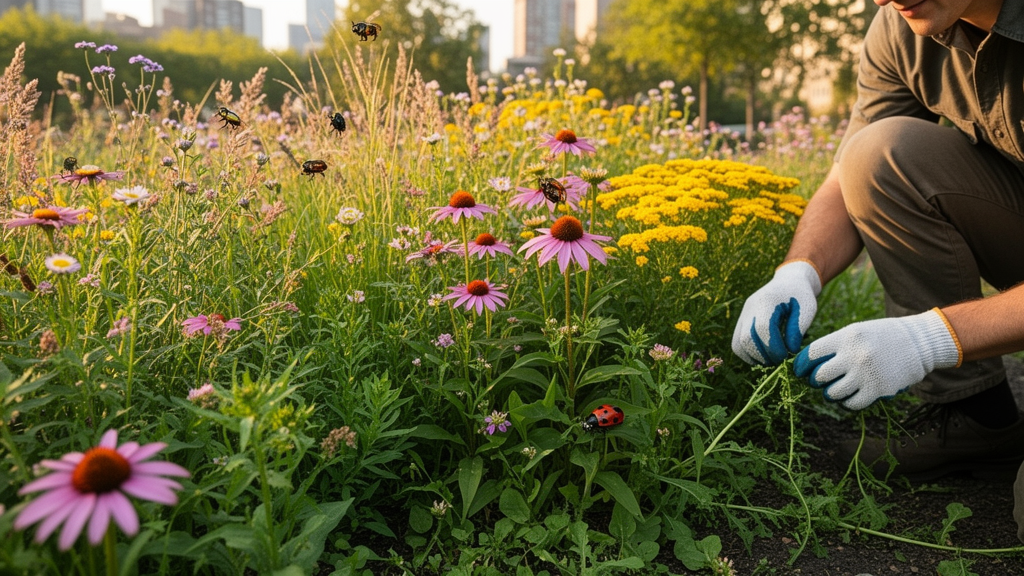
Urban green spaces are under pressure from two directions at once. Cities want landscapes that look good year-round, but they also need them to survive drought, survive without irrigation, and support the insects that pollination and pest control depend on. A three-year field experiment in northwestern Italy now offers one of the most detailed answers yet to a deceptively simple question: which combinations of ornamental perennial plants can deliver beauty, weed suppression, and biodiversity under the harshest low-maintenance conditions a city can impose?
Researchers at the University of Torino planted twelve different mixtures of herbaceous perennial species across 36 experimental plots at the Bosco Le Risere nursery in Candiolo, Piedmont. Each plot covered four square meters and held 15 plants per square meter, transplanted in autumn 2021 and mulched with volcanic lapillus. From April 2022 onward, the plots received no irrigation and no fertilization for three consecutive years. The only maintenance was periodic manual weeding twice per year and removal of senescent biomass in late winter and mid-summer. This regime deliberately mimicked the constraints facing public green spaces in Mediterranean and temperate cities, where water restrictions and shrinking maintenance budgets are becoming the norm rather than the exception.
The results, published in Frontiers in Horticulture, reveal that what matters most is not how many species a mixture contains but which functional traits those species bring. Mixtures dominated by drought-tolerant graminoids such as Carex flacca and Festuca glauca ‘Elijah Blue’, combined with mat-forming succulents like Sedum reflexum and Sedum spurium ‘John Creech’, and with woolly-foliaged perennials such as Stachys byzantina, rapidly achieved canopy closure above 89 percent and maintained it throughout the trial. These same mixtures kept ornamental quality scores above 81 percent on a 0-to-100 visual scale assessed monthly by a single trained observer, and they suppressed weeds so effectively that the best performer, mixture sG, produced only 160.6 grams of fresh weed biomass per weeding event, accumulating just 963.5 grams over three years.
At the opposite end of the spectrum, mixtures sY and sZ, which lacked persistent canopy-forming species adapted to full sun and summer drought, never established properly. Their mean ground cover hovered around 30 percent, ornamental quality fell below 28 percent, and they accumulated as much as 8,181 grams of weed biomass over the same period. The gap between the best and worst performers was not marginal; it was the difference between a self-sustaining living mulch and an abandoned patch of bare soil. Ground cover across all mixtures rose from 63.4 percent in year one to 80.2 percent in year three, but the rate of improvement depended entirely on whether the planted species could close canopy quickly enough to shade out competitors before weeds gained a foothold.
The mechanism behind this divergence is functional complementarity. Dense graminoids capture resources at soil level, mat-forming succulents occupy horizontal space with evergreen or semi-evergreen foliage, and aromatic stress-tolerant perennials fill vertical gaps. Together these traits create near-ground shading and a living mulch effect that limits light availability at the soil surface and reduces recruitment niches for spontaneous vegetation. The progressive dominance of Stachys byzantina in the best-performing mixture also highlights that interspecific competition shapes long-term stability, meaning designers must account not only for initial complementarity but for how competitive hierarchies shift as communities mature under low-input conditions.
Beyond vegetation performance, the experiment monitored insect biodiversity using two complementary bioindicator groups. Over 2023 and 2024, researchers deployed 20 pitfall traps filled with red vinegar and dish soap along a transect, checking them every 15 days, and counted 6,897 carabid beetle individuals. The most abundant species was Abax contractus, accounting for 34.6 percent of the total catch, followed by Harpalus rufipes at 21.8 percent. Butterfly monitoring used the standardized Pollard transect walk method along a 200-meter route divided into 50-meter sections, surveyed between 10 am and 4 pm under optimal weather conditions, and recorded 2,271 individuals. Pieris napi dominated at 32.8 percent, with Polyommatus icarus and Maniola jurtina also well represented.
Insect abundance followed a pronounced seasonal pattern for both groups. Carabid beetle activity-density rose from 291 individuals in early spring to a peak of 1,396 in late summer before declining to 614 in early autumn. Butterflies followed a similar trajectory, climbing from 71 in early spring to 999 in late summer. The Shannon-Wiener diversity index for carabids increased from 1.87 in 2023 to 2.01 in 2024, suggesting that the progressive establishment of dense perennial vegetation created increasingly favourable habitat structure, shelter, and trophic resources rather than reducing biodiversity over time. For butterflies, the Shannon index was slightly higher in 2023 at 1.68 than in 2024 at 1.50.
Two records of particular conservation significance emerged from the monitoring. The researchers detected Lycaena dispar, the large copper butterfly, and Lucanus cervus, the European stag beetle, both listed as priority species under the EU Habitats Directive. They also recorded the carabid beetle Stenolophus marginatus, a hygrophilous specialist associated with humid, organic-matter-rich substrates, whose regional expansion in Piedmont, Switzerland, and the Aosta Valley has been documented only since the 2010s. Its presence suggests that the experimental perennial mixtures foster moist micro-refugia and organic matter accumulation even within an urban matrix, conditions typically associated with fertilised hay meadows rather than low-input ornamental plantings.
Flowering dynamics added another layer to the picture. Flowering peaked in late spring with an average of 1.9 blooming taxa per assessment and declined sharply from autumn onward, becoming almost absent in winter. Mixture sC, which combined Dianthus barbatus, Gaura lindheimeri ‘Siskiyou Pink’, Hemerocallis ‘Stella de Oro’, Phlox subulata ‘Mac Daniels’, and Potentilla neumanniana, supported the highest flowering diversity with up to 4.7 simultaneously blooming taxa during spring and early summer. Mixture sA extended nectar availability through Lythrum salicaria, Mentha suaveolens, and Saponaria officinalis. However, the number of blooming taxa declined over the three years, from 1.0 in year one to 0.6 in year three, indicating increasing dominance of the most competitive species and a progressive compression of floral resources into a narrower seasonal window.
The authors conclude that combining flowering-rich mixtures like sC and sA, which provide seasonally complementary floral resources for pollinators, with structurally persistent weed-suppressive mixtures like sG, which create favourable microhabitats for ground-dwelling arthropods, represents the most effective strategy for multifunctional urban plantings. Carabid beetles may also contribute to weed seed regulation, adding another ecological service to the list. These findings underscore that trait-based species selection, validated through long-term field evaluation rather than short-term trials, is essential for designing biodiversity-oriented green infrastructure that can withstand the climatic and management constraints facing cities today. Perennial herbaceous mixtures, when composed with functional complementarity in mind, offer a resilient alternative to conventional lawns that reduces water, fertilizer, and labour inputs while simultaneously supporting pollinators, ground beetles, and species of conservation concern.
Subject of Research: Functional composition of perennial herbaceous mixtures drives vegetation stability, weed control and biodiversity in low-maintenance urban green spaces
Article Title: Functional composition of perennial herbaceous mixtures drives vegetation stability, weed control and biodiversity in low-maintenance urban green spaces
Article References: Caser, M., Pomatto, E., Busato, E., Gallizia, S., Devecchi, M., Ferracini, C., & Larcher, F. (2026). Functional composition of perennial herbaceous mixtures drives vegetation stability, weed control and biodiversity in low-maintenance urban green spaces. Frontiers in Horticulture, 5, Article 1923775. https://doi.org/10.3389/fhort.2026.1923775
Image Credits: AI Generated
DOI: 10.3389/fhort.2026.1923775
Keywords: perennial mixtures, urban green spaces, weed suppression, biodiversity, carabid beetles, butterflies, drought tolerance, low-input landscaping, pollinators, functional complementarity, living mulch, Habitats Directive
Cite Scienmag News
Gavin Prescott. (October 16, 2026). Perennial Plant Mixtures Turn Urban Green Spaces Into Weed-Fighting Insect Havens. Scienmag. https://scienmag.com/perennial-plant-mixtures-turn-urban-green-spaces-into-weed-fighting-insect-havens/
Gavin Prescott. "Perennial Plant Mixtures Turn Urban Green Spaces Into Weed-Fighting Insect Havens." Scienmag, 16 October 2026, https://scienmag.com/perennial-plant-mixtures-turn-urban-green-spaces-into-weed-fighting-insect-havens/. Accessed 16 October 2026.
Gavin Prescott. "Perennial Plant Mixtures Turn Urban Green Spaces Into Weed-Fighting Insect Havens." Scienmag. October 16, 2026. https://scienmag.com/perennial-plant-mixtures-turn-urban-green-spaces-into-weed-fighting-insect-havens/


