


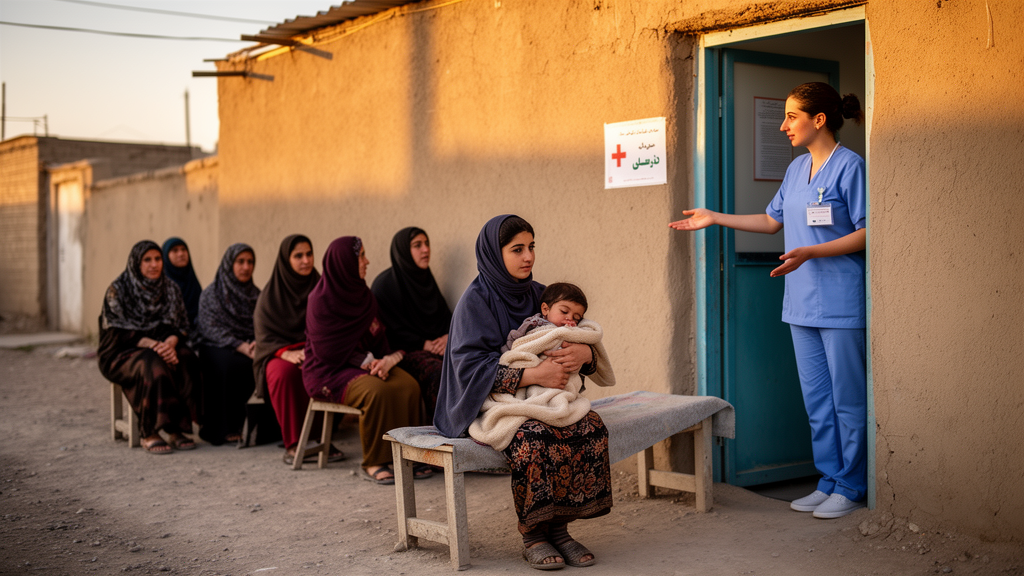
For the millions of Afghan migrants living in Iran, a routine visit to a midwife or a prenatal check-up can involve navigating a maze of legal insecurity, financial strain, linguistic mismatch, and social expectation. A new qualitative study published in PLOS Global Public Health dissects that maze in unprecedented detail, using the World Health Organization’s Social Determinants of Health framework to explain why Afghan migrant women of reproductive age so often arrive late to care, or not at all. The research, led by Seyedeh Tahereh Mirmolaei, Zohreh Mahmoodi, Amirhossein Takian, and Zahra Bayat Jozani, was conducted in Tehran over six months beginning in April 2024 and draws on in-depth interviews with twenty Afghan migrant women and ten key informants drawn from healthcare, midwifery, non-governmental organizations, and policy circles.
The methodological design matters as much as the findings. The team used purposive sampling with maximum variation, deliberately recruiting participants across a spectrum of residency status, socioeconomic background, and prior experience with the health system, so that the analysis would capture the full range of circumstances rather than a single archetype of the migrant patient. Semi-structured, in-depth interviews allowed women to describe their own trajectories through pregnancy, contraception, and gynecological care in their own words, while key informants supplied the institutional perspective of providers and administrators. The researchers then applied directed content analysis, coding the transcripts against the WHO framework’s distinction between structural determinants, such as law, macroeconomic policy, and gender norms, and intermediary determinants, such as material living conditions, psychosocial stress, and health behaviors. Prolonged member checking, in which participants reviewed the emerging interpretation, and peer debriefing among the research team strengthened the credibility and confirmability of the final categorization.
What emerged was a picture of access shaped at three interconnected levels. At the structural level, the study identified a restrictive legal and macroeconomic context as the foundational barrier. Iranian policy toward Afghan migrants has shifted repeatedly over decades of conflict and economic sanctions, and a woman’s documentation status determines whether she can enroll in insurance schemes, obtain subsidized care, or even travel to a clinic without fear of detention. Undocumented status, the researchers found, operates less as a single obstacle than as a multiplier that raises the perceived cost and risk of every subsequent step in the care-seeking process.
Financial mechanics compound the legal ones. Even for women with papers, reproductive health services in Iran involve substantial out-of-pocket payments, and the study documented how banking barriers, including difficulties opening accounts or transferring money, intersect with communication barriers to make routine transactions fraught. For a household living on precarious daily wages, the calculus is stark: a consultation fee, transport costs, and a day of lost earnings can outweigh the perceived benefit of preventive care, pushing women to defer visits until symptoms become severe. The macroeconomic pressures of sanctions-era inflation amplify these trade-offs, particularly for families already remitting money to relatives in Afghanistan.
Layered over these structural forces are patriarchal norms that constrain women’s agency in deciding when and whether to seek care. Participants described needing male relatives’ permission or accompaniment for appointments, and informants noted that husbands and mothers-in-law often act as gatekeepers to contraception and maternal services. This is not unique to Afghan communities, but the study shows how migration intensifies it: displacement can strengthen household hierarchies as families cling to familiar norms under pressure, while the absence of extended female support networks leaves young mothers without the informal guidance that might otherwise encourage timely care-seeking.
At the intermediary level, the researchers documented poor material circumstances, crowded and unstable housing, unsafe neighborhoods, and unreliable access to transport, that translate directly into missed appointments and delayed antenatal care. Psychosocial stressors, including chronic legal insecurity, fear of deportation, and the accumulated trauma of displacement, emerged as a distinct pathway. The study describes bio-behavioral responses to these stressors: women under sustained threat of detention or eviction reported postponing care even when services were nominally available, a delay pattern the authors interpret as a rational response to legal insecurity rather than ignorance or indifference. In other words, the decision to skip a check-up is often a risk calculation, not a knowledge gap.
The health system itself contributes a third tier of barriers. The study found a lack of migrant-sensitive facilities, meaning clinics and hospitals that lack interpreters, culturally adapted counseling, or staff trained in the specific needs of Afghan patients. Linguistic mismatches between Dari-speaking patients and Persian-speaking providers, though the languages are related, still generate misunderstandings about dosing, follow-up schedules, and informed consent. More corrosive still is perceived discrimination: participants reported feeling judged or deprioritized in waiting rooms, an experience that erodes trust and deters return visits. Cross-cutting factors such as inconsistent documentation requirements across facilities mean that a woman registered at one clinic may find herself refused at another, fragmenting continuity of care precisely when continuity matters most, during pregnancy and childbirth.
Against this dense web of barriers, the study identifies two forces that reliably bridge women to care: social capital and non-governmental organizations. Informal networks of neighbors, relatives, and fellow migrants who share information about which clinics are welcoming, which providers speak Dari, and how to navigate registration function as a parallel navigation system. NGO-run health posts and outreach workers, meanwhile, reach women whom the formal system misses, offering services and referrals at low or no cost. The authors emphasize that these bridges, while vital, are compensatory: they mitigate the damage of structural barriers rather than removing them, and they remain fragile, dependent on short-term funding and volunteer labor.
The analytical payoff of the WHO framework is that it shows how the three levels interact to produce what the researchers call a compounded vulnerability. An undocumented woman facing patriarchal household constraints, living in precarious housing, encountering a clinic with no interpreter and a billing system she cannot use, does not experience these as separate obstacles but as a single cumulative weight that grows heavier with each step toward care. This interaction explains why piecemeal interventions, a translation service here, a fee waiver there, have historically produced disappointing results: each addresses one strand of a braid.
The policy implications are correspondingly systemic. The authors argue that migrant-sensitive services, including linguistic accommodation, simplified and consistent documentation requirements, and staff training to counter discrimination, would improve uptake of essential services, but that durable gains require addressing the structural layer: legal pathways to documentation, insurance coverage for migrants regardless of status, and recognition that reproductive health access is not merely a clinical issue but a matter of law, economics, and gender. They also note a fiscal argument that resonates with host-country policymakers: delayed care for preventable conditions ultimately raises long-term healthcare costs for both migrant populations and the Iranian health system, through emergency interventions, complications, and untreated disease. Framing equity as cost containment, the study suggests, may be the most persuasive route to reform in a constrained fiscal environment, and the findings offer a template for assessing similar barriers faced by migrant women in other host countries across the region.
Subject of Research: Social determinants of reproductive health service access among Afghan migrant women in Iran
Article Title: Social determinants of access to reproductive health services among Afghan migrant women in Iran: A qualitative study
Article References: Mirmolaei, S. T., Mahmoodi, Z., Takian, A., & Bayat Jozani, Z. (2026). Social determinants of access to reproductive health services among Afghan migrant women in Iran: A qualitative study. PLOS Global Public Health, 6(10), e0007406. https://doi.org/10.1371/journal.pgph.0007406
Image Credits: AI Generated
DOI: 10.1371/journal.pgph.0007406
Keywords: Afghan migrants, reproductive health, Iran, social determinants of health, qualitative study, health equity, migrant health, maternal care, health policy, Tehran, undocumented migrants, health systems
Cite Scienmag News
Courtney Benton. (October 16, 2026). Why Afghan Migrant Women in Iran Struggle to Reach Reproductive Health Care. Scienmag. https://scienmag.com/why-afghan-migrant-women-in-iran-struggle-to-reach-reproductive-health-care/
Courtney Benton. "Why Afghan Migrant Women in Iran Struggle to Reach Reproductive Health Care." Scienmag, 16 October 2026, https://scienmag.com/why-afghan-migrant-women-in-iran-struggle-to-reach-reproductive-health-care/. Accessed 16 October 2026.
Courtney Benton. "Why Afghan Migrant Women in Iran Struggle to Reach Reproductive Health Care." Scienmag. October 16, 2026. https://scienmag.com/why-afghan-migrant-women-in-iran-struggle-to-reach-reproductive-health-care/


