


Urinary schistosomiasis remains one of the most widespread neglected tropical diseases, with roughly 229 million people infected worldwide and about 112 million affected in Africa alone by the blood fluke Schistosoma haematobium. As mass treatment campaigns with praziquantel drive infection levels down, the microscopic urine filtration test that serves as the diagnostic gold standard is losing sensitivity, particularly in individuals carrying light worm burdens. A research team at the University of Dschang in Cameroon has now tackled two stubborn obstacles that stand in the way of molecular diagnosis in the elimination era: how to store urine samples collected in remote field settings, and how to extract parasite DNA from those samples without breaking the budget. Their comparative study, published in Frontiers in Tropical Diseases, evaluated three DNA extraction methods applied to urine samples filtered and stored on Whatman filter paper for up to 20 weeks.
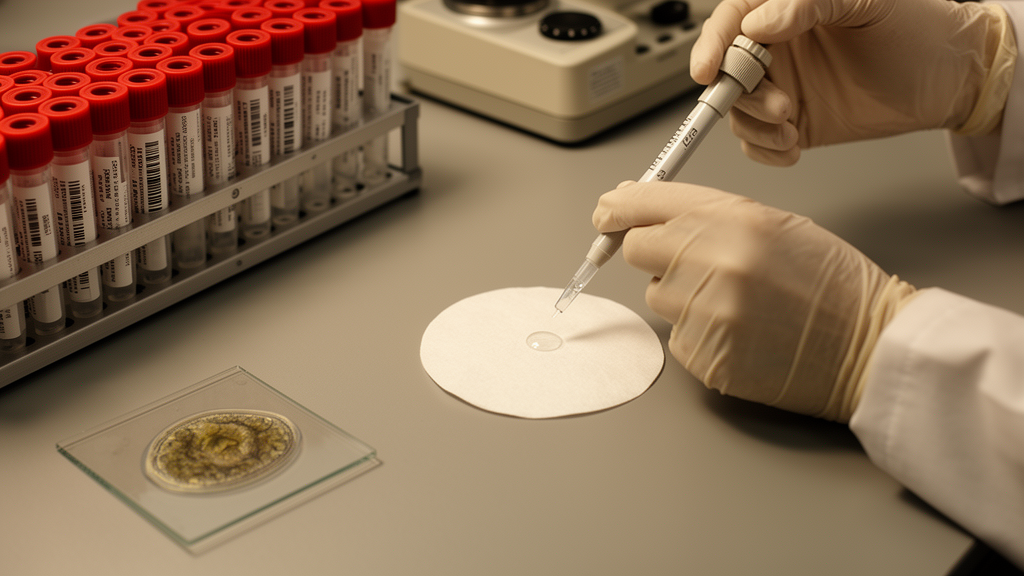
The study drew on urine samples collected from school-aged children attending four public primary schools in the Matta health area of the West Region of Cameroon, a locality recognized as endemic for urinary schistosomiasis for more than a decade. Each sample was examined using the urine filtration test, and the researchers selected 174 samples for molecular analysis: 120 in which S. haematobium eggs were detected and 54 that were egg-free. Ten milliliters of each urine sample were filtered through punched discs of Whatman No. 3 filter paper, each 13 millimeters in diameter and matching the size of the polycarbonate membranes used in standard urine filtration kits. The discs were air-dried under a fly-proof net, packed individually in small plastic bags with desiccant, and stored at room temperature in the laboratory for periods of 1, 3, 12, and 20 weeks.
DNA was then extracted from half-discs at each time point using three methods. The Chelex-based method relies on Chelex 100 resin, a styrene divinylbenzene copolymer carrying paired iminodiacetate ions that chelate polyvalent metal ions, allowing rapid DNA release without organic solvents. The CTAB-based method uses cetyltrimethylammonium bromide to lyse cell membranes and strip away polysaccharides and other contaminants, followed by chloroform-isoamyl alcohol extraction and isopropanol precipitation. The third approach was a commercial product, the Quick-DNA Miniprep Plus Kit from Zymo Research. Detection of the parasite was performed by amplifying a 365-base-pair fragment of the S. haematobium cytochrome oxidase 1 gene, a mitochondrial target widely used for species-specific identification of schistosome infections.
The results were striking. After just one week of storage, all three extraction methods achieved 100 percent amplification of the parasite DNA target from the 20 samples initially tested. But as storage lengthened, the methods diverged sharply. Every DNA extract obtained with the Chelex-based method from 120 egg-positive samples amplified successfully at both 3 and 12 weeks of storage, and the rate slipped only marginally to 99.2 percent after 20 weeks. The CTAB-based method declined gradually from 99.2 percent at 3 weeks to 97.5 percent at 12 weeks and 96.7 percent at 20 weeks. The commercial kit, by contrast, fell dramatically: from 100 percent at 3 weeks to 90.8 percent at 12 weeks and just 80 percent at 20 weeks, a statistically significant deterioration over time.
When the researchers compared amplification rates across the three methods at each storage duration, the differences after 12 weeks were significant (P = 0.0007) and became even more pronounced after 20 weeks (P < 0.0001), with the Chelex-based method consistently outperforming the other two. No significant difference existed among the methods after only 3 weeks, suggesting that the advantage of Chelex extraction emerges precisely when samples have been stored long enough to matter for real-world surveillance programs. The team also probed the 54 egg-negative samples for false positives. After 12 weeks of storage, the Chelex-based method detected parasite DNA in 9 of these samples (16.7 percent) and the CTAB-based method in 17 (31.5 percent), a finding that bears on the specificity of the molecular approach.
Measured against the urine filtration test as the reference standard, PCR built on Chelex extracts showed excellent diagnostic performance. Sensitivity ranged from 99.2 to 100 percent and specificity from 77.8 to 83.3 percent across the 12- and 20-week time points. Negative predictive values reached 97.7 to 100 percent and positive predictive values 90.8 to 93 percent. Kappa coefficients of 0.87 after 12 weeks and 0.81 after 20 weeks indicated good agreement between the molecular results and parasitology. The CTAB-based method performed somewhat lower, with sensitivity between 96.7 and 97.5 percent, specificity between 63 and 68.5 percent, and kappa values of 0.71 and 0.65. A paired comparison of the two laboratory-developed methods revealed a discrepancy of roughly 6.3 percentage points in favor of Chelex, a statistically significant difference.
The cost analysis may prove just as consequential as the performance data. Extracting DNA from a single filter paper disc cost an estimated €0.24 with the Chelex-based method, compared with €0.70 for the CTAB-based method and €3.20 for the Zymo Research kit used in the study. Commercial kits more broadly ranged from €2.20 to €16.50 per sample depending on the manufacturer and format. The Chelex approach was therefore at least twice as cost-effective as CTAB and roughly thirteen times cheaper than the kit employed. Speed added a further advantage: the Chelex procedure was completed in about one hour, whereas both the CTAB method and the commercial kit required more than 24 hours from start to finish.
The authors attribute the robust performance of the Chelex method to its chemistry. The alkalinity of the Chelex suspension combined with the high temperatures used during extraction likely disrupts the membranes of S. haematobium eggs trapped on the filter paper, releasing nucleic acids into solution. Meanwhile, the chelating groups of the resin bind metal ions released during the heat-shock process, protecting DNA from degradation by nucleases that require divalent cations. Because the method involves few steps, uses inexpensive reagents, and avoids harmful chemicals such as chloroform, it also reduces the risk of residual PCR inhibitors, a known problem since urine itself contains urea, crystals, nitrites, and hemoglobin that can sabotage DNA amplification.
The capacity of Whatman filter paper to preserve urine components for molecular detection is itself an epidemiologically valuable finding. The paper retained S. haematobium eggs or cell-free parasite DNA well enough to support amplification rates near 100 percent for up to 12 weeks and above 99 percent even after 20 weeks when paired with Chelex extraction. This means field teams can filter urine on-site, dry the discs, pack them with desiccant, and transport them to molecular laboratories without refrigeration or cold chains, a decisive benefit in rural endemic settings where electricity and laboratory infrastructure are scarce. The slight decline in amplification after 20 weeks suggests progressive degradation of parasite components on the paper, but the authors note that inappropriate storage conditions, sample heterogeneity, and inhibitor accumulation cannot be excluded as contributing factors.
The implications reach well beyond the laboratory bench. The WHO road map for neglected tropical diseases targets elimination of schistosomiasis as a public health problem by 2030, a goal that will require analyzing thousands of samples to validate elimination, monitor control programs, and conduct post-elimination surveillance. Health impact modeling has shown that more sensitive diagnostics can increase the probability of disease elimination by optimizing the frequency of mass drug administration, potentially improving disability-adjusted life years and enabling earlier decisions to stop treatment campaigns. By combining affordable field storage of urine on filter paper with a fast, safe, and reliable Chelex-based extraction method costing less than a quarter of a euro per sample, this study offers resource-limited endemic countries a practical molecular tool that could transform how urinary schistosomiasis is diagnosed, mapped, and ultimately eliminated. The researchers acknowledge that testing only a single 10-milliliter urine volume is a limitation, and they call for determining the minimum urine volume that can be filtered and stored, which may enable development of a field mini-kit for molecular diagnosis under real-world conditions.
Subject of Research: Comparative assessment of three methods (Chelex-based method, commercial kit, and CTAB-based method) for extracting DNA from Whatman filter paper on which urine samples were filtered and stored for molecular diagnosis of urinary schistosomiasis
Article Title: Comparative assessment of three methods (Chelex-based method, commercial kit, and CTAB-based method) for extracting DNA from Whatman filter paper on which urine samples were filtered and stored for molecular diagnosis of urinary schistosomiasis
Article References: Mewamba, E. M., Diengue, I. M. R. B., Motia, D. B., Mengoue, E. L. T., Atiokeng, R. T., Tiofack, A. A. Z., Fogue, P. S., & Simo, G. (2026). Comparative assessment of three methods (Chelex-based method, commercial kit, and CTAB-based method) for extracting DNA from Whatman filter paper on which urine samples were filtered and stored for molecular diagnosis of urinary schistosomiasis. Frontiers in Tropical Diseases, 7, Article 1918848. https://doi.org/10.3389/fitd.2026.1918848
Image Credits: AI Generated
DOI: 10.3389/fitd.2026.1918848
Keywords: Comparative, assessment, three, methods, Chelex-based, method, commercial, CTAB-based, extracting, Whatman, filter, paper
Cite Scienmag News
Ophelia Keating. (October 16, 2026). Chelex DNA extraction outperforms kits and CTAB for schistosomiasis diagnosis on filter paper. Scienmag. https://scienmag.com/chelex-dna-extraction-outperforms-kits-and-ctab-for-schistosomiasis-diagnosis-on-filter-paper/
Ophelia Keating. "Chelex DNA extraction outperforms kits and CTAB for schistosomiasis diagnosis on filter paper." Scienmag, 16 October 2026, https://scienmag.com/chelex-dna-extraction-outperforms-kits-and-ctab-for-schistosomiasis-diagnosis-on-filter-paper/. Accessed 16 October 2026.
Ophelia Keating. "Chelex DNA extraction outperforms kits and CTAB for schistosomiasis diagnosis on filter paper." Scienmag. October 16, 2026. https://scienmag.com/chelex-dna-extraction-outperforms-kits-and-ctab-for-schistosomiasis-diagnosis-on-filter-paper/


