


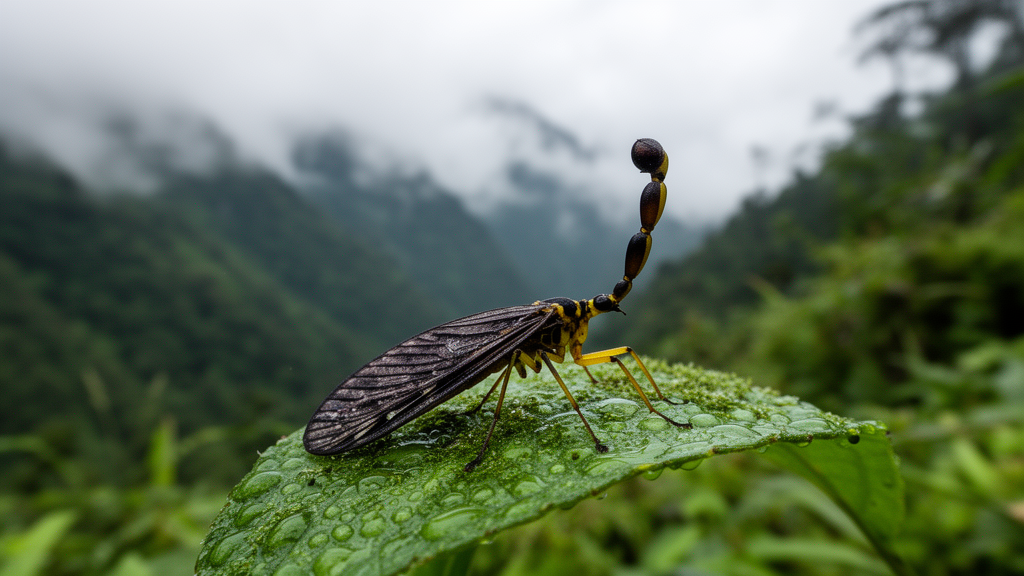
Deep in the river valleys of southern Xizang, China, entomologists have pulled back the curtain on a hidden radiation of scorpionflies, the curious insects whose enlarged, recurved male genitalia give them their name. A new taxonomic study published in the Deutsche Entomologische Zeitschrift describes two brand-new genera and six new species from the Himalayas and adjacent regions, records two genera and one species for the first time in China, and formally raises the known regional scorpionfly count from 32 to 38 species and from three to five genera. The findings, based on specimens collected during recent surveys in southern Xizang, significantly improve knowledge of insect diversity in one of Earth’s most celebrated biodiversity hotspots and spotlight the southern slope of the Himalayas as a key corridor for speciation and biogeographic connectivity within the family Panorpidae.
Panorpidae is the largest extant family of Mecoptera, distributed across the Holarctic and Oriental regions. Adults are commonly called scorpionflies because the male genital bulb curls upward like a scorpion’s stinger. The family is currently divided into two subfamilies, Panorpinae and Neopanorpinae, and members of the latter can be told apart by a suite of wing-vein characters, including a narrow wing base, a forewing first anal vein (1A) that ends proximal to the origin of the radial sector (ORs), only one cross-vein between 1A and the second anal vein (2A), a greatly shortened third anal vein, and the absence of the cubitus-anal cross-vein (cu-a) in the hindwing. Prior to this study, Neopanorpa was the only genus of the family recorded from the Himalayas and adjacent regions, with 25 species known from the area excluding those from southern India. Two genera, Lulilan and Phine, had recently been reported from Nepal and Bhutan, but never from China.
During recent surveys in southern Xizang, researchers collected a series of Neopanorpinae specimens, including two Lulilan species, three Neopanorpa species, one Phine species, and one representing an entirely new genus. All material is deposited in the Biological Science Museum of Dali University. Adults were collected with sweeping nets and preserved in 95% ethanol or pinned, then observed and measured under a Keyence VHX-7000 digital microscope. Photographs were taken with a Nikon D850 and a Nikkor AF-S Micro 105 mm f/2.8 lens for habitus shots, and with a Canon R5 paired with a Canon MP-E 65 mm f/2.8 1–5× macro lens or a Mitutoyo 10× M Plan Apochromatic Objective for the finer anatomical detail. The terminology and measurements follow Wang and Hua (2021).
The new species include Lulilan chumbi sp. nov. from Yadong County, Neopanorpa dinggyensis sp. nov. and N. ganmatsangpo sp. nov. from Dinggyê County, N. yadongensis sp. nov. from Yadong County, Phine linyejiei sp. nov. from Dinggyê County, and Yinorpa brevistyla sp. nov., the sole species of the new genus Yinorpa. Lulilan furcatus (Hardwicke, 1823), originally known from Nepal, is newly recorded from Xizang, China, and Lulilan cornutus (Esben-Petersen, 1915) is transferred from Neopanorpa to Lulilan as a new combination. The genera Lulilan and Phine, previously known only from Bhutan and Nepal, are recorded from Xizang, and from China, for the first time.
The second new genus, Sahyadrinorpa gen. nov., is erected for seven species previously assigned to Neopanorpa, primarily from the Western Ghats of India: S. appendiculata (Westwood, 1841), S. denticulata (Rust & Byers, 1976), S. echinata (Rust & Byers, 1976), S. indica (Rust & Byers, 1976), S. hirsuta (Crampton, 1931), S. salai (Navás, 1929), and S. zebrata (Esben-Petersen, 1915). The genus name combines the ancient Sanskrit name for the Western Ghats, Sahyadri, with the root suffix -norpa. Members of Sahyadrinorpa bear mostly unelongated sixth through eighth abdominal segments, closely resembling the condition seen in the Panorpinae genera Minorpa and Wornorpa, and are considered sisters to all other members of Neopanorpinae. The markedly elongated rostrum, enlarged second apical tooth of the pretarsal claws, and absence of the cu-a vein in the hindwings clearly support their placement within Neopanorpinae.
Yinorpa gen. nov., named in honor of Professor Zi-Wei Yin of Shanghai Normal University in recognition of his generous contribution of specimens, is unique within Panorpidae in having greatly reduced male gonostyli, which are elongate with a pointed apex in all other known species. In Panorpidae, gonostyli typically function as a pair of pincers to grasp the female’s pregenital segments during copulation. In Yinorpa brevistyla, however, the terminal portions of the gonostyli are highly reduced and do not meet during inward movement. Correspondingly, the basal lobes are greatly enlarged and likely assume the grasping function, while the greatly enlarged notal organ on the third tergum likely represents a compensatory adaptation enabling more effective grasping of the female’s wings.
The new species are diagnosed by detailed combinations of morphological characters. Lulilan chumbi, for example, is mostly similar to L. virgifer in the greatly elongated notal organ on male T3, the unelongated A6–A8, and the gonostyli shorter than gonocoxites, but can be readily differentiated by a notched posterior apical band, a narrow pterostigmal band, greatly elongated dorsocaudal horns on A6, and simple hypovalves in lateral view. Neopanorpa dinggyensis is most similar to N. chillcotti but differs in having a well-developed apical band and greatly reduced pterostigmal band, a slender notal organ extending slightly beyond the posterior margin of T5, a truncated epandrial apex, and slender hypovalves. N. ganmatsangpo is distinguished by a pterostigmal band lacking a conspicuous apical branch, a greatly enlarged terminal notal organ, an extremely shortened hypandrial basal stalk, thickened geniculate parameres, and elongated horn-like ventral aedeagal valves. N. yadongensis resembles N. wuchaoi in the yellow wings, reduced markings, and subbasally bifurcated parameres, but differs in having antennae shorter than the forewings, uniformly slender hypovalves as long as the gonocoxites, a protruding epandrial apex, and greatly developed apodemes of the axis extending beyond the main plate of the medigynium. Phine linyejiei, named after its discoverer Ye-Jie Lin, resembles P. succinea in the greatly enlarged apex of the parameres but differs in a stout rod-like notal organ, broad dorsal aedeagal processes cleaved medially with minute conical subapical processes, and a subtriangular medigynium main plate greatly narrowed basally.
Several of the new species bear characters typically found in the other subfamily, Panorpinae. Neopanorpa wuchaoi and N. yadongensis are notable for their lateroterminal processes on the epandrium and subbasally bifurcated parameres, characters usually seen in Panorpinae. However, other features clearly place them within Neopanorpinae, including an enlarged second apical tooth on the pretarsal claw, a narrow wing base, and the presence of epandrial lobes. N. ganmatsangpo is also distinctive, bearing moderately thickened parameres intermediate between most Neopanorpa species and Phine species. These three species differ markedly from their Himalayan and adjacent-region congeners but are similar to P. linyejiei and P. succinea in the elongated lateral apex of the ventral valves of the aedeagus and the broad, flat dorsal processes. For now, they are provisionally placed in Neopanorpa pending further evidence.
The distribution of all six Lulilan species suggests a southern-Himalayas pattern. The dorsocaudal horns on male A6, which closely resemble the so-called anal horns found in the Panorpinae genera Cerapanorpa, Dicerapanorpa, and Megapanorpa, likely represent a synapomorphy of Lulilan and probably function as clasping structures to control the female pregenital abdominal segments during copulation. From an evolutionary perspective, these horns may represent an independent male adaptation associated with overcoming female mating resistance, although direct evidence of mating behavior in Lulilan remains extremely limited. In the only documented observation, a mating pair of L. furcatus was photographed in Bhutan, but the functional role of the dorsocaudal horns was not clearly demonstrated. The ventrocaudal spur on S2 occurs exclusively in L. obscurus and L. spinifer, but its function has yet to be elucidated.
Hypothetically, the ancestor of Sahyadrinorpa probably entered the Indian subcontinent after the collision between India and Eurasia 55–40 million years ago and became separated from the Himalayas by the Rajasthan Plain, where the elevation and humidity are probably unsuitable. This geographic isolation likely explains the pronounced morphological divergence of Sahyadrinorpa from Himalayan taxa. The Deccan Plateau and the Eastern Ghats may harbor undiscovered scorpionflies, but no Panorpidae records are known from these regions to date. Given that Panorpidae likely originated in East Asia, ancestral lineages may have expanded westward along the rising Himalayas, becoming isolated in montane valleys and subsequently diversifying into distinct genera and species. Some taxa later dispersed across the range via deep river valleys, reaching the northern side of the eastern Himalayas, as exemplified by N. tibetensis from the Yarlung Zangbo Grand Canyon.
The Chinese new genus and five of the new species were all collected from Xizang’s southernmost borders, suggesting that these taxa likely also occur in adjacent Bhutan and Nepal and possibly northern India, such as Sikkim. The Qinghai–Xizang Plateau, with a mean elevation of roughly 4,000 meters, and the lowland plains of the Indus, Ganges, and Brahmaputra rivers are unsuitable for scorpionflies, which generally require cool, humid, montane environments. Consequently, the southern slope of the Himalayas emerges as a key corridor for speciation and biogeographic connectivity within Panorpidae, fostering both endemism and lineage exchange across adjacent regions. Given their close geographic proximity, many species discovered near national borders are unlikely to be confined to a single country, and additional country-level records can be expected in these regions. Only one species, N. chillcotti, has so far been recorded with a transnational distribution, occurring in both Nepal and Xizang, China.
With the addition of two new genera and six new species, the known Panorpidae diversity in the Himalayas and adjacent regions increases from 32 to 38 species and from three to five genera. The study also provides detailed illustrations and descriptions of all species, along with comprehensive identification keys to the males and females of the regional fauna, and a distribution map of all 38 species. The work significantly improves knowledge of insect diversity in the Himalayas and highlights the southern slope of the range as a key corridor for speciation and biogeographic connectivity within the family, underscoring how much hidden diversity still awaits discovery in one of the planet’s most topographically complex mountain ranges.
Subject of Research: Entomology
Article Title: Uncovering hidden diversity of Panorpidae ( Insecta , Mecoptera ) in the Himalayas and adjacent regions: New taxa and distributional records
Article References: Tang, Q., & Wang, J.-S. (2026). Uncovering hidden diversity of Panorpidae (Insecta, Mecoptera) in the Himalayas and adjacent regions: New taxa and distributional records. Deutsche Entomologische Zeitschrift, 73(1), 129-152. https://doi.org/10.3897/dez.73.183879
Image Credits: AI Generated
Keywords: scorpionflies, Mecoptera, Himalayas, taxonomy, new species, biodiversity, biogeography, Xizang, Neopanorpa, Panorpidae, Uncovering, hidden
Cite Scienmag News
Gavin Prescott. (October 16, 2026). Hidden scorpionfly diversity uncovered in the Himalayas: two new genera and six new species reshape the family tree. Scienmag. https://scienmag.com/hidden-scorpionfly-diversity-uncovered-in-the-himalayas-two-new-genera-and-six-new-species-reshape-the-family-tree/
Gavin Prescott. "Hidden scorpionfly diversity uncovered in the Himalayas: two new genera and six new species reshape the family tree." Scienmag, 16 October 2026, https://scienmag.com/hidden-scorpionfly-diversity-uncovered-in-the-himalayas-two-new-genera-and-six-new-species-reshape-the-family-tree/. Accessed 16 October 2026.
Gavin Prescott. "Hidden scorpionfly diversity uncovered in the Himalayas: two new genera and six new species reshape the family tree." Scienmag. October 16, 2026. https://scienmag.com/hidden-scorpionfly-diversity-uncovered-in-the-himalayas-two-new-genera-and-six-new-species-reshape-the-family-tree/


